
How do lingual braces differ from ordinary braces?
Lingual braces are fixed braces bonded to the back of the teeth instead of the front, so they are largely hidden when you smile. But they feel different. In studies, the tongue was sore far more often and the cheeks and lips less often, and speech changes were much more common at first.
- Overall soreness in the first months was not clearly different in one review; where it is felt moves from the cheeks and lips to the tongue.
- Speech changes are much more likely with lingual braces at first. Across all kinds of orthodontic appliances, most settled within weeks, though the 's' sound sometimes took more than three months.
- Studies did not compare how long treatment takes or what it costs, so neither is claimed here.
- Whichever you choose, a retainer is needed afterwards.
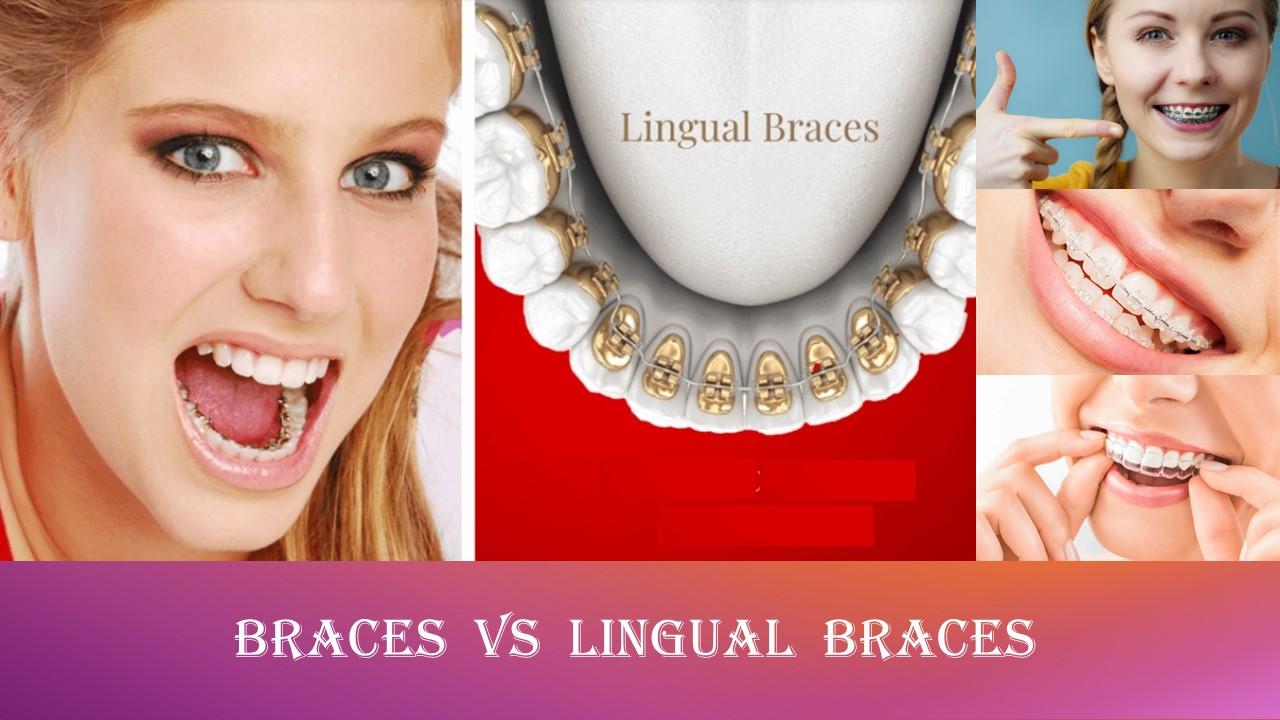
What lingual braces are
Ordinary fixed braces have small brackets glued to the front of each tooth, joined by a wire. Dentists call them labial braces, because they sit on the lip side. The brackets may be metal or tooth-coloured.
Lingual braces work on the same principle, but the brackets are bonded to the inside surface of the teeth, on the tongue side, and joined by a wire. From the front they are hard to see, which is the main reason people ask about them.
Clear aligners, which are removable plastic trays, are a third option; this article is about the two kinds of fixed braces.
The research comparing lingual and front braces is small, and most of it followed patients for only a few months.
| Lingual braces | Front (labial) braces | |
|---|---|---|
| Where they sit | Bonded behind the teeth, on the tongue side | Bonded to the front of the teeth |
| Seen when you smile | Largely hidden | Visible; tooth-coloured brackets are less noticeable |
| Where soreness is felt | More often the tongue | More often the cheeks and lips |
| Speech at first | Changes much more common | Changes less common |
| Cleaning | Studies differ on whether it is harder | Studies differ on whether it is easier |
| Length of treatment | Not compared in the studies we found | Not compared in the studies we found |
Comfort: different, not clearly worse
A common belief is that lingual braces hurt more. The evidence is more specific than that.
In a review of six studies, most of which followed patients for about three months, overall pain showed no significant difference1 between lingual braces (96 patients) and front braces (105 patients). That does not prove the two are equal; the studies were small, and the result is uncertain.
What changes is where it hurts. The same review found tongue pain far more often with lingual braces, and cheek and lip pain less often. A second review of eight studies found the same pattern: tongue pain more common, cheek and lip pain less common2. Its authors concluded that lingual patients have more pain, but that conclusion rests on the tongue result.
Eating was harder with lingual braces in the first review, but that result did not hold up when the authors re-tested it. In the second review the difference was not significant.
In short: expect a sore tongue rather than sore cheeks for the first weeks, and ask your orthodontist what to do if the edges of the brackets rub.
Speech: the biggest difference at the start
Both reviews found speech difficulties much more often with lingual braces than with front braces. In the first, the odds of a speech difficulty were about 8.6 times higher1; in the second, about 9.4 times higher2. These are odds from small studies, and the uncertainty around them is wide, but both point the same way.
The change is usually temporary. A review of 13 studies covered orthodontic appliances of all kinds, not only lingual braces. It found that most speech changes returned to normal within weeks3, while a distorted 's' sound sometimes lasted more than three months. The same review names lingual appliances among those with an evident effect on speech. The evidence is of low quality.
If you speak a lot for work, ask your orthodontist how to plan the first weeks.
Cleaning and gum health
Cleaning behind the teeth can feel harder, but the studies do not agree on how much it matters. One review found oral hygiene problems reported more often with lingual braces2. In the one study that measured it in the other review, hygiene problems were similar over the first three months1.
With any fixed braces, careful cleaning matters. White marks on the teeth, an early stage of decay, are common during fixed-brace treatment. In pooled studies whose patients averaged about 16 years old, about 55 in 100 orthodontic patients had them, compared with about 29 in 100 untreated people4. They were more common the longer treatment lasted. That review gives no separate figure for lingual braces. A review of gum recession also lists orthodontic treatment among the things that might increase the risk of the gums pulling back5.
- Brush carefully around every bracket, front and back, and clean between the teeth as your dentist shows you.
- Use a fluoride toothpaste.
- With fixed braces, do not chew gum, which can get stuck, and try to avoid hard, crunchy or sticky foods6.
- Cut down on sugary snacks and drinks: sugar can lead to plaque build-up around the brackets7.
Results, treatment time and cost
The reviews we rely on measured comfort, speech and cleaning. They did not show whether lingual braces give a better or worse finished result than front braces, and treatment duration was not evaluated in any of the studies1 in the first review.
The studies did not compare costs either, and this article gives no prices. If you are weighing the two, ask for a written plan for each option that says what is included, how often you will be seen, and what happens after the braces come off.
Which might suit you
Lingual braces may appeal most if being seen with braces is your main concern and you can accept a sore tongue and some change in your speech for the first weeks. Front braces may suit you better if speech matters a great deal in your work, or if you would rather keep the brackets where they are easiest to see and clean.
Whether either suits your teeth and bite is decided at an examination, and decay and gum problems are dealt with before any braces are fitted. The UK dental regulator accepts that some parts of dental care can be provided safely at a distance, while others need a face-to-face visit or a physical examination8. For orthodontics, it says there is at present no effective substitute for a physical, clinical examination8. Ask what the plan is expected to achieve, what the alternatives are, including clear aligners and no treatment, and what the risks are for you.
After the braces: retainers
With lingual or front braces, the work is not finished when the brackets come off. Teeth tend to drift back towards where they started9, so a retainer is worn to hold them. Your orthodontist will tell you how long you need to wear it6. Research has not settled on an exact length of time: most studies of retainers measured outcomes after less than a year9.
When to see your orthodontist or a dentist
Contact your orthodontist if:
- teeth are still painful more than a few days after the braces are fitted or adjusted6
- a sore patch on your tongue or cheek does not settle, or keeps being rubbed by a bracket or wire
- a bracket comes off, or a wire breaks or digs in
- you notice white or chalky marks around the brackets
- a retainer feels loose or no longer fits
See your dentist if your gums bleed when you brush, or are painful and swollen10, and keep up your regular dental check-ups during treatment.
Emergencies. Facial swelling, a fever or throbbing pain is not an expected part of orthodontic treatment: see a dentist without waiting. If you find it hard to breathe or swallow, or swelling spreads quickly in your mouth or neck, call 112 or go to the nearest emergency department.
Weighing up hidden braces?
Send us a message with your question. Our dentists will explain what an examination would look at and which options might be worth discussing.
Frequently asked questions
Are buck teeth caused by thumb-sucking?
Sometimes it plays a part. A long-term sucking habit is linked to bite problems, but heredity, injury and early or late loss of teeth can also contribute. Most bite problems have more than one cause.
Can buck teeth be fixed in adults?
Often, but how depends on the cause. If the teeth are mainly tipped forward, braces or aligners may be enough. If the jaws are the main cause, some adults are offered jaw surgery with orthodontic treatment.
Can I push my teeth back myself?
No. There is no evidence that pressing teeth moves them into a better position, and home methods such as elastic bands have caused serious harm. Teeth should only be moved under a clinician's care.
How do I know if my headache is coming from a tooth?
Dental problems usually cause pain in the tooth, gum or face, and only sometimes spread to the head. Headaches without any of that are less likely to be dental. A dentist can look for a dental problem; linking it to the headache takes a clinical assessment.
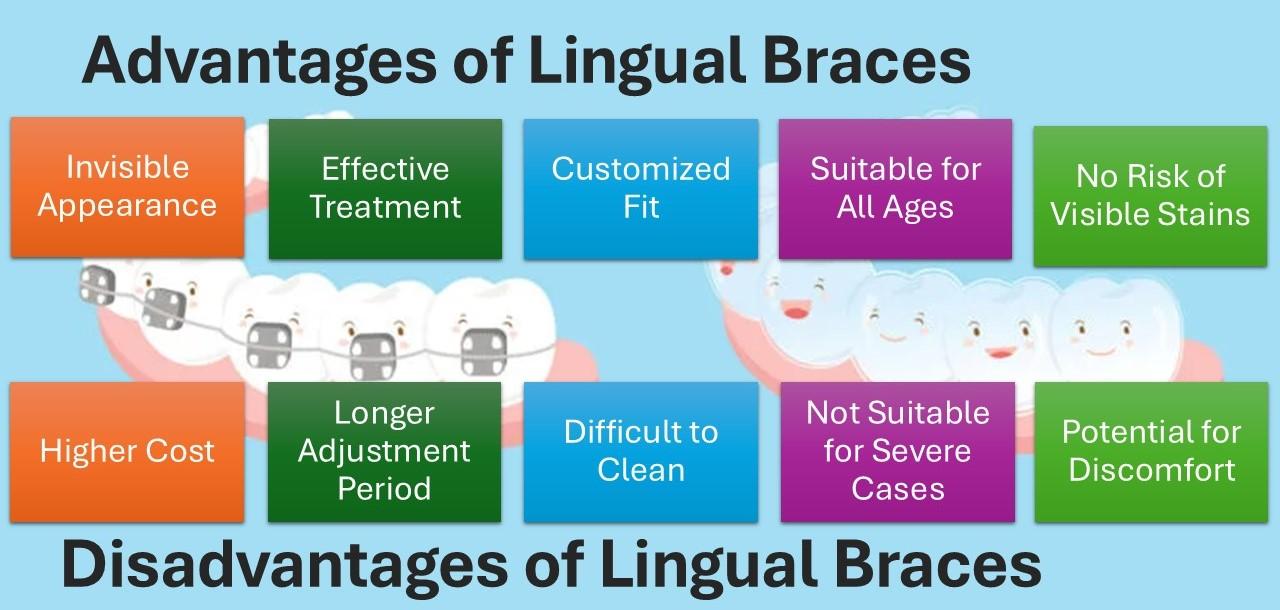
Do lingual braces take longer?
The studies we found did not measure it, so we cannot say. Ask your orthodontist for an estimate for your own case, for each option you are considering.
Sources
- Comparison of adverse effects between lingual and labial orthodontic treatment. The Angle Orthodontist 2013;83(6):1066-1073. 2013.↩doi.org
- Adverse effects of lingual and buccal orthodontic techniques: a systematic review and meta-analysis. American Journal of Orthodontics and Dentofacial Orthopedics 2016;149(6):820-829. 2016.↩doi.org
- Speech and orthodontic appliances: a systematic literature review. European Journal of Orthodontics 2018;40(1):29-36. 2018.↩doi.org
- Prevalence, incidence and risk factors of white spot lesions associated with orthodontic treatment - a systematic review and meta-analysis. Orthodontics & Craniofacial Research 2025;28(2):379-399. 2025.↩doi.org
- Mucogingival conditions in the natural dentition: narrative review, case definitions, and diagnostic considerations. Journal of Clinical Periodontology 2018;45 Suppl 20:S190-S198. 2018.↩doi.org
- Braces. NHS (UK). 2026.↩nhs.uk
- Braces. American Dental Association, MouthHealthy.↩mouthhealthy.org
- GDC statement on 'direct-to-consumer' orthodontic treatment. General Dental Council (UK).↩gdc-uk.org
- Retention procedures for stabilising tooth position after treatment with orthodontic braces. Cochrane Database of Systematic Reviews 2023;5:CD002283. 2023.↩doi.org
- Gum disease. NHS, page last reviewed 20 April 2026. 2026.↩nhs.uk

Dt. Dilek AKSU GÜLER
Dentist · Founder
She has completed advanced training in implantology and works in aesthetic restorations and smile design.