
What is cosmetic gum contouring?
Cosmetic gum contouring means changing the shape or level of the gum line so that the teeth and gums look more even. Most often, gum that covers too much of the teeth is removed. Aesthetic crown lengthening is the wider term: it exposes more of each tooth by reshaping the gum, and the bone underneath where needed. It is elective surgery on the gums.
Too much visible gum can also come from the upper lip or the position of the jaw1, so the treatment depends on the cause. A gum line that is uneven because the gum has receded may need tissue added, not removed. So the examination decides the technique, and sometimes the answer is to leave the gums as they are. Gum health is checked, and any gum disease treated, first.
Gum contouring can also be one step in a wider plan, for example before veneers or crowns. After crown lengthening, the gum margin may grow back part of the way over the tooth while it heals, mostly in the first three months2. Ask for the whole written plan, with the order and timing of every step, before you agree to any of it.
This page is written for readers who live outside Turkey and are considering treatment at our clinic in Antalya, Turkey. On this page, "we" means that clinic. "Your dentist" means the dentist who examines and treats you there; "your own dentist" means the dentist you see at home. Healing continues after you fly home. The later check of the gum line usually happens once you are home, with your own dentist, unless you return to Antalya for it. The section "Treatment in Antalya, follow-up at home" covers what can be done in Antalya and what continues at home.
- The cause decides the treatment: extra gum, the upper lip, the jaw and a receded gum line each need a different approach.
- Gum disease is treated first; cosmetic gum surgery is planned on healthy gums.
- After crown lengthening, the gum margin can grow back part of the way while it heals, so the final gum line is judged after healing.
- There is little research on the effect of lip surgery beyond one year.
- Agree in writing how gum contouring fits with any veneers or crowns, and who checks the healing once you are home.
Concerns it may address, and their causes
People ask about gum contouring for several different concerns. Each can have more than one cause, and the cause decides what can help.
- Too much gum when you smile (a "gummy smile"). The cause can be gum that covers more of the teeth than usual, or an upper lip that is short or moves a lot. It can also be the position of the upper jaw, or a combination of these1. Only the first is mainly a gum problem.
- Teeth that look short or square. The gum, and sometimes the bone under it, may sit further down the tooth than usual. This is where gum reshaping or aesthetic crown lengthening may be considered.
- An uneven gum line. Some teeth may have extra gum while others have receded. Extra gum can be reshaped; a receded area may need tissue added instead.
- Receded gums. Recession is common in adults and tends to increase with age3. Without signs of disease, monitoring the area3 is considered the proper approach; surgery may be considered in some cases.
- Dark patches on the gums. Natural (physiological) pigment in the gum can be removed for appearance. It can come back.
- Dark gaps between the teeth ("black triangles"). These appear where the gum no longer fills the space between two teeth. Treatment results are hard to predict.
The last three are covered in "Receded gums, dark patches and gaps between teeth".
Assessment: gum health comes first
Gum contouring is surgery on tissue that needs to be healthy first. Gums that bleed when you brush or eat hard foods are a reason to see a dentist4 before any cosmetic plan. So are painful, swollen gums and bad breath4. Gingivitis, the early stage of gum disease, is reversible with improved self-care5. Damage from periodontitis is irreversible, but the disease can be stabilised5. Its treatment follows steps, starting with oral hygiene and risk factors6. Cosmetic gum surgery is planned once the gums are healthy and stable. More on this is on the gum disease treatment page.
What the examination looks at
- How much gum shows when you smile and speak, and how far the upper lip lifts
- Where the gum sits on each tooth, and the length and width of the teeth
- Where the supporting bone lies under the gum, with X-rays if needed
- How thick the gum is, and whether enough would remain after reshaping
- Gum health: bleeding, gum pockets and any recession
- Photographs, and a scan or impressions if a wider plan is being made
A qualified dentist should examine you before your treatment plan and its cost are confirmed. A plan made from photographs alone is only a preliminary assessment.
Tell your dentist before treatment
If you take a blood thinner or any other regular medicine, have diabetes or heart disease, smoke, or are pregnant, tell your dentist before treatment. Bring a written list of your medicines. One hospital in London advises its gum-surgery patients to stop smoking. If they cannot stop completely, it advises stopping for at least 2 weeks after the surgery7 to help the gums heal. Do not stop or change8 your blood thinner for dental treatment unless your doctor or dentist tells you to.
Who it may suit, and who it does not
Where it may be considered
- Adults with healthy gums whose gum covers more of the teeth than usual, so that the teeth look short
- An uneven gum line where the extra gum is on some of the teeth
- A planned step before veneers or crowns, where the gum level affects how they will look
Where another route comes first, or it may not help
- Active gum disease: treated first.
- A gummy smile caused mainly by the upper lip or the jaw: removing gum does not change the lip or the jaw. Other treatments are considered (see the techniques below).
- Receded gums: reshaping removes gum, so it does not treat recession. Without signs of disease, monitoring the area3 is considered the proper approach; if treatment is needed, it may mean adding tissue with a graft.
- Expectations the tissues cannot meet: gum and bone have limits. For example, the gum may not fill a gap between two teeth, whatever is done.
- A wish to finish the whole smile in one short trip: the gum margin can still move during the first three months of healing2. This affects when veneers or crowns can be made.
Leaving the gums as they are is also an option. You can ask a dentist near your home for an independent opinion before you decide.
Techniques a dentist may consider
Which technique fits depends on the cause found at the examination. The studies cited here do not compare these treatments with each other directly. The figures come from published studies, not from our own records.
- Gum reshaping (gingivectomy) and aesthetic crown lengthening. When gum covers more of the teeth than usual, the gum is reshaped, together with the supporting bone where needed. If bone is to be reshaped, ask how much would be removed, and how much support would remain for the tooth and its neighbours. A randomised trial compared the conventional technique with a computer-guided one, which uses a surgical guide planned on a computer and then printed. It included 16 people with thick gums whose gum covered more of the teeth than usual (altered passive eruption). In both groups, the visible length of their teeth rose from about 7.1 mm to 8.46 mm at 6 months1. It did not change significantly between months 3 and 61. The trial was small and followed people for 6 months only.
- Lip repositioning surgery. This may be considered when an upper lip that lifts high is the main cause. Surgery inside the upper lip aims to limit how far it lifts. In a review of 13 studies, the gum on show was reduced by an average of 3.06 mm at 6 months9. The averages were 2.91 mm at 12 months and 2.76 mm at 36 months9. The review's abstract does not say how many studies the 36-month figure rests on. Another review, of 38 studies, found that most were case reports or case series10. It found no agreed definition of relapse, and a lack of studies on the effect beyond one year10.
- Treatments other than surgery. When the upper lip is the cause, treatments other than surgery also exist. Ask your own dentist or doctor about them.
- Orthodontics or other treatments. When the cause lies in the position of the teeth or the jaw, these are considered instead of gum surgery.
- A gum graft for a receded area, and removal of dark pigment: see the next section.
- Leaving the gums as they are. For a purely cosmetic concern this is an option, and the decision is yours.
| Gum reshaping or crown lengthening | Lip repositioning surgery | |
|---|---|---|
| Cause it addresses | Gum, and sometimes bone, covering too much of the teeth | An upper lip that lifts high |
| What is done | Gum removed; bone reshaped where needed | Surgery inside the upper lip |
| How long the effect lasts | The gum margin can grow back part of the way while it heals; trial data are short-term | Little research beyond one year; relapse not well defined |
| Main limitation | Does not change the lip or the jaw | Evidence mostly from case reports and case series |
Receded gums, dark patches and gaps between teeth
Receded gums: adding tissue, not removing it
Where the gum line is uneven because the gum has receded, a gum graft can cover part of the exposed root. This is periodontal surgery; more is on the periodontal surgery page. Studies followed single receded areas, without loss of gum or bone between the teeth, for at least 5 years. In some, the surgeon moved the gum over the root (a coronally advanced flap). In others, a graft of the patient's own tissue was added under it. With the flap alone, complete root coverage rates ranged from 33 to 60 per cent11. This range leaves out one flap-only group with unusually poor results. With the graft added, the rates were 66.7 to 88.2 per cent11. The studies were small and could not be pooled, so these are ranges, not a personal chance. Several of the studies counted treated areas, not people. Over the years, the gum margin tended to recede again12.
A collagen material from an animal source can be used instead of tissue from your palate. In a review of four trials, it meant shorter surgery, and less pain afterwards in three of the four trials13. But in studies of several receded teeth, complete root coverage was achieved more often with the patient's own tissue14. Sometimes tissue is taken from the palate and the wound is left to heal open. In a review of 68 studies of this, pain was most pronounced in the first three days, typically peaking on day 315. The same review reports that such a wound can take up to four weeks to heal completely15.
Dark patches of gum
Natural (physiological) dark pigment can be removed with a scalpel, a laser or other methods. Your dentist first examines the area to check whether the pigment looks natural. A dark patch that is new or changing is not a cosmetic matter: have it checked by a dentist before any cosmetic treatment. In a review of 25 controlled trials, laser and scalpel did not differ significantly in removing the pigment or in how often it came back16. Pain afterwards was lower with a laser16. In the individual trials, as that review reports them, recurrence ranged from 0 to 80 per cent16. It varied with the method, the trial and the time point. Follow-up was 15 months at most16. Another review found the lowest recurrence with freezing (cryosurgery)17, but it rested mainly on case reports. The controlled trials above found no significant difference between laser and scalpel. So no method has been shown to keep the pigment away better than the others, and no one can promise that it will not return.
Gaps between the teeth ("black triangles")
A 1992 study looked at 288 sites in 30 patients with natural teeth. When the contact point between two teeth was 5 mm or less from the bone, the gum filled the space almost every time18. At 6 mm it did so 56 per cent of the time18. At 7 mm or more, it did so 27 per cent of the time or less18. A 2024 review of 45 studies looked at hyaluronic acid injections, grafts, orthodontics and a concentrate made from the patient's own blood (platelet-rich fibrin). These seemed to improve the result at 3 months or more19. But the authors found the evidence insufficient to make recommendations19. No one can promise that the gap will close completely.
Laser or scalpel?
For removing pigment, the review above found similar results, with less pain after a laser. Some lip repositioning techniques include cutting the small fold of tissue between the upper lip and the gum (labial frenectomy)10. For frenectomy, a review of 6 trials found pain scores lower with a diode laser on day 1 and day 7, not on day 320. The certainty of that evidence was low to very low20. The reviews cited here do not compare laser and scalpel for reshaping the gum line itself. Ask your dentist which instrument they plan to use, and why.
Planning, anaesthesia and the appointments
The outline below is general. Your written plan should state the technique, the teeth involved, the number of appointments and the days they need. Ask for these in writing before you book.
Anaesthesia. At the hospital in London mentioned above, gum surgery is done with a local anaesthetic injection that numbs the gum, and you stay awake7. Ask which anaesthesia is planned for each step. If sedation is offered, ask what kind it is, why, where it is given and who gives it. A UK national standard covers conscious sedation in dentistry. For adults, it says that every form of sedation other than inhalation sedation requires an escort21. It also says that if an escort cannot be assured, treatment under sedation must not be provided. Ask us before you book whether the method planned for you needs an escort, and how this works if you are travelling alone.
How long it takes. In the trial described above, the operating time was about 45 minutes on average with the computer-guided technique, and 54 minutes with the conventional one1. Your dentist tells you how long your own appointment is likely to take.
Examination and records
Your gum health, how much gum shows, how the lip moves and the position of the teeth are assessed. Photographs are taken, and X-rays if needed. A plan made from photographs alone is only a preliminary assessment.
Gum health first
Any gum disease is treated, and brought under control, before cosmetic gum surgery is planned.
The written plan
The cause, the technique, the teeth involved and the intended gum line are written down. If veneers or crowns follow, the plan states the order of the steps and the time between them.
The procedure
With the anaesthesia agreed in advance, the gum is reshaped, together with the bone where needed. If the plan is different, a graft or lip surgery is carried out instead.
Early check
Some stitches dissolve; others are removed at a review, when the wound is also checked. Ask when this is due, and whether it will be before you fly home.
Healing check
Once the gum has settled, the gum line is checked again. This usually falls after you are home, with your own dentist or on a return visit.
Recovery and aftercare
- Pain. In the crown-lengthening trial, pain was scored from 0 to 10. On the first day it averaged about 4 in the computer-guided group and 5 in the conventional group1. The trial found no significant difference in pain between the two groups1. Pain had largely gone by two weeks1. Studies of lip repositioning that reported pain describe mild pain during the first three weeks10. If tissue was taken from the palate, that area can be sore too (see above).
- The gum line keeps settling. In studies of crown lengthening before a crown, the gum margin may grow back over the tooth (rebound), mostly in the first three months2. The final gum line is judged after healing, not on the day of surgery.
- Cleaning and eating. Follow the written instructions on when and how to clean the treated area. After gum surgery, including crown lengthening, the hospital in London mentioned above tells patients not to brush the area where they had surgery7. It tells them to use an antiseptic mouthwash 2 or 3 times a day for 2 to 3 weeks7. It also advises a soft diet for a week7. Ask your dentist when you can brush the treated area again. Keep up your daily care in the rest of your mouth. Brush twice a day with a fluoride toothpaste; afterwards, spit the toothpaste out and do not rinse4.
- Stitches and the wound check. At the hospital in London, stitches that do not dissolve are usually removed 1 to 2 weeks after surgery7, at a review appointment. Ask before you book which kind of stitches you will have, and who will check the wound if you fly home before then.
- Before veneers or crowns. How long to wait after crown lengthening before the final crown or veneer is a gap in the research2. Ask how long your dentist will wait, and why.
- Follow-up. Ask who checks the healing. If you are treated in Antalya, agree this before treatment. The later checks can be with your own dentist at home, if they accept that, or on a return visit.
Bleeding that does not stop, or pain and swelling that keep getting worse, are not normal. See "When to contact the clinic or a dentist" below.
Risks and benefits
Risks and limitations
- The gum can grow back part of the way. After crown lengthening, the gum margin may grow back over the tooth (rebound), mostly in the first three months2. This evidence comes from few studies with a high risk of bias2, and gives no figure for how much.
- Short follow-up. The randomised trial of aesthetic crown lengthening followed 16 people for 6 months1. The studies cited on this page do not show how the result looks years later.
- Exposed roots and sensitivity. An exposed root surface is frequently associated with sensitivity and a poorer appearance3. Ask before surgery about the chance of sensitivity, of the root surface showing, and of the appearance changing over time.
- Pain, swelling, bleeding and infection. These can follow any surgery on the gums. A hospital in Cambridge lists the risks of gum grafts in a patient leaflet. They include bleeding, infection, swelling, an uneven gum line and the need for further surgery22. At a palate donor site, bleeding, burning, altered sensation and changes in eating15 have also been reported.
- Longer-looking teeth and larger gaps. After gum surgery, your teeth may look longer and the spaces between them larger7. This depends on how much gum was reshaped. In cosmetic contouring, longer teeth are the aim; larger gaps are not.
- Uncertain results after lip surgery. There is no agreed definition of relapse, and little research beyond one year10.
- Pigment can return after it has been removed, and gaps between teeth may remain after treatment (see above).
- The result may differ from the design. A photograph or digital design is a visualisation, not a promise. The real result depends on your gums, bone and teeth.
Benefits
- Where extra gum is the cause, reshaping it can show more of each tooth1.
- Planning the gum line together with any veneers or crowns aims to avoid conflicting procedures.
Gum contouring inside a wider plan
If veneers or crowns are also planned, gum contouring can be planned together with them, as part of a smile makeover. The order matters: gum disease is treated first, the gum line is set, and the restorations are made to fit it.
The gum margin can still move during the first three months2. So ask these questions before you agree to anything.
- Will the gum contouring and the veneers or crowns be done on the same trip, or on separate trips?
- If on the same trip, how will the restorations allow for the gum settling afterwards?
- Who checks the gum line once it has settled, and who decides whether anything needs adjusting?
- Can you have the gum contouring alone, and decide on the rest later?
Ask for the whole written plan, with every step, before you agree to the first one. After the examination in Antalya, you can still decide not to go ahead. You can say no, or ask to stop, at any stage.
Who carries out the treatment?
Your treatment is provided by our clinic in Antalya, Turkey, and carried out there by the clinic's dentists.
Periodontology, the branch of dentistry that deals with the gums, is one of the nine dental specialties set by law in Turkey23. In Turkey, only a dentist who holds a certificate in that specialty23, issued and registered by the Ministry of Health24, may use its title.
Ask who will assess your gums and plan the gum line, and who will carry out the surgery. Ask what their titles are, where they qualified, and whether any of them holds a Ministry-registered specialty certificate in periodontology. Ask for the answers in writing.
Treatment in Antalya, follow-up at home
The surgery itself happens in Antalya, but healing continues after you fly home. The gum margin can still move during the first three months2, so the check of the settled gum line usually happens once you are home. Agree how this will work before treatment starts.
What can be done in Antalya
- Examination and planning. Gum health, the cause of the concern and the technique are established.
- Gum treatment, if needed. For gum disease, deep cleaning may take more than one appointment. Its re-assessment usually comes later; see the gum disease treatment page.
- The procedure. The technique in your plan, if the clinic carries it out. Ask which of these techniques the clinic itself performs, and which it would refer elsewhere.
- The early wound check, if it falls before you fly. Otherwise, agree who will check the wound and remove any stitches near your home (see "Before you fly home" below).
What usually continues at home
- Checking the settled gum line. Plan it with your own dentist at home, or plan a return visit to Antalya.
- Veneers or crowns that wait for healing. Ask whether they need a second trip.
- Regular check-ups. The UK's NICE guideline on dental recall says check-up intervals should be set for each person according to their risk25 and discussed with them. Agree yours with your dentist at home.
What to agree in writing before you start
Before you book, you receive a written preliminary plan with the appointments and how many days they need. It is based on what you send, such as photographs and any recent X-rays from your own dentist, and it is not a diagnosis. The examination confirms or changes it, and with it the days and the cost.
Ask for the plan to answer these questions:
- What is the cause of my concern, and which technique is planned for which teeth?
- Which steps happen in Antalya, and which are expected to continue at home?
- Will the stitches dissolve? If not, when is the wound check, and will it be before I fly?
- If veneers or crowns follow, on which trip, and how long after the gum surgery?
- Who checks the gum line once it has settled, and what happens if it has grown back?
- Which records will I take home for my own dentist?
- What is included if the result needs adjusting, and who pays for any extra trip?
You can also ask a dentist near your home for an independent opinion before you decide. Ask which treatment you need, and what having it where you live would involve. After the examination in Antalya, you can still decide not to go ahead. You can say no, or ask to stop, at any stage.
Flying. We have found no guidance that sets a waiting time before flying after gum contouring specifically. A 2023 narrative review of flying after dental treatment suggests waiting about a week after most dental interventions26. This assumes there is no pain, swelling or bleeding where you were treated. The authors note that the research is limited and comes mainly from military aviation. They call their intervals a starting point for the dentist's decision. Ask your dentist when you can fly.
Back home: your own dentist, your records and your cover
Your own dentist
Talk to your own dentist before you go. They need to know the plan if they are to check the healing. Ask them before you travel whether they will see you after the treatment, and what that will cost. If they will not, agree the follow-up with the clinic in writing. If you do not have a regular dentist, find one before you travel.
Your records
Ask the clinic for a written record of the treatment to take back to your own dentist. It should say which teeth were treated and with which technique, whether bone was reshaped, and where any graft tissue came from. Ask for the photographs taken before treatment and copies of any X-rays too. In Turkey, the health tourism regulation entitles international patients to an itemised bill. On request, they also get free copies of the records of the materials used, the tests and the imaging27.
Health service and insurance where you live
What a health service or an insurer covers after treatment abroad differs from country to country. Before you travel, ask the health service or your insurer where you live what they would cover. Ask in particular about a check of the healing, an adjustment of the gum line and any complication. Tell your travel insurer about your plans too. Before you book, ask whether anything linked to the treatment is covered, such as a complication or an extra trip.
Questions to ask before you book
These are the questions we suggest you ask before treatment abroad, with what this page can answer today and what to ask for in writing.
- Who will carry out my treatment, and what are their qualifications? The treatment is provided by our clinic in Antalya, Turkey. Ask for the name of the dentist who will examine and treat you. Ask where they qualified and what their title is (see "Who carries out the treatment?").
- Are you regulated by a professional body and registered with it? In Turkey, a health facility needs an authorisation certificate27 from the Ministry of Health to treat international patients. Authorised facilities appear in a register the Ministry publishes28, so you can check it yourself. The authorisation belongs to the facility, not to the dentist, and it says nothing about the result of your treatment. A dentist in private practice in Turkey must also register with the provincial or regional dental chamber29 within a month of starting. Ask for the treating dentist's own registration details as well. More is on our page about dental treatment abroad.
- Will someone explain the treatment in my language? Ask who will explain the plan, the consent form and the aftercare instructions to you in English, and whether you get them in writing.
- How often have you done this treatment, and what are your success and complication rates? The figures on this page come from published studies, not from the clinic's own results. Ask how often the clinic carries out gum contouring, whether it keeps its own figures, and how they were collected.
- Is the work guaranteed, and for how long? The gum margin can grow back part of the way, and removed pigment can return. This page makes no guarantee. Ask what the clinic's written terms cover, for example an adjustment if the gum line grows back.
- What happens if I am not happy with the result? For gum contouring, the result is judged once the gum has settled, often after you are home. Ask who would judge it, and ask for the clinic's answer in writing.
- What aftercare do you provide, and who can I contact after the treatment? Your written plan should say who checks the healing, whom to contact, how, and in which language.
- If there are complications, who pays for further treatment, extra flights and the hotel? Ask for the answer in writing before you commit.
- What happens if the examination shows that the planned treatment is not the right one for me? Ask in advance what you pay for the examination, and what happens to anything you have already paid.
- Do you have a complaints system, and can I see a copy? Ask for it before treatment. A complaint goes to the clinic first. If it is not resolved there, you can apply to the provincial health directorate's Patient Rights Board30, which does not assess allegations of medical error. The dental chamber can also open disciplinary proceedings29 against a dentist. Turkish regulation makes the facility responsible for complications and medical malpractice arising after the health service it provided27.
- Do you have insurance to cover this treatment? In Turkey a facility treating international patients must take out complication insurance for surgical and interventional procedures carried out in an operating theatre27. That does not by itself tell you whether your treatment is covered, so ask which procedures in your plan, if any, fall under it. Ask too, in writing, whether the clinic or the treating dentist holds insurance for complications or errors, what it covers and whom it protects.
Think twice before booking any treatment abroad if you see any of these signs. They are a hard sell, a lack of information, pressure to make a quick decision, no discussion of possible complications, and no mention of aftercare. Apply them to this clinic too.
When to contact the clinic or a dentist
Some tenderness and a little bleeding in the first days after gum surgery can be expected. If bleeding does not stop, press firmly on the area with gauze for at least 30 minutes7. Contact the clinic, or your own dentist if you are home, if:
- Bleeding still does not stop after that
- Pain or swelling keeps getting worse instead of easing
- You have a fever
If you cannot reach either, see a dentist where you are.
Emergencies. The following need urgent medical help31. Do not wait for a dental appointment or for the clinic's reply. Go to the nearest emergency department or call the emergency number where you are (112 if you are in Turkey).
- Swelling that makes it hard to breathe, speak or swallow
- Swelling of the eye or the neck32, a painful eye, or sudden problems with your eyesight
- A lot of swelling inside the mouth
- Finding it hard to open your mouth
Before you fly home
Make sure you have a written record of what was done to which teeth, and written care instructions. Know how to clean the treated area and whom to ask about it. Know when the gum line will be checked, and by whom. Know whether your stitches dissolve; if they do not, know who will remove them and when.
Once you are home
If a problem comes up that is not urgent, write to the clinic and send photographs. For anything that needs someone to look in your mouth, see your own dentist or a dentist near your home. In the emergencies above, do not wait for a reply.
What determines the cost?
This page does not give prices. Your treatment plan and its cost are confirmed after the examination. The main factors that shape them are:
- The cause of the concern, which decides the technique
- The technique itself: gum reshaping, crown lengthening with bone reshaping, a graft or lip surgery
- How many teeth are involved
- Whether gum disease needs treating first
- Whether veneers or crowns follow, and how many trips the plan needs
- X-rays, and the checks after healing, and whether these take place in Antalya or with a dentist near your home
Ask for the plan in writing, showing what is included and which procedures will be assessed separately. Ask too who pays for further treatment and extra travel if there is a complication.
If you are comparing with a plan from a practice near your home, compare what each one includes, item by item.
Thinking about your gum line?
Write to us about what bothers you, and send a photograph of your smile and any recent X-rays from your own dentist. Our dentists will write back on what the cause might be and what the next step is likely to be; the cause, and the plan, are only confirmed at an examination.
Frequently Asked Questions
Is gum contouring the same as crown lengthening?
They overlap. Gum contouring usually means reshaping the gum alone. Crown lengthening is the wider term: it exposes more of the tooth by reshaping the gum, and the bone under it where needed. Which one you need depends on where the bone sits, which the examination shows. Crown lengthening is also done for a non-cosmetic reason: to expose more of a tooth before a crown.
Will my gums grow back after contouring?
They can, part of the way. In studies of crown lengthening, the gum margin grew back over the tooth mostly during the first three months of healing. The research gives no reliable figure for how much. That is why the final gum line is judged after healing, and why the timing of any veneers or crowns matters.
Does gum contouring hurt?
Ask which anaesthesia is planned for the surgery. Afterwards, studies report soreness that is most noticeable in the first days and eases over the following weeks. Pain or swelling that keeps getting worse is not normal; contact the clinic, or your own dentist if you are home. If tissue is taken from the palate, that area can be sore too. Ask what pain relief is planned.
Can a gummy smile be treated without surgery?
Sometimes, depending on the cause. When the position of the teeth or the jaw is the cause, orthodontics or other treatments may be considered. When the upper lip is the cause, treatments other than surgery also exist; ask your own dentist or doctor about them. You can also leave your smile as it is.
Can gum contouring fix receded gums?
No. Contouring removes or reshapes gum, so it does not cover an exposed root. A receded area that needs treatment may need a gum graft, which adds tissue. A graft does not always cover the whole root, and the gum margin can recede again over the years. Without signs of disease, monitoring a receded area is considered the proper approach.
Can dark patches on my gums be removed?
Natural dark pigment can be removed with a scalpel, a laser or other methods. Your dentist examines the area first; a patch that is new or changing needs checking before any cosmetic treatment. The pigment can come back, so no one can promise a lasting result. Studies have not shown one method to be clearly better at keeping it away, and pain afterwards was lower with a laser.
Can the dark gaps between my teeth be closed?
Results are hard to predict. Whether the gum fills the gap depends largely on how far the contact point between the teeth is from the bone. Grafts, hyaluronic acid injections and orthodontics have been tried, but the evidence is too weak for firm recommendations. The gap may not close completely.
Can I have gum contouring and veneers on the same trip?
Ask before you book. The gum margin can still move during the first months after surgery. Research has not settled how long to wait before the final veneers or crowns. Some plans therefore need two trips. Ask for the written plan to show the order of the steps and the time between them.
Who checks the healing once I am home?
Agree this before you travel: your own dentist at home, if they agree to it, or a return visit to Antalya. Ask your own dentist before you travel whether they will see you. Take the written record of your treatment, the photographs and any X-rays to the appointment.
Who pays if the gum line needs adjusting later?
Agree this in writing with the clinic before you start: what happens if the gum line needs adjusting, and who pays for any extra trip. What a health service or an insurer covers after treatment abroad differs from country to country, so ask yours before you travel.
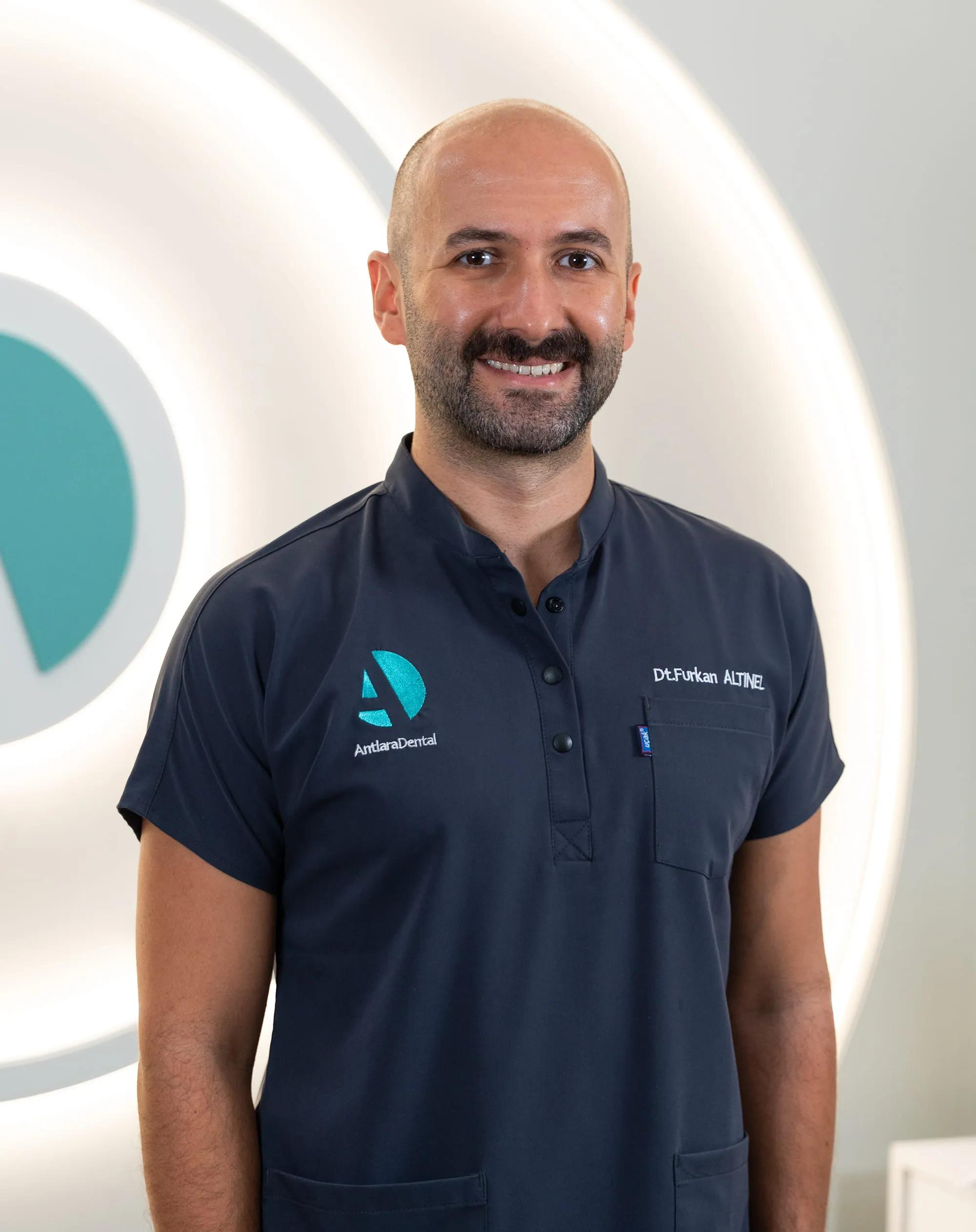
Dt. Furkan ALTINEL
Dentist
Dt. Furkan ALTINEL graduated from Istanbul University in 2011. Since 2024 he has worked at Antlara Dental in aesthetic dentistry, dental implantology, tooth extraction and implant surgery, and crowns, bridges and dentures. He speaks English.
Sources
- Treatment of excessive gingival display using conventional esthetic crown lengthening versus computer guided esthetic crown lengthening: a randomized clinical trial. BMC Oral Health 2024;24(1):317 (Borham E et al.). 2024.↩doi.org
- Pre-restorative crown lengthening surgery outcomes: a systematic review. J Clin Periodontol 2016;43(12):1094-1108 (Pilalas I, Tsalikis L, Tatakis DN). 2016.↩doi.org
- Mucogingival conditions in the natural dentition: narrative review, case definitions, and diagnostic considerations. Journal of Clinical Periodontology 2018;45 Suppl 20:S190-S198. 2018.↩doi.org
- Gum disease. NHS, page last reviewed 20 April 2026. 2026.↩nhs.uk
- Prevention and Treatment of Periodontal Diseases in Primary Care, 2nd edition. Scottish Dental Clinical Effectiveness Programme (SDCEP), February 2024. 2024.↩periodontalcare.sdcep.org.uk
- Treatment of stage I-III periodontitis - the EFP S3 level clinical practice guideline. Journal of Clinical Periodontology 2020;47 Suppl 22:4-60 (erratum 2021;48:163). 2020.↩doi.org
- Periodontal (gum) surgery: Overview and Recovery (patient information, resource 2850/VER6). Guy's and St Thomas' NHS Foundation Trust (UK), last reviewed June 2026, accessed 2 October 2026. 2026.↩guysandstthomas.nhs.uk
- SDCEP: Anticoagulant or antiplatelet medication and your dental treatment (information for patients). Scottish Dental Clinical Effectiveness Programme (SDCEP), March 2022. 2022.↩sdcep.org.uk
- Clinical efficacy of lip repositioning technique and its modifications for the treatment of gummy smile: systematic review and meta-analysis. Clin Oral Investig 2022;26(6):4243-4261 (Mendoza-Geng A et al.). 2022.↩doi.org
- Effectiveness of different modalities of lip repositioning surgery for management of patients complaining of excessive gingival display: a systematic review and meta-analysis. Biomed Res Int 2021;2021:9476013 (Younespour S et al.). 2021.↩doi.org
- Root coverage stability: a systematic overview of controlled clinical trials with at least 5 years of follow-up. Clin Exp Dent Res 2021;7(5):692-710 (Bertl K, Spineli LM, Mohandis K, Stavropoulos A). 2021.↩doi.org
- Long-term stability of gingival margin and periodontal soft-tissue phenotype achieved after mucogingival therapy: a systematic review. Journal of Clinical Periodontology 2024;51(2):177-195. 2024.↩doi.org
- Comparison of a subepithelial connective tissue graft and a xenogeneic collagen matrix in combination with a coronally advanced flap for gingival recession coverage with 12-month follow-up: a systematic review and meta-analysis. Medicina (Kaunas) 2025;61(9):1596 (Pranckeviciene A et al.). 2025.↩doi.org
- Xenogeneic collagen matrix vs. connective tissue graft for the treatment of multiple gingival recession: a systematic review and meta-analysis. Odontology 2024;112(2):317-340 (Zegarra-Caceres L et al.). 2023.↩doi.org
- Postoperative pain and morbidity at the donor site after palatal soft tissue harvesting: a systematic review. BMC Oral Health 2025;25(1):1960 (Chong WJ, Razali M, Baharin B, Nik Azis NM). 2025.↩doi.org
- Most effective method for the management of physiologic gingival hyperpigmentation: a systematic review and meta-analysis. J Indian Soc Periodontol 2019;23(3):203-215 (Gul M et al.). 2019.↩doi.org
- Systematic review of treatment modalities for gingival depigmentation: a random-effects Poisson regression analysis. J Esthet Restor Dent 2014;26(3):162-78 (Lin YH et al.). 2014.↩doi.org
- The effect of the distance from the contact point to the crest of bone on the presence or absence of the interproximal dental papilla. J Periodontol 1992;63(12):995-6 (Tarnow DP, Magner AW, Fletcher P). 1992.↩doi.org
- Interdental papilla reconstruction: a systematic review. Clin Oral Investig 2024;28(1):101 (Patel M, Guni A, Nibali L, Garcia-Sanchez R). 2024.↩doi.org
- Efficacy of diode laser versus conventional scalpel in labial frenectomy: a systematic review and meta-analysis of randomized controlled trials. Odontology 2026;114(3):1126-1138 (Atya A et al.). 2025.↩doi.org
- Standards for Conscious Sedation in the Provision of Dental Care (V1.1). Intercollegiate Advisory Committee for Sedation in Dentistry, Dental Faculties of the Royal Colleges of Surgeons and the Royal College of Anaesthetists, 2020. 2020.↩saad.org.uk
- Gum grafting procedure (soft-tissue grafting, patient information leaflet, document 101962, version 2). Cambridge University Hospitals NHS Foundation Trust (UK), approved 14 January 2025, accessed 2 October 2026. 2025.↩cuh.nhs.uk
- 1219 sayılı Tababet ve Şuabatı San'atlarının Tarzı İcrasına Dair Kanun (consolidated text). T.B.M.M.; RG 14/4/1928 No 863; consolidated on mevzuat.gov.tr. 1928.↩mevzuat.gov.tr
- Tıpta ve Diş Hekimliğinde Uzmanlık Eğitimi Yönetmeliği. T.C. Sağlık Bakanlığı; RG 3/9/2022 No 31942, amended RG 7/10/2023-32332 and 16/5/2024-32548. 2022.↩mevzuat.gov.tr
- Dental checks: intervals between oral health reviews (clinical guideline CG19). National Institute for Health and Care Excellence, published 27 October 2004. 2004.↩nice.org.uk
- Dental tourism and the risk of barotrauma and barodontalgia (narrative review with guiding principles). British Dental Journal 2023;234(2):115-117. 2023.↩doi.org
- Uluslararasi Saglik Turizmi ve Turistin Sagligi Hakkinda Yonetmelik. T.C. Saglik Bakanligi, Resmi Gazete 26/4/2025, No 32882. 2025.↩resmigazete.gov.tr
- Yetkili Saglik Tesisleri ve Araci Kuruluslar. T.C. Saglik Bakanligi, Saglik Turizmi Daire Baskanligi, list updated 20 August 2026. 2026.↩shgmturizmdb.saglik.gov.tr
- Türk Diş Hekimleri Birliği Kanunu, Law No. 3224 (consolidated text). Resmî Gazete 25/6/1985 No 18792; consolidated PDF, mevzuat.gov.tr. 1985.↩mevzuat.gov.tr
- Hasta Hakları Yönetmeliği (consolidated text). T.C. Sağlık Bakanlığı; Resmî Gazete 1/8/1998 No 23420, amended RG 8/5/2014-28994, 23/12/2016-29927, 16/1/2019-30657. 1998.↩mevzuat.gov.tr
- NHS: Dental abscess. NHS (nhs.uk). 2026.↩nhs.uk
- NHS: Toothache. NHS (nhs.uk). 2024.↩nhs.uk