
When should my child first see a dentist?
The first dental visit is advised when the first baby tooth comes through, or before 12 months of age at the latest1. At this visit the dentist looks at your child's teeth and talks with you about what to do at home. How often your child needs check-ups after that depends on their risk of tooth decay.
Children's dentistry covers protecting and treating baby teeth and permanent teeth, from infancy to the teenage years. In Turkey it is one of nine dental specialties set out in law2. This page is for babies, children and teenagers. For adults, see our other treatment pages, such as root canal treatment.
This page is written for families who live outside Turkey. Most of a child's dental care is ongoing: check-ups, prevention and care at home. That care is best planned with a dentist near where you live. The section "If your family lives outside Turkey" covers what to arrange at home. It also covers what to plan if your child is seen or treated in Antalya. On this page, "we" means our clinic in Antalya, Turkey.
- The first visit is advised when the first baby tooth comes through, or before the first birthday.
- The check-up interval is not the same for everyone; it is set by your child's risk of tooth decay.
- The most effective protection at home is brushing twice a day with the right amount of fluoride toothpaste for your child's age.
- Early decay can be stopped; once a hole has formed in the tooth, a filling is often needed.
Who is it for, and when?
The first visit and check-ups
- The first visit. The first teeth usually come through at around 6 months, but it is also normal for them to come earlier or later. The American Academy of Pediatric Dentistry also advises the first visit before 12 months of age3; it gives this recommendation no evidence grade.
- The check-up interval. A UK guideline (NICE) sets the shortest interval between routine check-ups at 3 months and, for under-18s, the longest interval at 12 months4. A child who is having treatment, or who has active decay or an urgent problem, can be seen sooner. The interval is set with the dentist, according to your child's level of disease and risk. There is no "every 6 months" rule for everyone.
Who this page is for
- Parents whose baby's first tooth has come through or is about to
- Parents who have noticed a mark, decay, pain or a knock on their child's teeth
- Parents whose child has been offered fissure sealants, fluoride or a filling
- Parents with questions about thumb sucking, dummies (pacifiers) or front teeth that stick out
- Parents of children with disabilities or additional needs. Tell the dentist about your child's needs before the first appointment, so that the visit can be planned around them
When to look at another page
- Bite problems and braces. The treatment plan is made after an orthodontic assessment; see the braces page.
- Adults. For root canal treatment, fillings or gum disease in adults, see the relevant treatment pages.
Children's dentists and the specialist title in Turkey
In Turkey, children's dental treatment can be carried out by dentists. A dentist is authorised to carry out the professional work2 of diagnosing and treating diseases of the teeth and gums. The title "specialist in paediatric dentistry" (çocuk diş hekimliği uzmanı) is different. Only a dentist who holds a specialist certificate issued and registered by the Ministry of Health5 may use it. The usual route to this certificate is the national specialty entrance exam (DUS), specialty training, a thesis and a final exam. In a Turkish dental practice, an approved copy of the dentist's practising certificate is displayed where patients can see it6.
Baby teeth and permanent teeth
Children have 20 baby teeth. Baby teeth usually start to come through at around 6 months7. In some babies they start before 4 months, in others after 12 months. In most children, all the baby teeth are through by the age of 2 to 38.
Adults have 32 permanent teeth, including four wisdom teeth. These teeth have usually come through by the age of 217.
In some children, one or more permanent teeth never form. Leaving wisdom teeth aside, in pooled studies 6.4% of people were missing at least one permanent tooth from birth9. The teeth most often missing are the second premolars in the lower jaw and the lateral incisors in the upper jaw. Most cases are mild. It is often an X-ray that shows it.
Protection at home: brushing by age
Under 3
Teeth are brushed twice a day as soon as the first tooth comes through, once just before bed. A parent or carer does the brushing. The UK's National Health Service (NHS) advises a toothpaste with at least 1,000 ppm fluoride, with only a smear on the brush1. A dentist may advise a stronger one, with 1,350 to 1,500 ppm. The point of using a small amount is to limit the risk10 of marks on the teeth called fluorosis. Fluoride-free toothpaste is not recommended.
Ages 3 to 6
Use a pea-sized amount1 of toothpaste with 1,000 to 1,500 ppm fluoride. Teeth are brushed twice a day. A parent does the brushing or helps the child. When your child starts brushing their own teeth, stay with them and watch.
Age 7 and over
The European Academy of Paediatric Dentistry advises parents to help with or supervise brushing until at least 7 years of age11. After this age, children can usually brush their own teeth. At this age the UK's NHS still advises keeping an eye on your child and using a toothpaste with 1,350 to 1,500 ppm fluoride1.
At every age
- Spit, don't rinse. Once your child can spit, the toothpaste is spat out after brushing, and the mouth is not rinsed with water1. This way the fluoride left on the teeth is not diluted12.
- Cut down on sugar. When sugar makes up less than 10% of daily energy, tooth decay is less common13. This is moderate-quality evidence from cohort studies.
- Any extra benefit from xylitol is uncertain. In children, a fluoride toothpaste with 10% xylitol was compared with a fluoride toothpaste alone over 2.5 to 3 years. It may have reduced decay by 13% (4,216 children)14. But this estimate rests on two studies by the same authors in the same population, and the quality of the evidence is low. Studies of other xylitol products are small and stand alone.
Prevention and treatment options at the clinic
The options below are ordered by the state of the tooth: first monitoring and prevention, then repair such as a filling.
- Monitoring and care at home. Tooth decay can be stopped at an early stage, and even reversed15. The basis for this is the right fluoride toothpaste for your child's age and less sugar. The dentist watches for change at check-ups.
- Fluoride varnish. A dentist can apply a fluoride varnish16 to stop early decay. Varnish is also used to prevent new decay. UK prevention guidance for dental teams (Delivering Better Oral Health) strongly recommends varnish twice a year for all children12 from age 3. Your dentist plans what your child needs according to their risk of decay.
- Fissure sealants. The pits and grooves on the biting surface of the permanent back teeth (molars) are covered with a thin resin. A review pooled 7 studies covering 1,548 children aged 5 to 10. After 24 months, decay was clearly less common in first permanent molars that had a sealant17. The quality of the evidence is moderate. The same guidance recommends sealants for children whose risk of decay is a concern12.
- Silver diamine fluoride (SDF). A liquid painted onto the decay to stop it; the tooth does not need drilling. After one application, the share of decay that stopped has been reported at between 47% and 90%18. The rate varies with the size and position of the decay. The treated decay usually turns black and hard, and the colour is permanent.
- Fillings. Once a hole (cavity) has formed in the tooth, a filling will probably be needed16.
- Pulp (nerve) treatment or extraction of a baby tooth. If decay has reached the nerve, pulp treatment or extraction is discussed for baby teeth too. The choice depends on the state of the nerve. A crown may also be needed to protect the treated tooth. After an extraction, a space maintainer may be needed to keep the gap open. We do not give figures for the results of these treatments on this page; ask your dentist.
| Fluoride varnish | Fissure sealant | SDF | Filling | |
|---|---|---|---|---|
| What is it for? | Preventing decay, stopping early decay | Protecting the biting surface of a back tooth | Stopping decay | Repairing a tooth with a hole |
| Is the tooth drilled? | No | No | No | Usually |
Children who cannot cope with treatment
Some children cannot cope with treatment because of fear or their age. In this case, splitting treatment into several short appointments, sedation or general anaesthetic may be discussed. This page does not cover who sedation and general anaesthetic suit in children, their risks, or the setting they should be done in. The sedation page is for adults. Ask your dentist whether these options suit your child, what the risks are and where it would be done.
What happens at a check-up?
The steps below are for a check-up or a first examination. Your dentist decides how long the examination takes and which steps are needed according to your child's age and situation.
Young children can often sit on a parent's lap during the examination. Before the visit, talk to your child about it in a calm way that does not frighten them.
Talking
Your child's health, diet, sugary food and drinks, brushing habits, and thumb or dummy sucking are discussed.
Examination
The teeth, gums and bite are examined by eye. Early decay and marks on the teeth are assessed.
An X-ray if needed
An X-ray is taken when needed, to see decay between the teeth or missing or extra teeth.
What to do at home
The right amount of toothpaste for your child's age, brushing and diet advice are discussed with your child and with you.
Plan
If needed, options such as varnish, fissure sealants, SDF or a filling are explained, with their benefits and risks. The family makes the decision together with the dentist.
Check-up interval
The time of the next check-up is set by your child's risk of decay.
Risks, limits and benefits
Risks and limits
- SDF leaves a permanent black colour on the tooth. Decay treated with SDF usually turns black and hard18. This is a side effect, not the aim of treatment. The American Academy of Pediatric Dentistry's guide on SDF recommends getting your consent about this before it is applied.
- Too much toothpaste can raise the risk of fluorosis. The point of putting only a smear of toothpaste on the brush for under-3s is to limit the risk of marks on the teeth. Do not use more than the recommended amount.
- Fissure sealants do not prevent all decay. The result above comes only from a review of the biting surfaces of permanent back teeth. Baby teeth were outside its scope. Sealants do not last for life17; they are checked at check-ups.
- An examination by eye cannot catch every early decay. A review covering 67 studies applied its results to an example in which 28% of tooth surfaces had decay. On that basis, for every 1,000 tooth surfaces, 40 early enamel lesions would be missed and 163 sound surfaces wrongly called decayed19. Most of these studies were done in a laboratory, and the certainty of the evidence is low. This result does not directly measure how well a child's examination works; but it is a reason not to judge a mark from a photograph. The dentist decides whether an X-ray is needed from what the examination shows.
- Sedation and general anaesthetic. This page does not cover their risks in children. Before deciding, ask your dentist for the risks and safety measures in writing.
Benefits
- Decay picked up at an early stage can often be stopped without drilling.
- Fissure sealants reduce decay on the biting surface of the permanent back teeth.
- Regular check-ups can help dentists notice conditions such as missing teeth or bite problems early.
Thumb sucking, dummies and front teeth that stick out
A long-lasting thumb, finger or dummy sucking habit is linked with bite problems, and the risk rises the longer it goes on20. But this is not the only cause of bite problems; genes, injuries and losing teeth early or late can also play a part.
In children whose upper front teeth stick out noticeably (an increased overjet), these teeth are more likely to be injured. Where the overjet was greater than 5 mm, the odds ratio for injury was about 2.4321. This figure is for children with a mix of baby and permanent teeth, or with permanent teeth only. In 12-year-olds it was about 1.8121. An odds ratio compares odds, not risk, so it does not mean "injured twice as often". These are associations from observational studies.
Early treatment between the ages of 7 and 11 reduced new injuries to the front teeth. It used a functional appliance, a type of brace for growing children. Of every 100 children in the group that waited until adolescence, 30 reported a new injury22, compared with 19 in the early-treatment group. This result rests on 332 children, and the quality of the evidence is moderate. The same review showed no other advantage22 of early treatment: when treatment ended, the results of the two groups were similar. Early treatment happens in two phases; it does not mean braces will not be needed later. Details are on the braces page.
Black marks on children's teeth
Some children have black marks along the gum line, in the form of a row of dots or a line. These marks are a deposit formed by bacteria23. Decay has been found less often24 in children with these marks. But this is an association, and it does not show that the stain protects the teeth.
Not every dark mark on a tooth is of this kind. Decay, and decay that has been stopped with SDF, can also look dark. A mark needs to be assessed at an examination, not from a photograph.
After treatment, and daily care
- If your child had a local anaesthetic, they may bite their lip, cheek or tongue until it wears off. Keep an eye on them during this time and hold off eating until the numbness has gone.
- It is expected that decay treated with SDF turns black; the colour does not fade. Ask your dentist whether the tooth can later be covered with a filling.
- Fissure sealants, fillings and teeth treated with SDF are checked at check-ups, usually by your dentist at home. If you notice that a sealant or filling has broken or come out, book an appointment without waiting for the next check-up.
- After an extraction, follow the written instructions you are given for the first days. Otherwise, daily care stays the same after treatment. Brush twice a day with the right amount of fluoride toothpaste for your child's age, once just before bed.
When should you contact a dentist?
Contact a dentist if any of the following happens:
- Toothache, or discomfort when eating
- A change of colour, a mark or a hole in a tooth
- A pimple-like swelling or discharge on the gum
- A thumb or dummy sucking habit that continues, or front teeth that stick out
- A permanent tooth that has not come through long after the baby tooth fell out
If you think your child has an abscess, see a dentist without delay, even if there is no fever or swelling. A dental abscess does not go away on its own and needs urgent dental treatment25. If your child has swelling in the face or jaw, or a fever together with toothache, get them seen the same day wherever you are.
A tooth that has had a knock. For a tooth that is broken, loose or knocked out, contact a dentist straight away. This page does not cover how to store a knocked-out tooth or whether it can be put back. Call a dentist near you for advice without waiting.
While you wait. Treating an abscess means the dentist draining the pus and removing the cause of the abscess25. Antibiotics do not replace this treatment. Use painkillers as directed on the pack; children under 16 must not be given aspirin25. Rinsing with salt water is not recommended for children26. Clove oil is not recommended27 for under-18s, because its use in children has not been established. Separately, life-threatening reactions have been reported in children under 2 who swallowed it.
Emergencies. The following need urgent medical help25. Do not wait for a dental appointment or for the clinic's reply. Go to the nearest emergency department or call the emergency number where you are (112 if you are in Turkey).
- Swelling that makes it hard to breathe, speak or swallow
- Swelling that spreads to the eye or the neck
- Swelling or pain in the eye, or sudden problems with sight
- Major swelling inside the mouth
- Difficulty opening the mouth
Before you fly home
If your child was treated in Antalya, know what was done on which tooth and what is still to come. Make sure you have written care instructions and a way to reach the clinic. If there is pain, swelling or bleeding where a tooth was treated, ask the dentist before you fly.
Once you are home
If a problem comes up that is not urgent, write to the clinic and send photographs, and see your own dentist. In the emergencies above, do not wait for a reply.
If your family lives outside Turkey
Most of a child's dental care is not a single appointment. Check-ups are repeated at an interval set by your child's risk of decay. Fluoride varnish may be repeated, and sealants and fillings are checked over the years. Brushing and diet at home do most of the work. So the dentist who sees your child regularly is usually one near where you live. Talk to that dentist before any treatment abroad. For a child, this is the dentist who will carry on the care.
If your child is seen or treated in Antalya
If you would like your child examined while your family is in Antalya, write to us before you come. A photograph cannot show whether a mark is decay, so the plan follows the examination. If treatment is needed, ask for the plan in writing before it starts, with the appointments it needs. Ask too which treatment could wait for your dentist at home. An abscess cannot wait: it needs treating wherever you are (see above). You can take time to decide, and you can say no, or ask to stop, at any stage. Treatment that is not urgent can also be left to your child's dentist at home.
Ask for a written record of what was done on which tooth, and copies of any X-rays. Your dentist at home needs them to follow up fissure sealants, fillings, SDF or a treated baby tooth. In Turkey, the health tourism regulation entitles international patients to an itemised bill. On request, they also get free copies of the records of the materials used, the tests and the imaging28. Whether follow-up care at home is covered depends on the health service or your insurer in the country where you live. Ask them before you travel.
Flying. A 2023 review of flying after dental treatment suggests waiting 24 hours after a filling and 24 to 48 hours after a simple extraction29. For most other dental procedures it suggests about a week29. These times apply only when there is no pain, swelling or bleeding where the tooth was treated. It gives no separate advice for children. The authors note that the research is limited and comes mainly from military aviation. Treat it as a starting point for your dentist's advice, not as a rule.
Questions to ask before your child is treated. Ask us these questions, and ask for the answers in writing:
- Who will carry out the treatment, and what are their qualifications?
- Will someone speak our language, or will there be a translator?
- Are you regulated by a professional body and registered with it?
- What aftercare do you provide, and who can we contact after the treatment?
- Do you have a complaints system, and can I see a copy?
The full list, with our answer to each question, is on our page about dental treatment abroad.
What determines the cost?
This page carries no prices. The plan is prepared for your child after an examination. The main factors that shape it are:
- Whether only a check-up and prevention are needed, or treatment too
- How many teeth need treatment, and whether each is a baby tooth or a permanent tooth
- The size of the decay, and whether it has reached the nerve of the tooth
- Whether an X-ray is needed
- How many appointments the treatment is split into; whether sedation or general anaesthetic is needed
- Whether treatment is done during your stay or with your dentist at home
Ask for the plan in writing. It should say what is included and what would be charged separately.
Do you have a question about your child's teeth?
Write to us with your question. Our dentists will write back on what the next step is likely to be. They will also say whether it is best done at home or during your stay. Whether a mark is decay, and what treatment is needed, are known only after an examination.
Frequently Asked Questions
Baby teeth fall out anyway, so do they need treating when they decay?
Baby teeth stay in the mouth for years. A decayed baby tooth can cause pain and an abscess; an abscess does not go away on its own. Early decay can often be stopped without drilling. Your dentist decides at the examination which teeth to watch and which to treat.
When should I start brushing my baby's teeth?
As soon as the first tooth comes through. You brush the teeth twice a day, once just before bed. Put only a smear of fluoride toothpaste on the brush.
Should I use a fluoride-free toothpaste for my child?
No. Guidelines recommend fluoride toothpaste; they do not recommend fluoride-free toothpaste. The way to limit the risk of the marks called fluorosis is to adjust the amount of toothpaste to your child's age.
Are fissure sealants also put on baby teeth?
The review described here looked only at the biting surfaces of permanent back teeth; baby teeth were outside its scope. Your dentist decides, according to the state of the tooth, whether to use sealants on baby teeth or on other surfaces.
My child is very scared of the dentist. What can I do?
Tell the dentist about the fear beforehand. Treatment can be split into short appointments. If sedation or general anaesthetic is to be discussed, ask your dentist whether it suits your child. Ask too what the risks are and where it would be done.
We live abroad. Can my child have a check-up while we are in Antalya?
Yes, write to us before you come. A check-up during a stay does not replace regular check-ups with a dentist where you live, who can follow your child over the years. Ask for a written record and copies of any X-rays to take home.
Can my child fly after a filling or an extraction?
Ask the dentist who treated your child. A review of flying after dental treatment suggests a short wait after a filling or an extraction. That applies only if there is no pain, swelling or bleeding where the tooth was treated. The research is limited and gives no separate advice for children. The suggested waits are in the section on families living outside Turkey above.
Does thumb sucking damage the teeth?
A long-lasting thumb, finger or dummy sucking habit is linked with bite problems, and the risk rises the longer it goes on. But it is not the only cause. If the habit continues, or the front teeth are sticking out, talk about it at a check-up.
Are the black marks on my child's teeth decay?
Not always. Black marks in a row of dots along the gum line can be a bacterial deposit. But decay can also look dark. An examination is needed to tell them apart.
Is there a difference between a children's dentist and a specialist?
In Turkey, children's dental treatment can be carried out by dentists. The title "specialist in paediatric dentistry", however, may be used only by a dentist with a specialist certificate registered by the Ministry of Health. The dentist's practising certificate should be displayed in the practice.
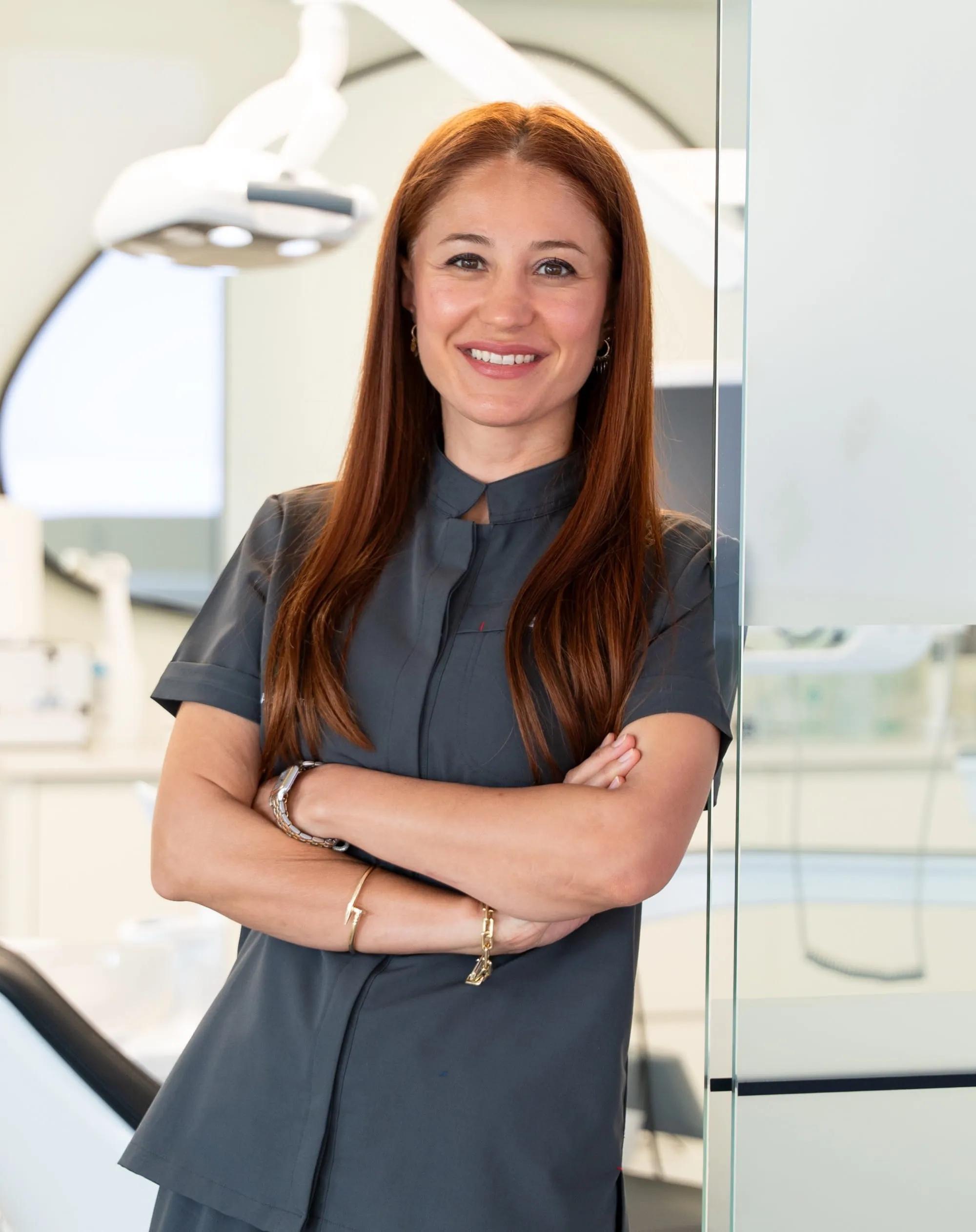
Dt. Dilek AKSU GÜLER
Dentist · Founder
She has completed advanced training in implantology and works in aesthetic restorations and smile design.
Sources
- Children's teeth. NHS (nhs.uk), page last reviewed 30 June 2025. 2025.↩nhs.uk
- 1219 sayılı Tababet ve Şuabatı San'atlarının Tarzı İcrasına Dair Kanun (consolidated text). T.B.M.M.; RG 14/4/1928 No 863; consolidated on mevzuat.gov.tr. 1928.↩mevzuat.gov.tr
- Perinatal and infant oral health care (Reference Manual of Pediatric Dentistry). American Academy of Pediatric Dentistry, Reference Manual 2025:337-41, latest revision 2025.↩aapd.org
- Dental checks: intervals between oral health reviews (clinical guideline CG19). National Institute for Health and Care Excellence, published 27 October 2004. 2004.↩nice.org.uk
- Tıpta ve Diş Hekimliğinde Uzmanlık Eğitimi Yönetmeliği. T.C. Sağlık Bakanlığı; RG 3/9/2022 No 31942, amended RG 7/10/2023-32332 and 16/5/2024-32548. 2022.↩mevzuat.gov.tr
- Ağız ve Diş Sağlığı Hizmeti Sunulan Özel Sağlık Kuruluşları Hakkında Yönetmelik (consolidated text). T.C. Sağlık Bakanlığı; Resmî Gazete 6/10/2022 No 31975, amended RG 5/3/2024-32480 and 15/12/2024-32753. 2022.↩mevzuat.gov.tr
- Eruption charts. American Dental Association, MouthHealthy.↩mouthhealthy.org
- Baby teething symptoms. NHS (nhs.uk), page last reviewed 14 May 2026. 2026.↩nhs.uk
- Prevalence of hypodontia and associated factors: a systematic review and meta-analysis. Journal of Orthodontics 2014;41(4):299-316. 2014.↩doi.org
- Fluoride therapy (Reference Manual of Pediatric Dentistry). American Academy of Pediatric Dentistry, Reference Manual 2025:372-8, latest revision 2023.↩aapd.org
- Guidelines on the use of fluoride for caries prevention in children: an updated EAPD policy document. European Archives of Paediatric Dentistry 2019;20(6):507-516. 2019.↩doi.org
- Delivering Better Oral Health, chapter 2: summary guidance tables for dental teams. Office for Health Improvement and Disparities / DHSC, NHS England et al.. 2025.↩gov.uk
- Systematic review of the effect on caries of sugars intake: ten-year update. Journal of Dental Research 2022;101(9):1034-1045 (Moores CJ, Kelly SAM, Moynihan PJ). 2022.↩doi.org
- Xylitol-containing products for preventing dental caries in children and adults (Cochrane review). Cochrane Database of Systematic Reviews 2015;(3):CD010743 (Riley P et al.). 2015.↩doi.org
- Delivering Better Oral Health, chapter 4: dental caries. Office for Health Improvement and Disparities / DHSC, NHS England et al.. 2025.↩gov.uk
- NHS: Tooth decay. NHS. 2025.↩nhs.uk
- Pit and fissure sealants for preventing dental decay in permanent teeth. Cochrane Database of Systematic Reviews 2017;7:CD001830. 2017.↩doi.org
- Chairside Guide: Silver Diammine Fluoride in the Management of Dental Caries Lesions. American Academy of Pediatric Dentistry, Reference Manual.↩aapd.org
- Visual or visual-tactile examination to detect and inform the diagnosis of enamel caries. Cochrane Database of Systematic Reviews 2021; CD014546. 2021.↩doi.org
- Establishing the association between nonnutritive sucking behavior and malocclusions: a systematic review and meta-analysis. Journal of the American Dental Association 2016;147(12):926-934.e6. 2016.↩doi.org
- The association of overjet size and traumatic dental injuries - a systematic review and meta-analysis. Dental Traumatology 2019;35(4-5):217-232. 2019.↩doi.org
- Orthodontic treatment for prominent upper front teeth (Class II malocclusion) in children and adolescents. Cochrane Database of Systematic Reviews 2018;3:CD003452. 2018.↩doi.org
- Black stain and dental caries: a review of the literature. BioMed Research International 2015:469392. 2015.↩doi.org
- Association between chromogenic black stain and dental caries in children: a systematic review and meta-analysis. Children (Basel) 2025;12:1624. 2025.↩doi.org
- NHS: Dental abscess. NHS (nhs.uk). 2026.↩nhs.uk
- NHS: Toothache. NHS (nhs.uk). 2024.↩nhs.uk
- Community herbal monograph on Syzygium aromaticum (L.) Merill et L. M. Perry, floris aetheroleum (clove oil). European Medicines Agency, Committee on Herbal Medicinal Products, EMA/HMPC/534924/2010, adopted 13 September 2011. 2011.↩ema.europa.eu
- Uluslararasi Saglik Turizmi ve Turistin Sagligi Hakkinda Yonetmelik. T.C. Saglik Bakanligi, Resmi Gazete 26/4/2025, No 32882. 2025.↩resmigazete.gov.tr
- Dental tourism and the risk of barotrauma and barodontalgia (narrative review with guiding principles). British Dental Journal 2023;234(2):115-117. 2023.↩doi.org