
How many teeth should an adult have?
A full set of adult (permanent) teeth is 32, including four wisdom teeth at the back. Without the wisdom teeth, the count is 28. Many adults see fewer than 32 in the mouth: some wisdom teeth never form or have been removed, and others are there but stay under the gum. Children have 20 baby teeth.
- A full adult set is 32 teeth, usually all through by about age 21.
- Without the four wisdom teeth the count is 28.
- Children have 20 baby teeth, usually all through by age 2 to 3.
- Missing wisdom teeth are common: more than 1 in 5 people (22.6% in pooled studies) lack at least one.
Tooth count at a glance
- Baby (primary) teeth
- 20: 10 in the upper jaw, 10 in the lower
- Adult (permanent) teeth
- 32: 16 in the upper jaw, 16 in the lower
- Adult teeth without wisdom teeth
- 28
- First baby teeth
- Usually around 6 months
- All adult teeth through
- Usually by about age 21
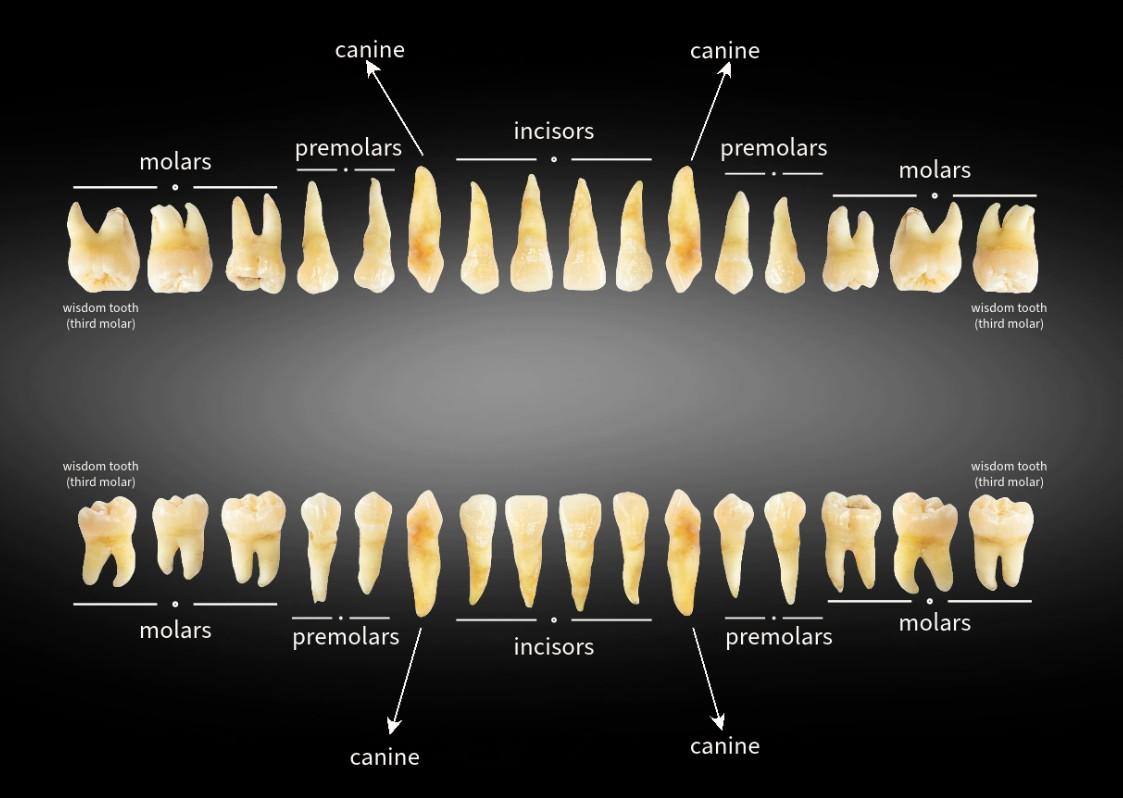
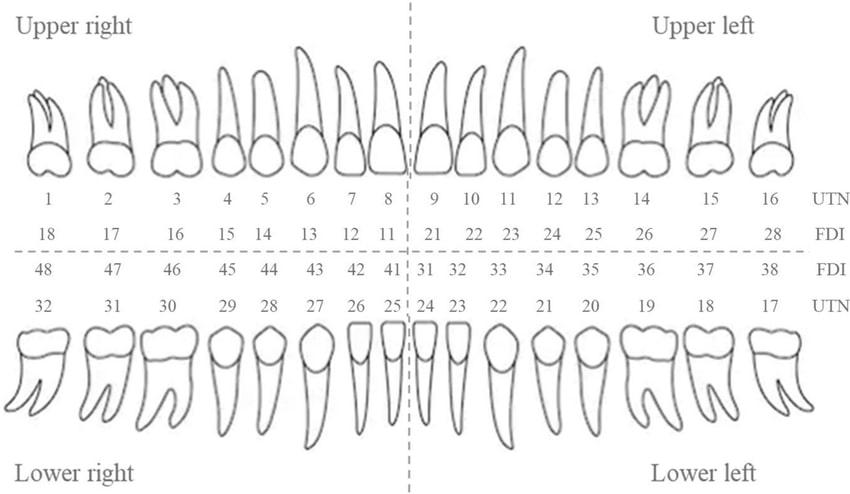
The American Dental Association states that people usually have 20 baby teeth, and all 32 permanent teeth1 have usually come through by age 21. Baby teeth start to come in at about 6 months. The counts per jaw, and the 28 without wisdom teeth, follow from these totals by simple arithmetic.
Adult teeth come in four kinds, from front to back: incisors, the flat cutting teeth at the front; canines, the pointed teeth at the corners; premolars, the teeth between the canines and the molars; and molars, the broad grinding teeth at the back. The wisdom teeth are the last molars, one in each corner of the mouth, which is why there are four.
Children's teeth: 20 baby teeth, then the adult set
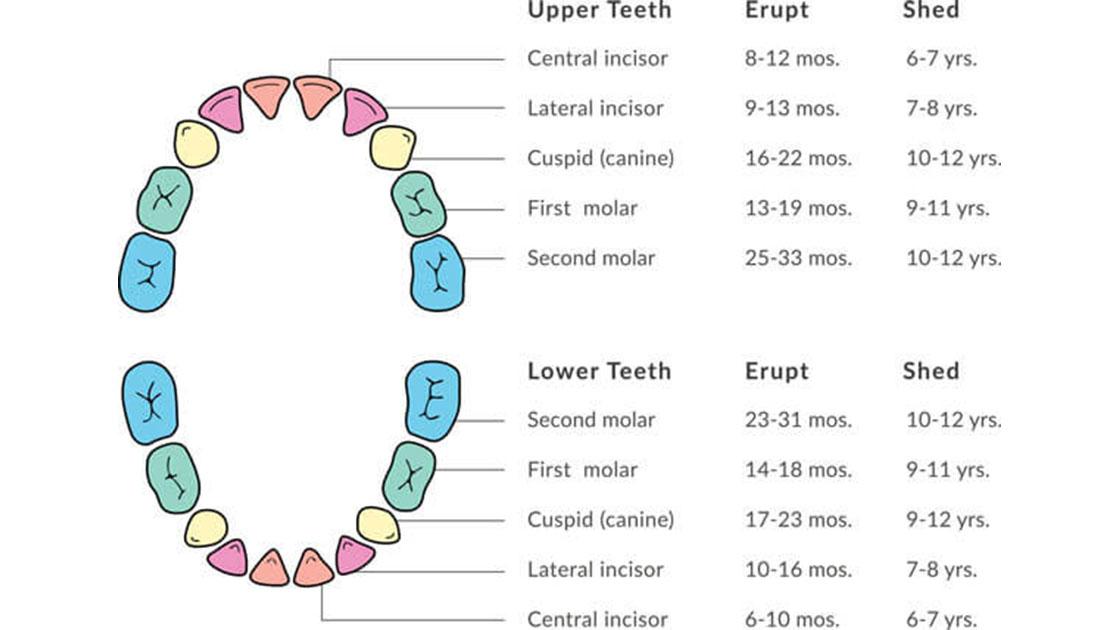
Most babies start teething at around 6 months, although some start before 4 months and some after 12 months. The NHS says most children have all their milk teeth by 2 to 3 years old2. The baby teeth usually arrive in a rough order: the front teeth first, then the first molars, the canines, and the second molars last, with lower teeth often coming through before the matching upper ones.
From around school age, the baby teeth start to fall out and adult teeth take their place, while extra adult molars come through behind them. For some years a child has a mix of baby and adult teeth. The timing varies a lot from child to child, so there is no fixed "right" number for a given age. A dentist can tell you whether your child's teeth are coming through as expected.
Why you may have fewer than 32
Counting fewer than 32 teeth in the mirror is common, and usually not a problem. There are three main reasons.
Some teeth never formed
Wisdom teeth are the teeth most often missing from birth. A review of 92 studies with 63,314 people worldwide found that 22.6% had at least one wisdom tooth missing3, more than 1 in 5, although the figure varied widely between studies (from 5% to 56%). Missing one or two wisdom teeth was more common than missing three or four, and women were slightly more likely than men to lack one.
Other teeth can be missing too, a condition called hypodontia. Pooled studies found that about 6.4% of people were born without at least one tooth4 other than a wisdom tooth, with large differences between studies. The teeth most often missing were the lower second premolars, then the upper lateral incisors (the small teeth beside the two front teeth), then the upper second premolars. In most people with hypodontia only one or a few teeth are missing.
Some teeth have not come through
A tooth can form but stay under the gum or in the bone because there is not enough room or it is growing at an angle. This is called an impacted tooth, and wisdom teeth are the usual example. A tooth that is still fully under the gum cannot be counted in the mirror, and one that is only partly through can be hard to see; a dentist may use an X-ray to see where it is.
Some teeth have been removed
Teeth may have been taken out because of decay, gum disease, injury or for orthodontic treatment, or wisdom teeth may have been removed because they caused problems.
Do wisdom teeth have to come out?
Not necessarily, and the evidence points in more than one direction. The NHS says a healthy wisdom tooth will usually be left where it is and monitored5. UK guidance from NICE, published in 2000 and now being updated, states that the preventive removal of impacted wisdom teeth that are free of disease should be discontinued6, and that surgery should be limited to teeth with evidence of disease, such as decay that cannot be repaired, infection or a cyst. Having no symptoms is not the same as being free of disease, which is why a dentist's examination matters.
A Cochrane review found insufficient evidence7 to say whether impacted wisdom teeth with no symptoms and no disease should be removed or kept. It found that keeping them may be linked with gum disease around the neighbouring molar, on very low-certainty evidence, and suggested that people who keep them have them checked at regular intervals. A review of 37 studies concluded that kept wisdom teeth that cause no symptoms rarely remain disease-free over time8, most often because of decay or gum problems. One small trial in teenagers who had finished orthodontic treatment, at high risk of bias, found no clinically significant effect of removing wisdom teeth on the alignment of the other teeth.
Removal has its own risks. In a review of 44,171 extractions of impacted lower wisdom teeth, the nerve that gives feeling to the lower lip and chin was injured temporarily after 1.20% and permanently after 0.28%9 of them. The NHS says this kind of nerve damage usually gets better but can last a few weeks or months. Whether to remove or keep a wisdom tooth is a decision to make with your dentist.
Can you have more than 32 teeth?
Yes. Some people develop extra teeth, called supernumerary teeth. Whether one needs treatment depends on where it is and how it affects the teeth around it, which a dentist assesses.
When to see a dentist
The number of teeth matters less than whether they are healthy and working. Ask a dentist to look if:
- a baby tooth is still firmly in place well after the adult tooth should have replaced it, or an adult tooth has not come through
- a gap has appeared and the teeth around it seem to be moving
- a wisdom tooth area is painful or swollen, or the gum over it keeps getting sore
- you want to know whether you have teeth that have not come through: that needs an X-ray, chosen by the dentist after examining you
After a wisdom tooth is removed, get urgent dental help for bleeding that does not stop, pain or swelling that is severe or getting worse when painkillers are not helping, or pain with a bad taste in your mouth, a high temperature or feeling unwell. The NHS lists these as signs to act on5.
Emergencies. Swelling around a wisdom tooth, or anywhere in the mouth or face, that makes it hard to breathe, speak or swallow10 is an emergency: call 112 or go to the nearest emergency department.
Frequently asked questions
Is one implant brand better than the others?
The evidence we use does not rank brands. Published survival figures are averages pooled from many studies, not the result of one brand. The right system depends on your bone, the gap, the tooth planned on top and your dentist's experience with that system.
Can another dentist repair my implant crown later?
Usually they need to know which system you have and to have matching parts and tools. A written record of the system makes that much easier. If you do not have one, ask the clinic that placed the implant.
How can I check that a dentist is registered?
Look for the dentist's working certificate, approved by the provincial health directorate, in the surgery. Dentists in private practice must register with the local dental chamber. The Turkish Dental Association's website has a search by name and province; a name you cannot find is a reason to ask.
Can I take my All-on-4 bridge out to clean it?
No. A fixed bridge is screwed onto the implants and only your dentist can remove it. You clean it in place, around and underneath. Your dentist removes it when cleaning or repair needs access underneath.
How many teeth do adults have without wisdom teeth?
Without the four wisdom teeth, a full adult set has 28 teeth. With them it is 32: one wisdom tooth at the back of each side of the upper and lower jaw.
Does a lifetime warranty mean the implant will last for life?
No. A warranty is a commercial promise with conditions; read what it covers and what you must do to keep it. The reviews we use give figures for up to ten years only, and no one can promise a lifetime result.

Dt. Dilek AKSU GÜLER
Dentist · Founder
She has completed advanced training in implantology and works in aesthetic restorations and smile design.
Sources
- Eruption charts. American Dental Association, MouthHealthy.↩mouthhealthy.org
- Baby teething symptoms. NHS (nhs.uk), page last reviewed 14 May 2026. 2026.↩nhs.uk
- Morphologic and demographic predictors of third molar agenesis: a systematic review and meta-analysis. Journal of Dental Research 2015;94(7):886-94. 2015.↩doi.org
- Prevalence of hypodontia and associated factors: a systematic review and meta-analysis. Journal of Orthodontics 2014;41(4):299-316. 2014.↩doi.org
- NHS: Wisdom tooth removal. NHS (nhs.uk). 2024.↩nhs.uk
- NICE TA1: Guidance on the extraction of wisdom teeth. National Institute for Health and Care Excellence, published 27 March 2000 (last reviewed 31 March 2015; update ID898 in progress). 2000.↩nice.org.uk
- Surgical removal versus retention for the management of asymptomatic disease-free impacted wisdom teeth (Cochrane review). Cochrane Database of Systematic Reviews 2020;5:CD003879. 2020.↩doi.org
- Does retaining third molars result in the development of pathology over time? A systematic review (37 studies). Journal of Oral and Maxillofacial Surgery 2020;78(11):1892-1908. 2020.↩doi.org
- Risk relationship associated with inferior alveolar nerve injury following removal of mandibular third molars: a systematic review (23 studies). Journal of Stomatology, Oral and Maxillofacial Surgery 2020;121(1):63-69. 2020.↩doi.org
- NHS: Dental abscess. NHS (nhs.uk). 2026.↩nhs.uk