
How do you clean an All-on-4 or All-on-6 bridge?
Clean it in place every day, including underneath, and keep your reviews. A fixed All-on-4 or All-on-6 bridge is screwed onto the implants, so you cannot take it out at home. Plaque collects on its underside and where it meets the gum. Brush twice a day and clean under the bridge once a day with the tool your dentist shows you. Attend reviews at the interval set for you.
This matters because inflammation around implants is common. Reviews of full-arch bridges report peri-implantitis, inflammation with loss of the bone around an implant, in 4 to 18 per cent1; the review summaries do not say whether that counts patients or implants.
- Plaque is behind inflammation around implants; the underside of the bridge and the gum line are where it collects.
- No cleaning tool has been shown to be best under a full-arch bridge; use the one you can use well every day.
- Chlorhexidine mouthwash is for short periods only and does not replace cleaning under the bridge.
- Reviews start from a baseline X-ray and measurements when the bridge is completed; the interval is set by your risk.
Why cleaning matters with a full-arch bridge
The 2017 World Workshop consensus describes peri-implantitis as a plaque-associated condition2: inflammation of the tissue around an implant with progressive loss of the supporting bone. Inflammation limited to the soft tissue, without bone loss, is called peri-implant mucositis. Treating peri-implantitis may need surgery, and if it progresses the implant can be lost.
It is not rare. Reviews of full-arch bridges report it in 4 to 18 per cent1 over 5 to 15 years of follow-up; the summaries do not say whether that counts patients or implants. A 57-study review of implant patients in general found it in about 20 in 100 patients3. The rate depends on the definition used and how long the implants have been in place. After past treatment for periodontitis, gum disease that has damaged the bone around the teeth, peri-implantitis was about 3 times as common4, and the rate of implant loss over follow-up was about 1.75 times higher (a hazard ratio).
A fixed bridge adds its own difficulty. It covers the gum where the teeth used to be, and food and plaque collect between its underside and the gum. The line where the bridge meets the gum is the hardest place to keep clean. Because the bridge is screwed in, only your dentist can remove it. The All-on-4 and All-on-6 pages explain both designs.

A daily routine
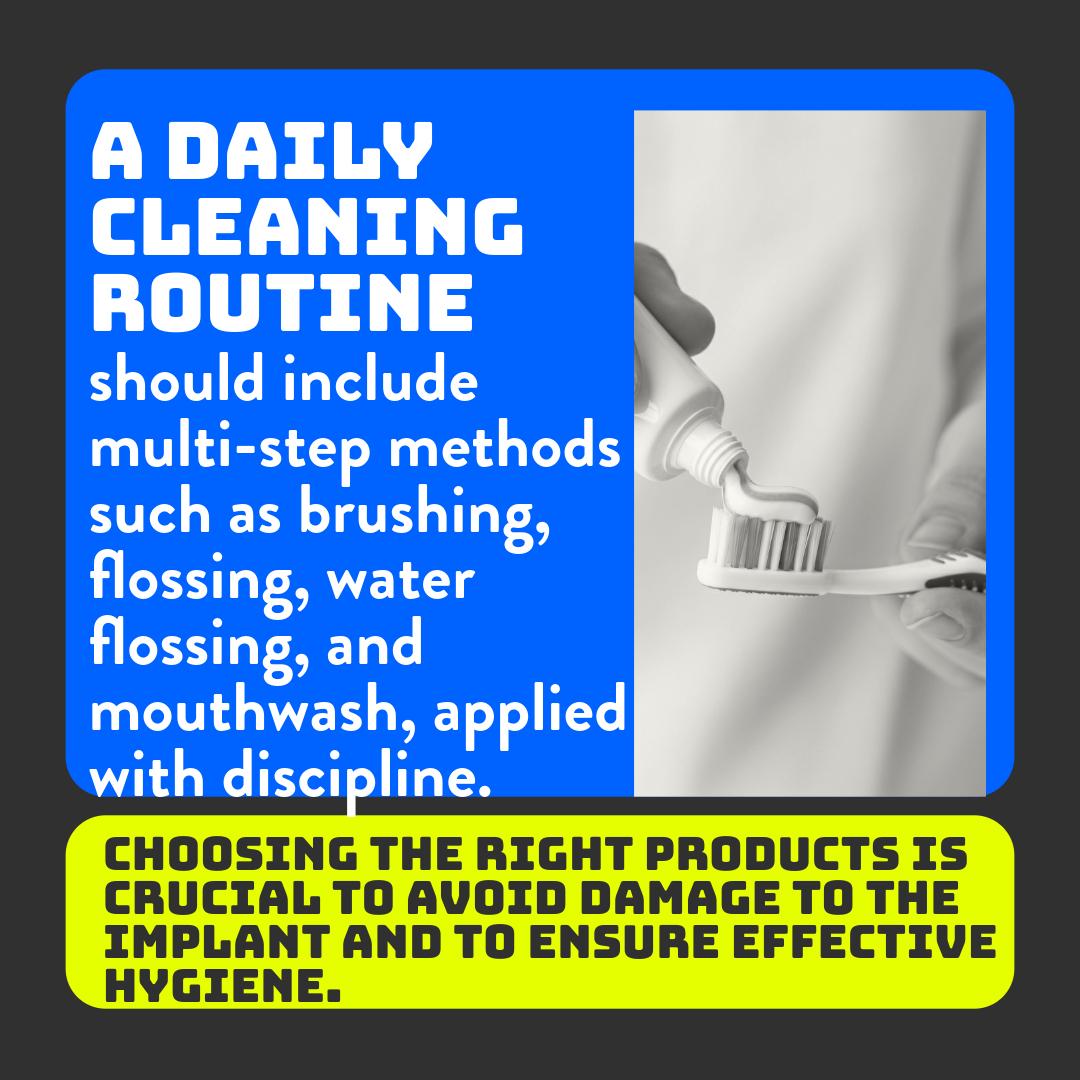
Your dentist shows you the routine on your own bridge, because the space under each bridge is different. The usual parts are these:
- Brush twice a day. UK prevention guidance advises brushing at least twice a day5 with fluoride toothpaste and spitting it out; thorough brushing may take at least two minutes. Use a small-headed brush with soft or medium bristles, not hard ones, and angle the bristles towards the line where the bridge meets the gum, on the cheek side and on the tongue or palate side.
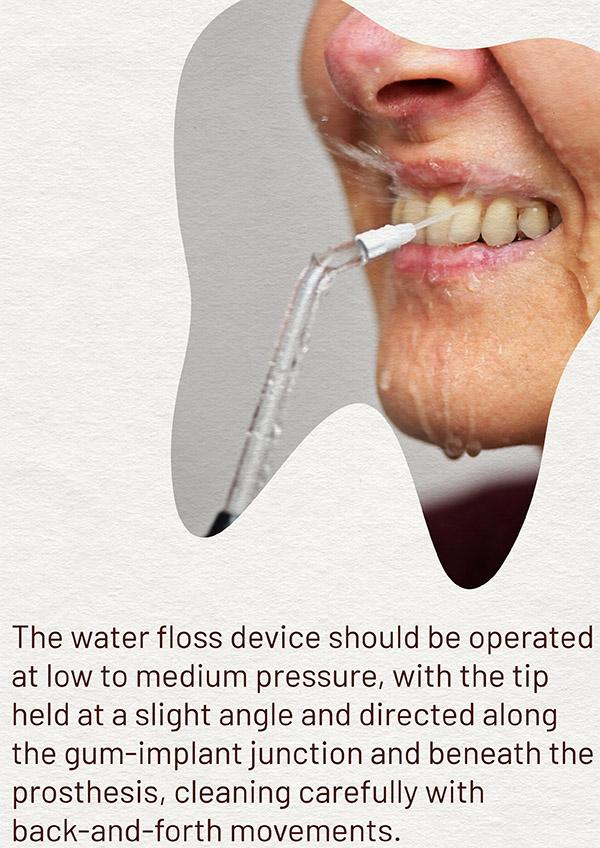
- Clean under the bridge once a day. Thread bridge floss (floss with a stiffened end) under the bridge and around each implant, or pass an interdental brush of the right size between the bridge and the gum. A water flosser can also reach under the bridge. Your dentist shows you which works in your mouth and which brush size fits. If floss catches or shreds at one spot, stop using it there and tell your dentist.
- Check in a mirror. Redness, swelling or bleeding along the gum line can point to a place you are missing.
- Protect the bridge. If you clench, a night guard may be advised. It has not been shown to prevent implant loss; its purpose is to protect the bridge.
In the weeks after surgery, while a provisional bridge is in place, follow the written aftercare instructions you are given. Cleaning around the healing gum is gentler at first, and your dentist tells you when to move to the full routine.
What the evidence says about the tools
Most studies of home cleaning were done on natural teeth, not under full-arch implant bridges. They are a guide, not proof for your bridge.
- Powered or manual brush. A Cochrane review of 51 trials found that powered brushes reduced plaque and gum inflammation slightly more6 than manual ones, with moderate certainty. How much that difference matters is unclear, and both kinds remove plaque.
- Floss and interdental brushes. A Cochrane review of 35 trials found that floss added to brushing may reduce gum inflammation7, and that interdental brushes added to brushing may reduce plaque. The certainty was low or very low, and the differences may not be clinically important. Where they fit, interdental brushes may reduce inflammation more than floss.
- Water flossers. We found no study in our sources comparing water flossers with other tools under full-arch bridges. There is no good evidence in our sources that one of them is better.
- Mouthwash. Chlorhexidine mouthwash reduces plaque. In people with mild gum inflammation, though, its effect on the gums was not considered clinically relevant8. It stains teeth and can alter taste and irritate the mouth, so it is advised for short periods only, when your dentist recommends it. No mouthwash replaces cleaning under the bridge.
- Toothpaste. We found no study in our sources comparing toothpastes on implant bridges. Ask your dentist which suits the material of your bridge.
Professional reviews and cleaning
Daily cleaning is one part of the care; regular reviews and professional cleaning are the other. Tell your dentist if you smoke or have diabetes so that both are taken into account, and ask your doctor for support if you want to stop smoking.
- A baseline. When the bridge is completed, an X-ray and probing measurements are taken as a baseline2. Later changes around the implants are judged against that record.
- A programme, not a fixed date. The European Federation of Periodontology guideline calls for a structured supportive care programme9, with regular assessment, once implants are in use. The NICE guideline on dental recall recommends that the interval between reviews be set for each patient10 according to their risk; that guideline covers check-ups in general, not implants. There is no single interval that suits everyone; yours is given in writing.
- What is checked. The gum around the implants is checked for bleeding and swelling, and the bridge, its screws and your bite are checked. X-rays are taken when needed, and your cleaning is reviewed with you.
- Removing the bridge. Because the bridge is screwed in, the dentist can remove it when cleaning or repair needs access underneath.
- How it is cleaned. Hand instruments, ultrasonic instruments and air polishing are used around implants. A review of trials in gum and implant maintenance found that the two implant trials of air polishing reached conflicting results11, and most of its trials had a high risk of bias. The review could not show which method is better for cleaning around implants.
When to see a dentist
Do not wait for your next review if you notice any of these:
- Bleeding, a bad smell, discharge or receding gum around the bridge
- Food packing under the bridge in a place you cannot clean
- The bridge moves, a screw feels loose, or a piece cracks or breaks
- Pain on biting, or a bite that feels high
- Nasal discharge, blockage or sinus pain (upper jaw)
Emergencies. Difficulty breathing or swallowing, rapidly spreading swelling of the face or neck, high fever or swelling around the eye are serious signs. Do not wait for the clinic's reply: go to the nearest emergency department or call 112.
Frequently asked questions
What should my implant record include?
The manufacturer, the system name, the implant's width and length, where and when it was placed, and the parts on top, including the crown material. An X-ray taken when the crown is fitted gives a baseline for later reviews. Ask for a copy.
How many teeth do adults have on top and bottom?
A full adult set has 16 teeth in the upper jaw and 16 in the lower jaw. Children's 20 baby teeth are 10 upper and 10 lower.
Is it normal to have only 28 teeth?
It can be. Having 28 is normal if all four wisdom teeth are missing, have not come through or have been removed, and the other adult teeth are there. More than 1 in 5 people (22.6%) lack at least one wisdom tooth. A dentist can check which teeth you have.
How many teeth should a child have at age 7 or 12?
There is no fixed number. During the school years children have a mix of baby and adult teeth, and the timing varies from child to child. A dentist can check whether it is on track.
Will a professional clean hurt my teeth?
A clean removes deposits and stain from the surface; it does not bleach the tooth. Your gums may feel tender for a short time afterwards, especially if they were inflamed. Tell the clinician if anything hurts during the clean.
Dt. Dilek AKSU GÜLER
Dentist · Founder
She has completed advanced training in implantology and works in aesthetic restorations and smile design.
Sources
- Prosthetic complications of implant-supported complete arch prostheses: an umbrella review of systematic reviews (7 reviews, >=5-year follow-up). Journal of Prosthetic Dentistry 2026;136(1):52-59. 2026.↩doi.org
- Peri-implant diseases and conditions: consensus report of workgroup 4 of the 2017 World Workshop on the Classification of Periodontal and Peri-Implant Diseases and Conditions. Journal of Clinical Periodontology 2018;45 Suppl 20:S286-S291. 2018.↩doi.org
- What is the prevalence of peri-implantitis? A systematic review and meta-analysis (57 articles, 2005-2021). BMC Oral Health 2022;22(1):449. 2022.↩doi.org
- Effectiveness of implant therapy in patients with and without a history of periodontitis: systematic review with meta-analysis of prospective cohort studies (14 studies, >=36 months). Journal of Periodontal Research 2025;60(6):524-543. 2025.↩doi.org
- Delivering Better Oral Health, Chapter 8: Oral hygiene. Department of Health and Social Care / NHS England et al., updated 10 September 2025. 2025.↩gov.uk
- Powered versus manual toothbrushing for oral health. Cochrane Database of Systematic Reviews 2014;6:CD002281. 2014.↩doi.org
- Home use of interdental cleaning devices, in addition to toothbrushing, for preventing and controlling periodontal diseases and dental caries. Cochrane Database of Systematic Reviews 2019;4:CD012018. 2019.↩doi.org
- Chlorhexidine mouthrinse as an adjunctive treatment for gingival health. Cochrane Database of Systematic Reviews 2017;3:CD008676. 2017.↩doi.org
- Prevention and treatment of peri-implant diseases: the EFP S3 level clinical practice guideline. Journal of Clinical Periodontology 2023;50 Suppl 26:4-76. 2023.↩doi.org
- Dental checks: intervals between oral health reviews (clinical guideline CG19). National Institute for Health and Care Excellence, published 27 October 2004. 2004.↩nice.org.uk
- Efficacy of air polishing in comparison with hand instruments and/or power-driven instruments in supportive periodontal therapy and implant maintenance: a systematic review and meta-analysis. BMC Oral Health 2022;22:85. 2022.↩doi.org