
Why dental materials vary
Dental treatment uses many materials besides the crown, filling or denture you can see. Some protect a tooth for a few weeks, while others are meant to last for years. Some fix a restoration in place, record the shape of your teeth, help bone or gum to heal, or fill the inside of a root.
Each job needs different properties. So materials differ in strength, in how they attach to the tooth and in how the body responds to them. Products of the same type can also differ in their exact ingredients. This page describes the materials that have no page of their own. It also covers how materials are chosen, what is known about sensitivities and how to find out what was used. Each section points to the page with more detail.
On this page, "we" and "our clinic" mean our clinic in Antalya, Turkey. Your dentist will tell you which materials, products and laboratory they use. You can ask for this in writing (see "Before you travel: questions and records" below). The figures on this page come from published studies, not from our own records.
- Temporary materials protect a tooth or fill a gap while the final work is made; they do not replace it.
- A crown, inlay or veneer is fixed with a thin layer of cement. With adhesive bonding, the surfaces are also treated so that it bonds to the tooth. A crown on an implant may instead be held by a screw.
- Graft materials can come from your own body, a human donor or an animal, or be synthetic; say so if the source matters to you.
- Reactions to dental materials are uncommon, but allergies to some resins and metals have been reported; tell your dentist about any you have had.
- Ask in writing for the product names and manufacturers, and take a record home for your own dentist.
Temporary and provisional materials
Temporary (provisional) materials protect a tooth or fill a gap while the final work is made; they do not replace it. How long they stay depends on the material and your treatment plan, so ask how long yours is meant to last.
- Temporary crowns and bridges. A 2022 review divides the resins used for them into two broad types1: resins based on PMMA or a related acrylic, and bis-acrylic resins. They can be shaped in the mouth, or milled or 3D-printed1. Some are made to stay in the mouth for longer1.
- Temporary fillings and dressings. When root canal treatment needs more than one appointment, the tooth will be temporarily dressed2 between visits. In 2006 the European Society of Endodontology (ESE) called an effective temporary restoration essential to prevent contamination3 of the canals between visits.
- Immediate dentures. These are fitted on the day teeth are taken out and can fill the gap while the gums heal. As the gum and bone change shape, they often need adjusting or replacing within about a year4.
If a temporary crown or filling comes off, see a dentist soon to protect the tooth, and do not glue it back yourself. Our page on acrylic in dentures and temporary teeth explains provisional resins and dentures in more detail.
Cements and bonding materials
A crown, inlay or veneer made outside the mouth has to be fixed to the tooth. In both of the broad ways of doing this, a thin layer of material fills the space between the restoration and the prepared tooth. The choice depends on the material and the tooth.
- Conventional cementing. A cement fills the space and holds the restoration in place. In 2015 the European Commission's Scientific Committee on Emerging and Newly Identified Health Risks (SCENIHR) published an opinion on filling materials. It says glass ionomer cements bind chemically to dental hard tissues5.
- Adhesive bonding. The tooth and the fitting surface of the restoration are first treated, so that the material bonds to both. The 2015 opinion describes bonding systems made up of etchants, primers and bonding resins5. Glass ceramics such as lithium disilicate can be etched with acid and treated with silane, which allows a strong adhesive bond6. Bonding to zirconia can be challenging6.
Either way, the design has to leave the right space. A 2014 review says that with too much space, the restoration fits loosely; with none, it will not fit7 unless it is adjusted by hand.
Some materials can be fixed in more than one way. One manufacturer says its milled lithium disilicate restorations can be fixed adhesively, self-adhesively or with conventional cement8, depending on the clinical situation.
A crown on an implant can be cemented onto the abutment (the connecting part fixed to the implant) or held by a small screw. An international consensus says neither failure nor complication can be avoided9 by choosing one method. Problems can occur with both, but which problems are more common differs between them9. Cement left under the gum is a possible risk indicator10 for inflammation around the implant. Ask which method is planned for you, and why. Our composite resin page explains how composite is bonded.
Impression and model materials
An impression records the shape of your teeth and gums, so that a restoration, denture or appliance can be made to fit.
- Conventional impressions. A tray of soft material is pressed over the teeth and left to set. Clinical studies of implant impressions have compared scans with impressions in polyvinyl siloxane or polyether materials11.
- Digital scans. An intraoral scanner records the teeth and gums as a 3D model on a computer. With a scan, no plaster model is needed12.
- Models. In the conventional route, a laboratory pours a model from the impression. A 2014 review describes recording an impression, pouring a stone model and constructing a wax pattern7. Models can also be 3D-printed from a scan. A 2021 review names working models for diagnosis and surgery13 as the most common use of 3D printing in dentistry. It adds that the accuracy of printed models is somewhat reduced13 compared with that of the digital files.
Neither method suits every case. A 2017 review found that scans did not appear to have the same accuracy as conventional impressions12 for long bridges and full arches. Our digital scanning page explains when each method is used, including later studies of full arches on implants.
Grafting and regenerative materials
Graft materials help the body rebuild bone or gum. Bone grafts are used where there is too little bone for an implant, for example in a sinus lift.
- Where bone graft material comes from. Cambridge University Hospitals, a UK hospital trust, wrote a leaflet for its own patients. It says graft material can come from yourself, another person, an animal or a synthetic source14. The graft creates a scaffold for your own bone to grow into14. Covering membranes can also be of animal origin.
- Does the source change the result? A review looked at sinus lifts done through a window in the side of the sinus, with at least five years of follow-up. In its studies, 6 mm of bone or less was left below the sinus15. The review found no significant difference15 in implant loss between your own bone and bone substitutes. That does not show that every material works equally well.
- Gum grafts. For receding gums, a collagen material of animal origin can be used instead of tissue taken from your palate. In a 2025 review, there was less pain after surgery with it in three of four trials16. But in trials of several receded teeth, complete root coverage was more frequent with your own tissue17.
- Regeneration in gum surgery. Guy's and St Thomas', a hospital trust in London, explains gum surgery to its patients. It says it may apply some material to try and regenerate (re-grow) bone and attachment18.
If animal-derived products matter to you, for religious or personal reasons, say so before you consent. The Cambridge leaflet asks anyone with concerns about use of animal-based products14 to discuss them with the surgeon. The leaflet also lists problems after a sinus lift, among them infection, exposure of the graft and too little new bone for an implant14. Our bone grafting page explains when a graft is proposed and its risks.
Endodontic materials
Root canal (endodontic) treatment removes infected or inflamed tissue from inside a tooth, then cleans and fills the canals. A leaflet that Leeds Teaching Hospitals, also a UK hospital trust, wrote for its own patients describes the materials used along the way.
- a rubber sheet (a rubber dam, also called a dental dam) keeps the tooth dry and prevents infection from saliva2;
- the canals are washed with a disinfectant, which the leaflet calls dental bleach2;
- between appointments, the tooth has a temporary dressing;
- a root filling is placed to prevent re-infection2.
In 2006 the ESE said root filling materials should be biocompatible, dimensionally stable and able to seal3. They should also show up on X-rays and be removable if the tooth needs treating again. It also said a solid or semi-solid filling material should be combined with a sealer, which fills the gaps between it and the canal wall3. The ESE's 2023 guideline, summarised by its authors in 2025, says filling the canals with gutta-percha and a sealer19 may be considered. The sealer can be based on epoxy resin, zinc oxide-eugenol or calcium silicate; the guideline does not rank them.
A different treatment aims to keep the nerve alive when deep decay has exposed it (vital pulp therapy). For this, the guideline recommends a protocol that includes a hydraulic calcium silicate cement19. This protocol is one of the guideline's recommendations on deep decay. Its summary says these were expert-based recommendations, made because studies were lacking19. They rest on the views of the guideline's authors rather than on research evidence.
After root canal treatment the tooth usually needs a filling, onlay or crown. The Leeds leaflet says the success of the treatment depends on this final seal2. Among the risks, it lists dental bleach or filling material passing out through the root end. This may cause pain, burning, swelling, bruising, numbness or tingling of the face, and may need further treatment2. Our root canal treatment page explains the treatment and its risks.
If pain keeps increasing, or you have facial swelling or a fever, see a dentist without waiting for the clinic's reply. Ask your own dentist for an urgent appointment, or see a dentist where you are.
Emergencies. With a suspected dental abscess, the following need urgent medical help20. Do not wait for a dental appointment or for the clinic's reply. Go to the nearest emergency department or call the emergency number where you are.
- It is hard to breathe, speak, swallow or open your mouth
- A swollen or painful eye, or sudden problems with your eyesight
- A lot of swelling inside your mouth
Material-selection criteria
Your dentist proposes a material at an examination, tooth by tooth. The questions that usually matter are:
- The job. Whether it must protect a tooth for weeks or last for years. Whether it is made in the mouth or in a laboratory.
- The site and the forces. Front or back teeth, your bite, and whether you clench or grind your teeth.
- How it will be fixed. Bonded, cemented or, on an implant, screwed (see "Cements and bonding materials").
- The product's instructions. Each product has its own limits (see "Traceability and product instructions").
- Your health. In 2015 SCENIHR advised basing the choice of filling material on patient characteristics. It named whether the tooth is a baby tooth or an adult tooth, pregnancy, allergies to components of dental materials and reduced kidney function5.
- The evidence. Studies show what tends to happen in groups of patients and restorations. They cannot predict exactly how your own will do.
Ask which material and product are proposed for you, why, and what the alternatives are.
Biocompatibility and sensitivities
Biocompatibility describes how a material and the tissues of the body respond to each other. Reactions to dental materials are uncommon. In its 2015 opinion, SCENIHR put local reactions in the mouth to dental materials in general, including allergy, at an incidence below 0.3 per cent5. It said they are usually readily managed. It also named substances that cause allergy in patients and dental staff. Among them were two resin ingredients, TEGDMA and HEMA, and the metals nickel, cobalt and palladium from alloys5.
- Resins and acrylics. Acrylic sets when small molecules (monomers) join up. A 2026 narrative review says that leftover monomer in acrylic resins can trigger delayed allergic reactions21.
- Metals. A 2026 review found it difficult to estimate22 how common dental metal allergy is. For titanium, the German guideline on titanium hypersensitivity says intolerance is not adequately documented23.
- Materials of animal origin. Some graft materials and membranes come from animals (see "Grafting and regenerative materials").
Tell your dentist about any reaction you have had to dental materials, latex (natural rubber), metals, acrylic nails or adhesives. If a reaction is suspected later, the product names in your records help a dentist find out what was used. Our pages on titanium and on metal-ceramic restorations and dental alloys explain metal sensitivity in more detail. If you notice a reaction after treatment, contact your dentist. If you have trouble breathing or swallowing, do not wait: go to the nearest emergency department or call the emergency number where you are.
Traceability and product instructions
Traceability means that you, or a dentist later on, can find out exactly what was used in your mouth.
- Custom-made items. A crown, bridge or denture made for one patient is a custom-made device. Turkey's medical device regulation was prepared in line with EU legislation24. Under it, the maker draws up a statement for each such device, and the device is accompanied by that statement24. The regulation does not say that the statement is given to you; ask for a copy.
- Factory-made products. Cements, bonding agents, impression and graft materials, root fillings and implants are made by manufacturers. Ask for each product's name, its manufacturer and its batch (lot) number where there is one.
- Product instructions. Manufacturers say how their products should be used. One, for example, gives minimum thicknesses for veneers and crowns8 made from its milled ceramic, and the ways they may be fixed.
- What is in a product. In 2015 SCENIHR noted that the full chemical make-up of tooth-coloured filling materials is not always divulged5. The product name lets a dentist look up what the manufacturer does publish.
- Your treatment record. For root canal treatment, the ESE's 2006 guidelines list the root filling material, sealer and technique3 among the details to record.
Our dental laboratory page explains the statement for custom-made devices and what it contains.
Where to find detailed material pages
Our dental materials page compares the main families of materials and links to each detailed page.
- Ceramics: porcelain and dental ceramics, zirconia, lithium disilicate, and e.max (a trade name for one manufacturer's product family).
- Metals: titanium, and metal-ceramic restorations with their dental alloys.
- Resins: composite resin, and acrylic in dentures and temporary teeth.
- How restorations are made: the dental laboratory, CAD/CAM and digital scanning.
The bone grafting and root canal treatment pages, linked above, explain those treatments.
Before you travel: questions and records
Before treatment, ask in writing:
- which temporary, cementing or bonding, impression, graft and root filling materials are planned, with their product names and manufacturers;
- for any graft or membrane, its source: your own body, a human donor, an animal or a synthetic material;
- where any custom-made item will be made, and whether you will receive a copy of its statement;
- what the written terms say if a temporary restoration comes off, a crown comes loose or a root-filled tooth gives trouble after you are home;
- the aftercare plan: when your reviews are, who carries them out once you are home, and whom to contact if a problem appears;
- who pays for the repair and for any extra trip.
In private dental facilities in Turkey, a consent form is required for every intervention25. Two copies of the form are signed, and one is given to you26. Ask for your copy.
Take home for your own dentist a written record of the materials and products used, with batch (lot) numbers where they exist. For root canal treatment, add which teeth were treated and the root filling material and sealer. Ask for copies of your X-rays and for your aftercare plan in writing as well. Turkey's 2025 health tourism regulation entitles international patients, on request, to copies of the records of the materials used, the tests and the imaging27. These copies are given without charge27.
Aftercare. Later problems are usually first seen by your own dentist near your home. Before you go, ask your dentist whether they will see you afterwards. If you do not have a dentist where you live, it helps to find one before you travel. In an emergency, do not wait for the clinic's reply. Go to the nearest emergency department or call the emergency number where you are. What a health service or an insurer covers after treatment abroad differs from country to country. Before you go, ask the health service or your insurer where you live what they would cover.
Your choice. A second opinion from a dentist near your home gives you a point of comparison, and having treatment there remains an option. You can say no, or ask to stop, at any stage. Once a tooth has been prepared, that step cannot be undone. More questions to ask before treatment abroad are on our page on dental treatment abroad.
Frequently Asked Questions
Is a temporary crown or filling meant to last?
Not as long as the final restoration. It protects the tooth or fills a gap until the final restoration is ready, though some are made to stay in for longer. It can come off or break. If it does, see a dentist soon to protect the tooth, and do not glue it back yourself.
What is the difference between bonding and cementing?
In both, a thin layer of material fills the space between the restoration and the tooth. With adhesive bonding, the tooth and the restoration are also treated so that the material bonds to both. Which is used depends on the material and the tooth.
Are bone graft materials of animal origin?
Some are. Graft material can be your own bone, or come from a human donor, an animal or a synthetic source, and membranes can be animal-derived too. If the source matters to you, say so before you consent and ask about the alternatives.
What is a root canal filled with?
A European guideline says the canals may be filled with gutta-percha and a sealer, and that several types of sealer may be considered. Afterwards the tooth usually needs a filling, onlay or crown to seal it. Ask for a written note of the materials used.
Can I be allergic to dental materials?
Reactions are uncommon, but allergies to some resins and metals have been reported, in patients and in dental staff. Before treatment, tell your dentist about any reaction you have had to dental materials, latex, metals, acrylic nails or adhesives.
How can I find out exactly which products were used?
Ask in writing for each product's name, manufacturer and batch number, and for a copy of the statement for any custom-made crown, bridge or denture. Keep these with your X-rays for your own dentist near your home.
Is a digital scan better than an impression?
Neither suits every case. A scan avoids the impression tray, but conventional impressions are still used, for example for some long bridges and full arches. Our digital scanning page compares the two. Ask which method is planned for you, and why.
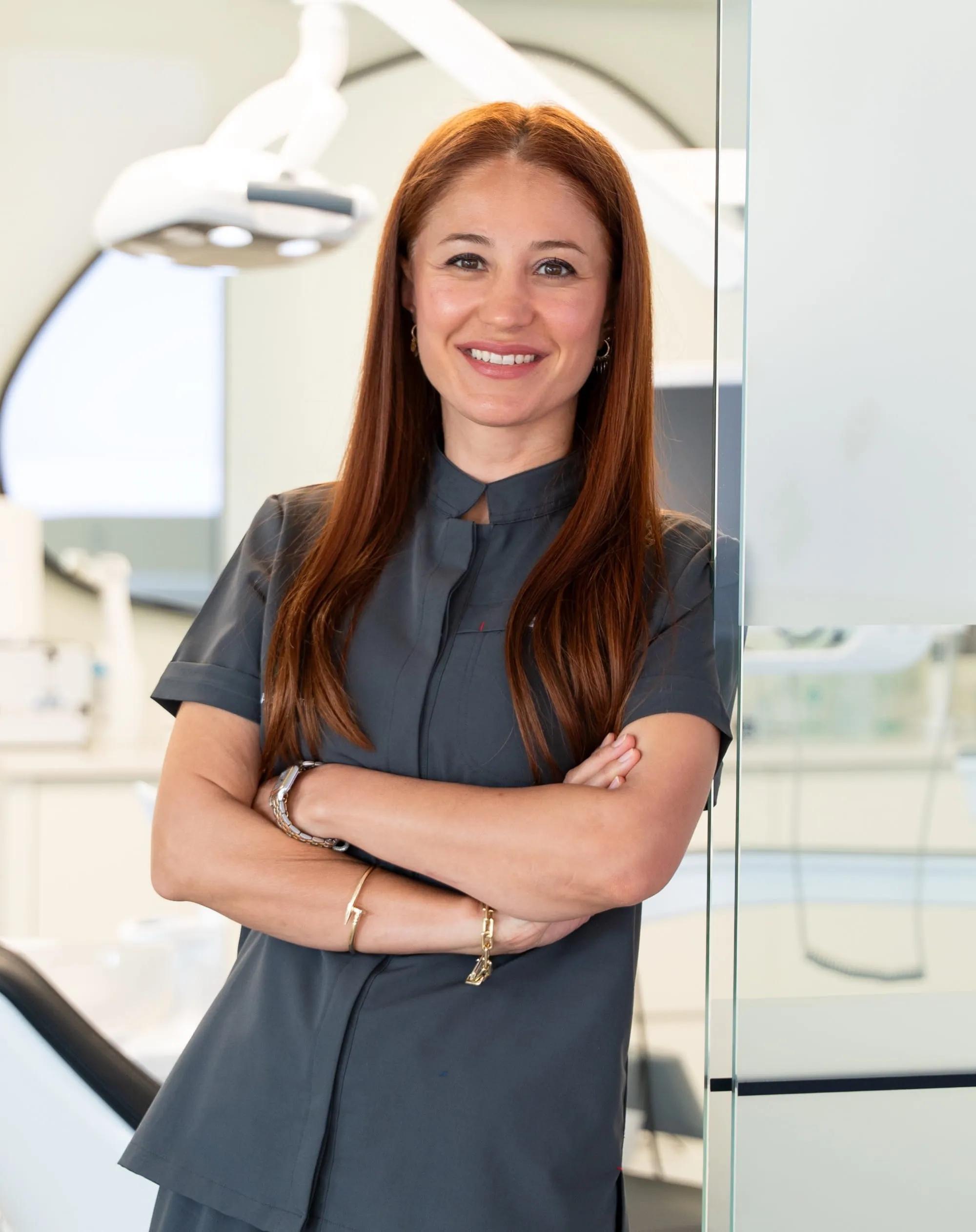
Dt. Dilek AKSU GÜLER
Dentist · Founder
She has completed advanced training in implantology and works in aesthetic restorations and smile design.
Sources
- Physical and mechanical properties of 3D-printed provisional crowns and fixed dental prosthesis resins compared to CAD/CAM milled and conventional provisional resins: a systematic review and meta-analysis. Polymers (Basel) 2022;14(13):2691 (Jain S, Sayed ME, Shetty M, et al.). 2022.↩doi.org
- Understanding your Endodontic (Root Canal) Treatment: information for patients (leaflet LN006096). Leeds Teaching Hospitals NHS Trust, Leeds Dental Institute (UK); 1st edition version 1, publication date 04/2026, review date 04/2029. 2026.↩flipbooks.leedsth.nhs.uk
- Quality guidelines for endodontic treatment: consensus report of the European Society of Endodontology. European Society of Endodontology (ESE); International Endodontic Journal 2006;39(12):921-930. 2006.↩doi.org
- Dentures (false teeth). NHS (England). 2025.↩nhs.uk
- Opinion on the safety of dental amalgam and alternative dental restoration materials for patients and users (update). European Commission, Scientific Committee on Emerging and Newly Identified Health Risks (SCENIHR); adopted at the 10th plenary, 29 April 2015. 2015.↩health.ec.europa.eu
- Survival and complication rates of ceramic laminate veneers by material: systematic review and meta-analysis (29 studies). Journal of Esthetic and Restorative Dentistry 2025;37(3):601-619. 2025.↩doi.org
- Trends in computer-aided manufacturing in prosthodontics: a review of the available streams. International Journal of Dentistry 2014;2014:783948 (Abduo J, Lyons K, Bennamoun M). 2014.↩doi.org
- IPS e.max CAD product information. Ivoclar.↩ivoclar.com
- Clinical performance of screw- versus cement-retained implant-supported fixed reconstructions: consensus statements and treatment guidelines (5th ITI Consensus Conference 2013). International Team for Implantology, ITI Academy consensus database; print: Int J Oral Maxillofac Implants 2014;29 Suppl:137-40 (Wismeijer D et al.). 2014.↩academy.iti.org
- Excess cement and the risk of peri-implant disease: a systematic review (26 publications). Clinical Oral Implants Research 2017;28(10):1278-1290. 2017.↩doi.org
- Accuracy of digital versus conventional implant impressions in partially dentate patients: a systematic review and meta-analysis. Journal of Dentistry 2025;160:105918 (Park JS, Alshehri YFA, Kruger E, Villata L). 2025.↩doi.org
- Intraoral scanners in dentistry: a review of the current literature. BMC Oral Health 2017;17(1):149 (Mangano F, Gandolfi A, Luongo G, Logozzo S). 2017.↩doi.org
- A review of 3D printing in dentistry: technologies, affecting factors, and applications. Scanning 2021;2021:9950131 (Tian Y, Chen C, Xu X, Wang J, Hou X, Li K, Lu X, Shi H, Lee ES, Jiang HB). 2021.↩doi.org
- Sinus lift procedures (patient information leaflet, document 101925, version 3). Cambridge University Hospitals NHS Foundation Trust (UK), Oral and Maxillofacial Surgery, approved 15 July 2024, accessed 2 October 2026. 2024.↩cuh.nhs.uk
- Long-term effectiveness of maxillary sinus floor augmentation: systematic review and meta-analysis (11 prospective studies, follow-up at least 5 years). Journal of Clinical Periodontology 2019;46 Suppl 21:307-318. 2019.↩doi.org
- Comparison of a subepithelial connective tissue graft and a xenogeneic collagen matrix in combination with a coronally advanced flap for gingival recession coverage with 12-month follow-up: a systematic review and meta-analysis. Medicina (Kaunas) 2025;61(9):1596 (Pranckeviciene A et al.). 2025.↩doi.org
- Xenogeneic collagen matrix vs. connective tissue graft for the treatment of multiple gingival recession: a systematic review and meta-analysis. Odontology 2024;112(2):317-340 (Zegarra-Caceres L et al.). 2023.↩doi.org
- Periodontal (gum) surgery: Overview and Recovery (patient information, resource 2850/VER6). Guy's and St Thomas' NHS Foundation Trust (UK), last reviewed June 2026, accessed 2 October 2026. 2026.↩guysandstthomas.nhs.uk
- Endodontic S3-level clinical practice guidelines: the European Society of Endodontology process and recommendations. British Dental Journal 2025;238(7):580-586 (Duncan HF, El-Karim I et al.); open access (CC BY 4.0). 2025.↩doi.org
- NHS: Dental abscess. NHS (nhs.uk). 2026.↩nhs.uk
- Allergenic and cytotoxic potential of (meth)acrylate monomers in dental materials: a narrative review. Frontiers in Dental Medicine 2026;7:1846292 (Smidtas L, Johnson J, Pacheco RR, Jauregui C). 2026.↩doi.org
- Prevalence of metal allergy in patients treated with intraoral prostheses and restorations: a systematic review and meta-analysis. Journal of Prosthetic Dentistry 2026;136(2):e115-e128 (Afroz S, Amina A, Ansar H, Samreen A, Yusufi FNK, Rahman SA). 2026.↩doi.org
- The German S3 guideline on titanium hypersensitivity in implant dentistry: consensus statements and recommendations. International Journal of Implant Dentistry 2022;8(1):51. 2022.↩doi.org
- Tıbbi Cihaz Yönetmeliği (Medical Device Regulation, Turkey; consolidated text). Türkiye İlaç ve Tıbbi Cihaz Kurumu (TİTCK); Resmî Gazete 2/6/2021 No 31499 (mükerrer), amended RG 29/7/2022-31907, 2/4/2023-32151, 17/8/2024-32635. 2021.↩mevzuat.gov.tr
- Ağız ve Diş Sağlığı Hizmeti Sunulan Özel Sağlık Kuruluşları Hakkında Yönetmelik (consolidated text). T.C. Sağlık Bakanlığı; Resmî Gazete 6/10/2022 No 31975, amended RG 5/3/2024-32480 and 15/12/2024-32753. 2022.↩mevzuat.gov.tr
- Hasta Hakları Yönetmeliği (consolidated text). T.C. Sağlık Bakanlığı; Resmî Gazete 1/8/1998 No 23420, amended RG 8/5/2014-28994, 23/12/2016-29927, 16/1/2019-30657. 1998.↩mevzuat.gov.tr
- Uluslararasi Saglik Turizmi ve Turistin Sagligi Hakkinda Yonetmelik. T.C. Saglik Bakanligi, Resmi Gazete 26/4/2025, No 32882. 2025.↩resmigazete.gov.tr