
What is e.max?
In dentistry, e.max is the name most often used for lithium disilicate, a glass ceramic that contains no metal. It is the name of a material, not of a treatment. The same material can be used for a veneer or for a crown. A veneer mainly covers the front of the tooth; a crown covers the whole tooth. Which one suits you depends on the state of your tooth.
For crowns and for most veneers, tissue is removed from the tooth, and that tissue does not grow back1. In some selected cases a veneer can be made without removing any tooth tissue. This does not suit everyone, and it does not mean the procedure can be undone.
This distinction matters. Putting a crown on a healthy tooth means removing far more tooth tissue than a veneer would. If you are offered a crown, ask why. The tooth should have a large loss of structure, a fracture or a weakness that cannot be protected another way.
The name comes from a manufacturer's product family, IPS e.max. On this page it means lithium disilicate restorations. These are not zirconia, and they are not the same as zirconia-reinforced lithium silicate ceramics2.
This page is written for readers who live outside Turkey and are considering treatment at our clinic in Antalya, Turkey. On this page, "we" means that clinic. The section "If you are coming from abroad" covers appointments, flying and aftercare at home.
- e.max is a ceramic material, not a treatment; both veneers and crowns are made with it.
- A crown needs far more tooth tissue removed than a veneer; the tissue removed does not grow back.
- In studies, most ceramic veneers are still in the mouth after 10 years; this does not mean no problem arose during that time.
Who it suits, and who it does not
Where it may be suitable
- Discolouration that whitening does not improve
- Small chips, wear or irregular shapes on front teeth
- Gaps between teeth small enough not to need orthodontic treatment
- Teeth with a large loss of structure or a fracture that need protecting with a crown
Where it is not suitable, or another treatment comes first
- Healthy, well-shaped teeth where only the colour bothers you. Teeth whitening should be considered first; veneers come into question only if whitening does not give enough.
- Marked crowding or a bite problem. Rather than correcting teeth by cutting them down, orthodontic treatment should be considered first.
- Untreated gum disease or decay. These are treated first.
- Severe clenching or grinding. The risk of the ceramic fracturing increases, and for some people these restorations may not be suitable. Your dentist may choose another material or recommend a night guard; a night guard may reduce the risk, but it does not remove it.
- Not enough enamel. Veneers hold most reliably when they are bonded to enamel. Where a veneer has to be bonded to the tissue beneath the enamel (dentine), the risk of failure is higher3. This needs assessing tooth by tooth.
- Long bridges and heavy chewing loads at the back of the mouth. Here zirconia or metal-ceramic restorations may be considered, depending on the bridge design and the bite.
Where it has limits
- Very dark teeth. Thin, translucent veneers may not mask the colour well enough. More opaque options are considered; these may need more tissue removed.
The right option is decided at an examination, with X-rays assessed where needed.
What can be done instead of a veneer or crown?
A veneer or crown is not the only option, and often it should not be the first.
- Doing nothing. If your teeth are healthy and your concern is only about how they look, leaving them alone is always an option.
- Teeth whitening. For concerns about colour, it can work without removing any tooth tissue. It works on natural teeth only: whitening does not lighten crowns or veneers4.
- Shaping with composite (bonding). Used for small chips and gaps; often little or no tooth tissue is removed. It stains more easily than ceramic and is easier to repair if damaged1. It should not be thought of as fully reversible: the tooth surface is treated so the material can bond.
- A filling or a partial restoration. An inlay fills a cavity inside the tooth; an onlay also covers weakened cusps (the raised chewing points) where needed. If enough of the tooth remains, these can take the place of a full crown. Having had root canal treatment does not on its own mean a full crown is needed.
- Orthodontic treatment. May correct the alignment of the teeth.
- Another ceramic. Zirconia may be preferred for back teeth and bridges, and hand-layered feldspathic porcelain for thin veneers.
Our pages on laminate veneers and dental crowns explain each type of restoration in more detail.
| e.max (lithium disilicate) | Zirconia | Metal-ceramic | |
|---|---|---|---|
| What it is | Glass ceramic with no metal | Ceramic with no metal, made from zirconium oxide | Porcelain on a metal framework |
| Where it is used most often | Veneers and single crowns | Crowns on back teeth, bridges, implant crowns | Back teeth and long bridges |
| Appearance | Translucent, close to a natural tooth | More opaque; newer types are more translucent | The metal framework can look dark at the gum line |
| Strength | High | Higher | High |
| Long-term data as a veneer | Yes | No | Not used |
How are e.max restorations made?
The treatment is usually completed in two or three appointments. How they fit a trip is covered in "If you are coming from abroad".
How much tissue is removed from the tooth depends on its colour, its position, any existing loss of structure and the restoration chosen. For the ceramic itself, the smallest thickness the manufacturer gives for its product is 0.4 mm for a veneer and 1 mm for a crown5. These are lower limits that apply only to particular products, designs and bonding methods set out in the manufacturer's instructions. Whether they apply to your tooth is decided by your dentist. They are not the amount of tissue removed from the tooth. Because a crown needs tissue removed from every surface of the tooth, the total loss is clearly greater than for a veneer.
Examination and planning
An examination, with X-rays where needed, assesses decay, the gums and the bite. Your medical history and medicines are reviewed too. If treatment is suitable, an impression or a digital scan of your teeth is taken. You may be able to try the result in your mouth with a temporary model (mock-up).
Preparing the tooth
Under local anaesthetic, the tooth is reduced just enough for the planned restoration. For a veneer, the aim is to keep the preparation within the enamel. An impression is taken. For crowns and deeper preparations, temporaries are fitted; very thin preparations may not need them.
Laboratory
The ceramic is pressed, or shaped from a ceramic block by a computer-controlled machine (CAD/CAM). Its colour and surface are worked to match the neighbouring teeth.
Try-in and bonding
Fit, colour and bite are checked in the mouth. Once you agree, the ceramic is bonded permanently to the tooth with a special adhesive. If you need a night guard, the impression for it is taken at this appointment.
Review
The bite and the fit at the gum are checked again, and you are given written advice on care. If you need a night guard, it is handed over.
Risks and benefits
Risks and disadvantages
- It cannot be undone. Tooth tissue that is removed does not grow back1; from then on, the treated tooth will always need a restoration.
- New decay. A veneer or crown does not protect the tooth beneath it from decay. New decay can develop at its edges or underneath it, and further treatment may be needed.
- Sensitivity. Sensitivity to heat and cold may follow the procedure; it usually eases within weeks.
- Fracture or cracking. Biting hard objects, clenching and knocks can break the ceramic. Small surface chips can sometimes be repaired; larger cracks and fractures may mean the restoration has to be replaced.
- Coming loose. This can happen with veneers, especially when they are bonded to the tissue beneath the enamel.
- Effect on the nerve. The deeper the preparation for a crown, the more likely the tooth is to need root canal treatment later.
- Staining at the edges and receding gums. Over the years, the edge of the restoration can become visible.
- Need for replacement. No veneer or crown lasts for ever. When the time comes it has to be replaced, and each replacement may take a little more tissue from the tooth.
Benefits
- With no metal framework, no metal edge shows. The colour of the tooth underneath, staining at the edges or receding gums can still make it look darker.
- It lets light through in a way similar to a natural tooth.
- Its surface stains less than composite.
- Veneers bonded to enamel have good long-term results (see "How long does it last?").
Recovery and daily care
After the procedure, wait until the anaesthetic has worn off before eating or drinking. Mild sensitivity and tender gums are normal in the first days.
Daily care
- Brush twice a day with a fluoride toothpaste, and clean between your teeth every day.
- Do not bite hard objects, and do not use your teeth as tools.
- If you clench or grind your teeth, wear the night guard your dentist recommends.
- Keep up regular check-ups with a dentist; small problems are easier to solve when they are found early.
How long does it last?
Studies do not give a lifespan in years. They report how many restorations are still in place after a period of time. The figures below come from published studies, not from our own records. They describe restorations staying in the mouth. They do not mean that no problem or repair was needed during that time.
Veneers
A 2025 review combining 29 studies found that, of every 100 lithium disilicate veneers, about 97 were still in the mouth after 10 years6. The same review found no significant difference in this respect between lithium disilicate and feldspathic porcelain. For zirconia veneers there were no long-term data. Another review, from 2024, looked at different glass-ceramic veneers together. After an average follow-up of 6.5 years, about 90 in every 100 veneers were still in the mouth7. The two results come from different studies, so they cannot be compared directly.
For veneers, keeping the enamel is one of the important factors. A retrospective study followed 580 porcelain veneers for up to 12 years. Veneers bonded to the tissue beneath the enamel had about 10 times the risk of failure3.
Crowns
For single crowns, the differences between the three materials below are small. A 2026 review reported how many of every 100 crowns were still in the mouth after five years: about 98 to 998 for monolithic (single-piece) lithium disilicate, 97 for metal-ceramic and 97 for monolithic zirconia. These estimates are for single crowns on natural teeth. In other words, "a stronger material" and "a restoration that stays in the mouth longer" are not the same thing.
When to contact a dentist
Contact a dentist if any of the following happens. While you are in Antalya, that is the clinic; once you are home, it is usually your own dentist.
- The veneer or crown cracks, breaks or moves
- It comes off (keep the piece, and do not glue it back yourself)
- Sensitivity that lasts more than a few weeks or keeps getting worse
- Pain that starts on its own or wakes you at night
- Swelling, bleeding or discharge from the gum
- It feels high when you bite, or your jaw feels tired
Emergencies. If pain is increasing, or you have facial swelling or a fever, see a dentist where you are without waiting for the clinic's reply. If you have difficulty breathing or swallowing, or swelling in the mouth or neck that spreads quickly, go to an emergency department. In an emergency, call the emergency number of the country you are in; in Turkey it is 112.
Before you fly home
Make sure your bite has been checked and that you have written care instructions. Take the written record of your treatment with you for your dentist at home. If you need a night guard, make sure it has been handed over.
Once you are home
If a problem comes up that is not urgent, write to the clinic and send photographs. Photographs do not replace an examination, so see your dentist at home as well. In the emergencies above, do not wait for a reply.
If you are coming from abroad
e.max veneers and crowns usually need two or three appointments. The ceramic is usually made in a laboratory between preparing the teeth and bonding it, and you may wear temporaries in between. The number of days in Antalya depends on how many teeth are treated and whether they are veneers or crowns. It also depends on whether anything is needed first, such as whitening, root canal treatment or treatment for decay or gum disease. Before you book, you receive a written preliminary plan with the appointments and how many days the treatment will take. It is based on your photographs, so the examination confirms or changes it, and with it the days and the cost. If it changes, you receive the revised plan in writing before treatment starts. You can say no, or ask to stop, at any stage. Once a tooth has been prepared, that step cannot be undone.
Flying. A 2023 review of flying after dental treatment suggests waiting at least 24 hours after restorative treatment9, and longer after surgical procedures. These times assume there is no pain, swelling or bleeding where you were treated. The authors note that the research is limited and comes mainly from military aviation. Treat it as a starting point for your dentist's advice, not as a rule.
Your dentist at home. Talk to your own dentist before you go. They need to know the plan in case problems come up later. If you do not have a dentist where you live, it helps to find one before you travel. Ask for a written record of the treatment to take back to them. It should show which teeth have veneers or crowns and the materials used. In Turkey, the health tourism regulation entitles international patients to an itemised bill. On request, they also get free copies of the records of the materials used, the tests and the imaging10.
Veneers and crowns need regular check-ups for as long as they are in the mouth. UK guidance (NICE) says the interval between check-ups should be set for each person according to their risk11; agree it with your dentist at home. Before you travel, check the rules of the health service or your insurer in the country where you live about care after treatment abroad.
Questions to ask before you commit. Before you agree to treatment abroad, ask:
- Who will carry out my treatment, and what are their qualifications?
- Are you regulated by a professional body and registered with it?
- Are the remake and correction terms in writing, and for how long do they apply?
- What aftercare do you provide, and who can I contact after the treatment?
- If there are complications, who pays for further treatment, extra flights and the hotel?
- Do you have a complaints system, and can I see a copy?
Before treatment, we give you in writing how complications are handled and the terms for remaking a veneer or crown. A longer list, with our answer to each question, is on our page about dental treatment abroad.
What determines the cost?
This page does not show prices. A treatment plan is prepared for you after an examination, with X-rays where needed. The main factors that shape it are:
- How many teeth need treatment, and which type of restoration (veneer or crown)
- Treatment needed first: decay, root canal treatment, gum treatment
- The ceramic used and the laboratory work
- A night guard, if needed
- The number of trips the appointments need
Ask for the plan in writing, including what it covers and what would be charged separately. Ask too who pays for further treatment and extra travel if there is a complication.
Frequently Asked Questions
What is the difference between e.max and zirconia?
Both are metal-free ceramics. e.max (lithium disilicate) is more translucent and is used for veneers and single crowns. Zirconia is stronger and more often chosen for back teeth and bridges. For single crowns on natural teeth, survival figures are close; the choice depends on the restoration and the bite.
I asked for veneers. Why was I offered an e.max crown?
A veneer needs a tooth with enough sound structure and enamel. If the tooth has a large loss of structure, a fracture or a weakness that a veneer cannot protect, a crown may be proposed. On a healthy tooth a crown removes far more tissue than a veneer, so ask your dentist to explain the reason for each tooth.
Does e.max treatment involve cutting the tooth?
In most cases, yes. For a veneer a thin layer is removed from the front of the tooth; for a crown, tissue is removed from every surface. In some selected cases a veneer can be made without removing tooth tissue, but not for everyone. Removed tissue does not grow back.
Does e.max stain or turn yellow?
The glazed ceramic surface stains less than composite. Staining over time is usually at the edge, where the adhesive is. Whitening does not lighten crowns or veneers, so tell your dentist if you plan to whiten your natural teeth.
Can e.max break?
Yes. Biting hard objects, clenching or grinding, and knocks can increase the risk. If you clench your teeth, tell your dentist; a night guard may be advised.
Can an e.max veneer fall off?
It can come loose, although this is uncommon. With veneers the risk rises when they are bonded to the tissue beneath the enamel, which is why keeping the preparation within the enamel matters. If it comes off, keep the piece, do not glue it back yourself, and see a dentist.
Is e.max mixed with zirconium?
IPS e.max CAD and Press are lithium disilicate ceramics. The listed composition of e.max CAD can include a small share of zirconium oxide among other oxides, but that does not make it zirconia. Neither e.max CAD nor Press is the same as the zirconia-reinforced lithium silicate ceramics, such as Celtra Duo and Vita Suprinity. Zirconium is a metal; dentistry uses its oxide, zirconia.
Can the tooth under an e.max crown or veneer decay?
Yes. A veneer or crown does not protect the tooth beneath it from decay. New decay can develop at its edges or underneath it, and further treatment may be needed. Daily cleaning between the teeth and regular check-ups matter.
How many days do I need to be in Antalya?
e.max veneers and crowns usually take two or three appointments, with laboratory time between preparing the teeth and bonding the ceramic. The number of days depends on how many teeth are treated and whether other treatment is needed first. Before you book, a written preliminary plan states the appointments and the number of days. It is made from photographs, so the examination confirms or changes it.
Will I need follow-up, and will that be in Turkey or at home?
Yes. Veneers and crowns need regular check-ups for as long as they are in the mouth. These are usually with a dentist where you live, at an interval set for your risk. Tell them about the treatment and bring the written record. For a problem that is not urgent, write to the clinic with photographs; for urgent symptoms, get local care first.
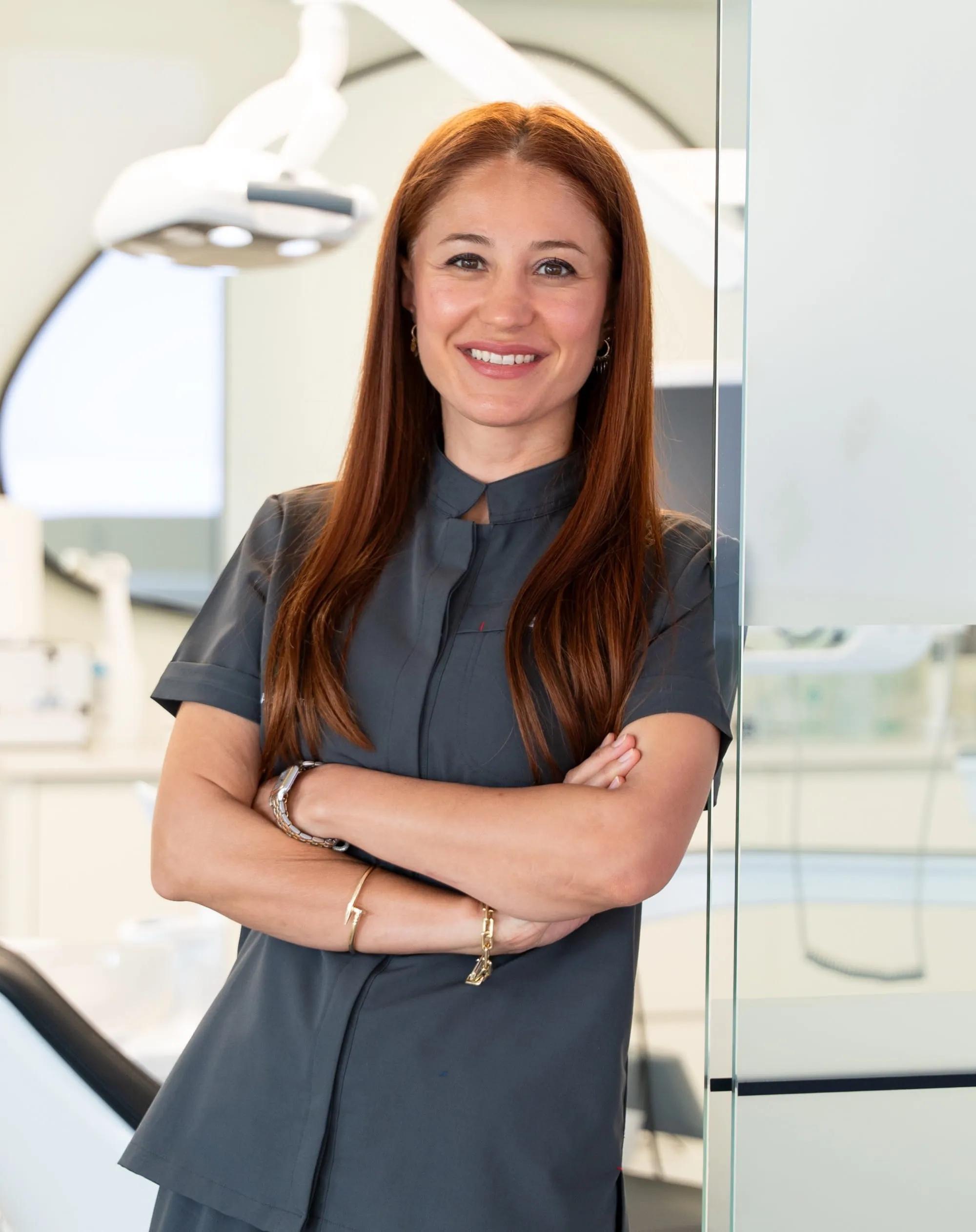
Dt. Dilek AKSU GÜLER
Dentist · Founder
She has completed advanced training in implantology and works in aesthetic restorations and smile design.
Sources
- Veneers. American Dental Association, MouthHealthy.↩mouthhealthy.org
- Lithium silicate-based glass ceramics in dentistry: a narrative review of composition and strength. Materials 2023;16(12):4398. 2023.↩doi.org
- Porcelain laminate veneers, 580 veneers up to 12 years: effect of preparation in enamel versus dentin. International Journal of Periodontics & Restorative Dentistry 2013;33(1):31-39. 2013.↩doi.org
- Teeth Whitening (patient information). American Dental Association, MouthHealthy.↩mouthhealthy.org
- IPS e.max CAD product information. Ivoclar.↩ivoclar.com
- Survival and complication rates of ceramic laminate veneers by material: systematic review and meta-analysis (29 studies). Journal of Esthetic and Restorative Dentistry 2025;37(3):601-619. 2025.↩doi.org
- Clinical survival of glass-ceramic restorations: meta-analysis of 46 articles. Journal of Prosthetic Dentistry 2024;132(5):879.e1-e13. 2024.↩doi.org
- Survival of monolithic lithium disilicate, monolithic zirconia and metal-ceramic single crowns: systematic review. International Journal of Prosthodontics 2026;39(3):308-324. 2026.↩doi.org
- Dental tourism and the risk of barotrauma and barodontalgia (narrative review with guiding principles). British Dental Journal 2023;234(2):115-117. 2023.↩doi.org
- Uluslararasi Saglik Turizmi ve Turistin Sagligi Hakkinda Yonetmelik. T.C. Saglik Bakanligi, Resmi Gazete 26/4/2025, No 32882. 2025.↩resmigazete.gov.tr
- Dental checks: intervals between oral health reviews (clinical guideline CG19). National Institute for Health and Care Excellence, published 27 October 2004. 2004.↩nice.org.uk