
How do I choose a clinic for veneers or crowns?
Judge the clinic by how it plans your teeth, not by its adverts. A careful clinic examines you before it proposes anything, treats decay and gum disease first, asks whether you clench or grind, starts from the option that removes the least tooth, and explains each material with its limits. It chooses the shade with you, and it tells you in writing who deals with a chip or a veneer that comes off.
Adverts cannot show you any of this. A before-and-after photo shows one patient's result under conditions you cannot check. Treatment on healthy front teeth also cannot be undone: enamel removed for a veneer does not grow back1. That is why the planning conversation matters more than the pictures.
- Judge the clinic by its examination and plan, not by adverts or before-and-after photos.
- A careful plan treats decay and gum disease first, checks for grinding and starts from the option that removes the least tooth.
- Ask how the shade will be chosen, what each material can and cannot do, and who deals with problems afterwards, in writing.
What adverts and photos can and cannot tell you
In Turkey, covert or overt advertising of health services is prohibited2; clinics may promote and inform only within set principles. Among them, promotion may not be built on patients' thanks or satisfaction and may not give prices, discounts or campaigns. The Turkish Dental Association's guide also forbids wording that implies a clinic, its staff or its devices are superior3. Clinics authorised for international health tourism may run sponsored promotion on separate platforms aimed abroad2, with some rules of their own. Whatever the channel, "the best clinic", a ranking or a stream of glowing testimonials tells you nothing you can use about your own treatment.
Before-and-after photos. The Ministry's guidance on the regulation says patient images need the patient's explicit consent4, may not be technically altered afterwards, and before-and-after pairs should be taken under the same conditions and shown with the treatment and photo dates. Even a correct photo has limits:
- It shows another person's teeth, gums and bite, not yours.
- It shows the day of the result, not how the teeth look years later.
- It does not show how much tooth was removed, whether the teeth received veneers or crowns, or whether a gentler option would have done.
Titles. Cosmetic dentistry is not one of the nine dental specialties in Turkish law, and specialist titles based on certificates are not allowed under any name2. If someone is called a cosmetic or aesthetic "specialist", ask what that rests on; our article on dental titles explains them. Our article on choosing a dental clinic explains how to check a clinic's licence and a dentist's working certificate.
How a careful clinic plans cosmetic work
- An examination first. A plan made from photos is a preliminary idea. The dentist needs to examine your teeth, with X-rays where needed, to judge how much sound tooth there is and what preparing it would risk. Ask how much healthy tooth would be removed, and what that means for sensitivity and the nerve of the tooth. Our consultation checklist explains what a consultation covers.
- Decay and gums before cosmetic work. Problems such as decay and gum disease are treated before veneers5, and veneers may not suit people with a deep bite or gum disease.
- Your bite and grinding. Clenching or grinding raises the risk of a veneer breaking. In a small retrospective study, among 30 patients with bruxism, those who wore a night guard had fewer fractures6. A guard may lower the risk; it does not remove it. A clinic that does not ask about grinding has missed a question.
- The least removal first. A plan should start from the option that removes the least tooth: doing nothing, whitening, bonding or orthodontic treatment before veneers, and veneers before crowns on a healthy tooth. Our article on "Turkey teeth" lists the questions to ask for each tooth.
- Whitening before the shade is set. Whitening does not lighten crowns, veneers or fillings as it does natural teeth7, and a veneer's colour cannot be changed after it is bonded5. If you want whiter natural teeth as well, say so before the shade is chosen.
- A shade chosen with you. Most often the dentist compares your teeth with tabs from a shade guide. Two meta-analyses found that standardised photos8 usually matched the target shade more closely than the eye alone. They disagreed on measuring devices9, intraoral scanners were no better than the eye, and the studies were few and small. Light affects the match too10. Ask how the shade will be taken and whether you will see it next to your teeth. Our tooth shade guide explains how it is chosen.
- A preview before any tooth is prepared. Ask whether you can see the planned shape in your mouth while the choice is still open.
Material claims to question
Every material has strengths and limits. A clinic that presents one material as right for everyone, or as lasting for life, is selling, not explaining.
- Ceramic veneers. In pooled studies, about 94 to 97 in 100 ceramic veneers were still in place after ten years11. "Still in place" does not mean never repaired.
- Composite (resin) veneers. They may need less enamel removed and are easier to fix if damaged1, but they are less resistant to staining and wear than porcelain. Neither "composite lasts as long as porcelain" nor "porcelain always lasts longer" has been proven for every patient.
- Zirconia veneers. There are no long-term data11: the studies so far followed them for an average of 2.6 years.
- Crowns. A 2026 review of single crowns on natural teeth found about 97 to 99 in 100 still in place after five years12 for monolithic lithium disilicate, monolithic or layered zirconia and metal-ceramic, and the monolithic crowns had fewer fractures and chips than layered ones. These figures do not apply to bridges or crowns on implants. Our zirconia crowns page and our article on zirconia or porcelain crowns compare crown materials, and our article on crowns or veneers explains which a tooth needs.
Ask the dentist why they suggest this material for this tooth, and what it would mean if it chipped.
What to agree about afterwards
Any veneer, composite or porcelain, may chip, crack, wear or loosen over time1 and need to be re-bonded, repaired or replaced. Before you start, ask:
- who deals with a chip, a crack or a restoration that comes off, how quickly, and on what written terms
- what is expected of you, such as check-ups, cleaning along the edges every day, or wearing a night guard
- for your copy of the consent form, which is signed in two copies13, and later for your records: X-rays, the plan, what was done to each tooth, and the material and shade used
These records give another dentist what they need to assess your teeth later.
Reasons to slow down
- A plan for a set number of teeth, the same treatment on every tooth, or a package.
- Crowns proposed for healthy teeth, with no reason given for each one.
- Nobody asks about grinding, gum disease or decay.
- A material presented as lasting for life.
- Before-and-after photos with no dates, or a promise that you will look like them.
- No clear answer to "what happens if it breaks?"
None of these proves a clinic is wrong. Each is a reason to ask more and, if you are unsure, to get a second opinion.
When to see a dentist
A dentist's examination is the right start before any cosmetic treatment. If you already have veneers or crowns, see a dentist if:
- one is loose, chipped or has come off (keep it, and do not glue it back yourself)
- a tooth becomes painful when you bite, or sensitive for more than a few days
- the gums around a restoration bleed, swell or recede
Swelling, pus or a bad taste near a restored tooth can mean an infection: see a dentist urgently, the same or the next day.
Emergencies. Difficulty breathing or swallowing, rapidly spreading swelling of the face or neck, a high fever or swelling around the eye are serious signs. Go to the nearest emergency department or call 112.
Ask us before you decide
Send us a photo of your teeth and tell us what bothers you, or send a plan you were given. Our dentists will answer with the options, starting from the one that removes the least.
Frequently asked questions
Can I trust before-and-after photos?
They show another person's result on one day. Under the Ministry's guidance they should be unaltered, taken under the same conditions and dated. Even then they cannot show how much tooth was removed or how your teeth would respond.
Why doesn't a clinic advertise prices or discounts?
Health promotion in Turkey may not give prices, discounts or campaigns, may not rest on patients' thanks, and should not claim superiority; clinics authorised for health tourism have some separate rules abroad. Ask for a written plan for your own teeth instead.
Should I whiten my teeth before veneers?
If you want whiter natural teeth too, tell your dentist before the shade is chosen. Whitening does not lighten veneers or crowns later, and their colour cannot be changed once they are bonded.
Is composite or porcelain better?
Neither is best for everyone. Composite may need less enamel removed and is easier to repair; porcelain resists staining and wear better. Your teeth, bite and habits decide, so ask why one is suggested for you.
What should the clinic give me in writing?
The plan tooth by tooth, your copy of the consent form, and later your X-rays and a record of what was done, with the material and shade. Ask also for the terms on repairs.
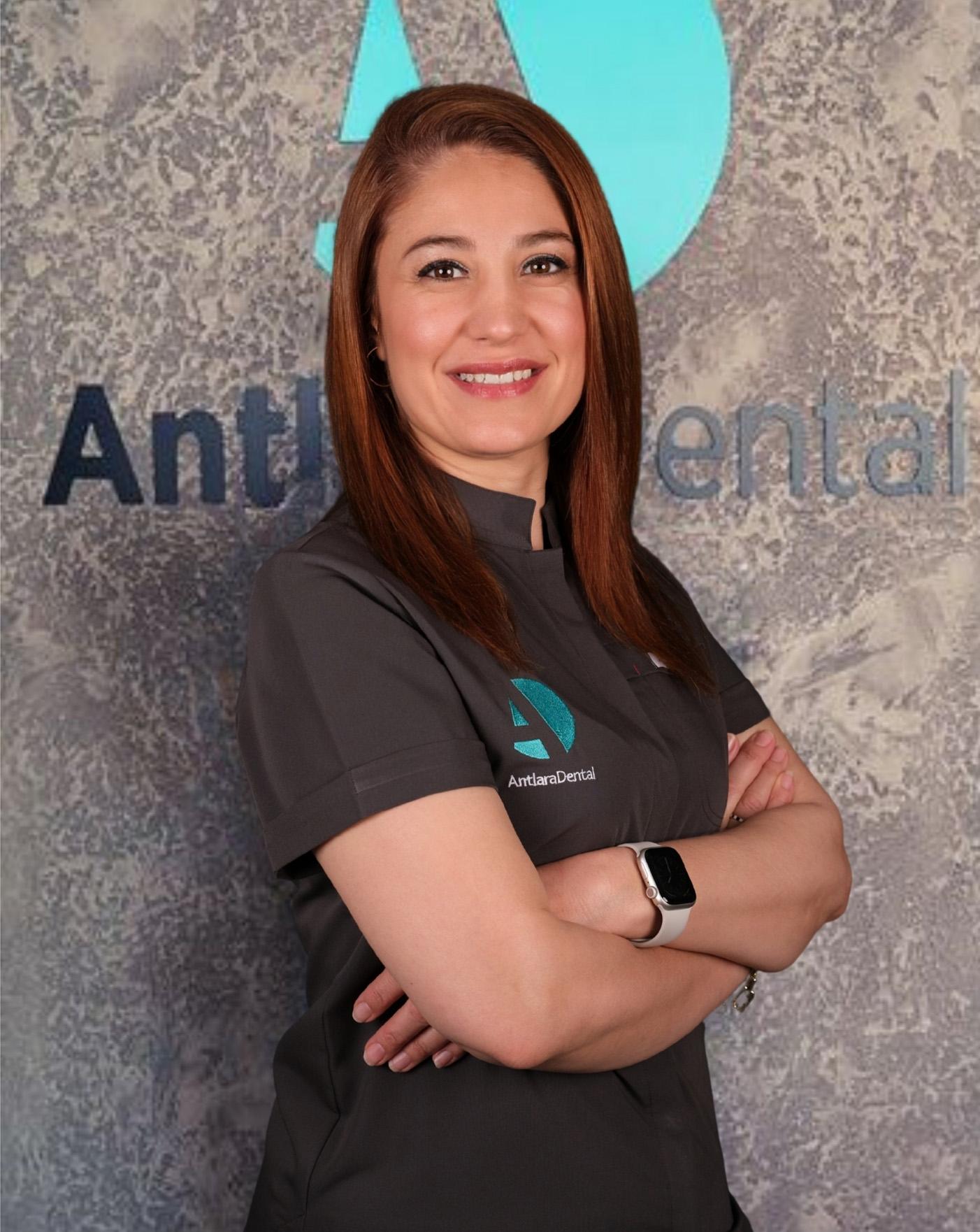
Dt. Dilek AKSU GÜLER
Dentist · Co-founder
Dt. Dilek Aksu Güler graduated from Süleyman Demirel University Faculty of Dentistry in 2005 and is the founding dentist of Antlara Dental in Lara, Antalya. She focuses on aesthetic restorations (veneers and crowns), digital smile design and implant-supported prostheses, and speaks Turkish, English and German.
Sources
- Veneers. American Dental Association, MouthHealthy.↩mouthhealthy.org
- Sağlık Hizmetlerinde Tanıtım ve Bilgilendirme Faaliyetleri Hakkında Yönetmelik. T.C. Sağlık Bakanlığı; RG 12/11/2025 No 33075. 2025.↩resmigazete.gov.tr
- Dişhekimlerinin Her Türlü İletişim Ortamında Yayın Yapmalarına İlişkin Kılavuz. Türk Dişhekimleri Birliği, Merkez Yönetim Kurulu kararı 4 Mar 2026. 2026.↩tdb.org.tr
- Sağlık Hizmetlerinde Tanıtım ve Bilgilendirme Faaliyetleri Hakkında Sıkça Sorulan Sorular. T.C. Sağlık Bakanlığı, Sağlık Hizmetleri Genel Müdürlüğü, Denetim ve Değerlendirme Dairesi; announcement 17 Nov 2025. 2025.↩dosyamerkez.saglik.gov.tr
- Veneers. healthdirect Australia (government-funded health information), last reviewed February 2025. 2025.↩healthdirect.gov.au
- Porcelain veneers in patients with bruxism: 323 veneers in 70 patients, 3-11 years. Medicina Oral Patologia Oral y Cirugia Bucal 2014. 2014.↩pmc.ncbi.nlm.nih.gov
- Teeth Whitening (patient information). American Dental Association, MouthHealthy.↩mouthhealthy.org
- Color difference for shade determination with visual and instrumental methods: a systematic review and meta-analysis. Syst Rev 2023;12(1):95. 2023.↩doi.org
- Novel trends in dental color match using different shade selection methods: a systematic review and meta-analysis. Materials (Basel) 2022;15(2):468. 2022.↩doi.org
- Shade matching performance of normal and color vision-deficient dental professionals with standard daylight and tungsten illuminants. J Prosthet Dent 2010;103(3):139-47. 2010.↩doi.org
- Survival and complication rates of ceramic laminate veneers by material: systematic review and meta-analysis (29 studies). Journal of Esthetic and Restorative Dentistry 2025;37(3):601-619. 2025.↩doi.org
- Survival of monolithic lithium disilicate, monolithic zirconia and metal-ceramic single crowns: systematic review. International Journal of Prosthodontics 2026;39(3):308-324. 2026.↩doi.org
- Hasta Hakları Yönetmeliği (consolidated text). T.C. Sağlık Bakanlığı; Resmî Gazete 1/8/1998 No 23420, amended RG 8/5/2014-28994, 23/12/2016-29927, 16/1/2019-30657. 1998.↩mevzuat.gov.tr