
Role of a dental laboratory
A dental laboratory makes the parts of your treatment that are made to measure outside the mouth. Examples are crowns, bridges, veneers, inlays, onlays, dentures and the teeth fixed on implants. The people who make them are dental technicians. In the UK, the General Dental Council (GDC) regulates dental technicians. Its guidance says they construct custom-made dental devices to the prescription of a dentist1 or clinical dental technician. That guidance is written for dental professionals registered in the UK.
The dentist examines you, plans the treatment with you, prepares the teeth, records them and writes the prescription. The laboratory makes the restoration to that prescription. The dentist then checks it in your mouth, fits it and checks it again at a later review. In Great Britain, the Medicines and Healthcare products Regulatory Agency (MHRA) publishes guidance on custom-made devices. Its example for dentistry is dental appliances, prescribed by a dentist and made by dental laboratories2.
Some clinics have their own laboratory; others send the work to an outside one. Ask which applies to your treatment, and where the laboratory is.
On this page, "we" and "our clinic" mean our clinic in Antalya, Turkey.
- A dental laboratory makes crowns, bridges, veneers, inlays, dentures and other custom-made devices to a dentist's written prescription.
- The dentist diagnoses, plans the treatment with you, prepares the teeth and fits the restoration. The laboratory makes it to the prescription and checks it before it leaves.
- The shade is usually chosen with a shade guide in good light and sent with photographs. A 2025 review advised against choosing it with an intraoral scanner, though its evidence was of very low certainty.
- Turkey's medical device rules require the maker of a custom-made device to draw up a statement that identifies the device, the patient and the prescriber. The statement goes with the device. The rules do not say that you receive a copy, so ask for one.
- Ask who makes your restoration and where, from which material, and what happens if it does not fit.
Clinical prescription and records
The prescription is the dentist's written instruction to the laboratory. In Great Britain, MHRA guidance says a written prescription may take the form of a letter2, or of an impression sent with an order. The technician can only make what the prescription and the records show.
What usually goes to the laboratory
- What to make: the type of restoration, the teeth involved and the material.
- A record of the prepared teeth and their neighbours: an intraoral scan, or an impression or a model made from it.
- The opposing teeth and your bite, so that the restoration meets the teeth it bites against.
- The shade, usually with photographs (see "Shade and aesthetic communication").
- For implant work, the implant system and the position of each implant.
- Other instructions, for example on shape, length, the edges and how the restoration will be fixed.
When the laboratory needs more
A scan records only what the scanner can see. If the file reaches the laboratory while you are still at the clinic, the technician can ask straight away for another scan3. A problem found later may mean another visit. Our digital scanning page explains how scans are taken and checked.
Ask whether you can see the prescription, or a summary of it, and keep a copy with your records.
Digital and conventional workflows
Laboratories work in two broad ways, and many combine them.
Conventional
A 2014 review describes the conventional route: an impression is taken, a stone model is poured and a wax pattern is made4. The wax is then replaced with metal, ceramic or acrylic4. Porcelain can also be built up in layers by hand, and some ceramics are pressed.
Digital
When the work starts from a scan, no plaster model is needed3. The file can be sent to the laboratory electronically3. The restoration is designed on a computer and then milled from a block or 3D-printed. A model can still be printed when one is needed. A 2021 review names working models for diagnosis and surgery5 as the most common use of 3D printing in dentistry.
Mixing the two
An impression or a plaster model can be scanned to give a digital file5, so a conventional start can lead to digital manufacture. A milled core can also be finished with porcelain layered by hand.
Which route is used depends on the restoration, the material and the equipment of the clinic and the laboratory. Neither route suits every case. Our CAD/CAM page explains digital design and manufacture, and what studies show about restorations made this way.
Material and design selection
The dentist chooses the material with you. The choice depends on the tooth, your bite and the appearance you want. The technician can advise: the GDC lists advice and guidance to the clinical team on dental appliance design1 among a dental technician's usual tasks.
The dentist and the laboratory also settle the design:
- the shape and length of the teeth;
- the thickness of the material;
- where the edge of the restoration sits;
- the contacts with the neighbouring teeth;
- how the restoration meets the opposing teeth.
Each material needs a minimum thickness. Where there is not enough room, a 2014 review says a change to the tooth preparation can be recommended4. That is a decision for the dentist, with you.
Products differ, even within one material. In a review of laboratory tests, lithium-based blocks from different manufacturers differed in composition and strength6. Ask for the material, the product name and the manufacturer of each restoration in writing.
Our pages on zirconia (often called zirconium) and lithium disilicate explain two of the ceramics that laboratories use.
Production stages
The steps depend on the restoration and the material. The outline below is typical for a crown or bridge, and our dental crowns page explains the treatment itself. According to a 2014 review, milling is the most widely used computer-aided manufacturing method in dentistry4. Pressing, casting and building up porcelain by hand are also used. Some ceramics are fired after milling. For example, some lithium disilicate blocks are fired to reach their final strength, shade and translucency6.
For complete dentures, the work goes back and forth between the clinic and the laboratory. An NHS hospital leaflet from Leeds describes the stages. They include two sets of impressions, a bite record and a trial fit with some parts of the dentures in wax7. It notes that a second trial fit is often needed7, before the fitting and reviews. Our dentures page explains the treatment.
Checking what has arrived
The technician checks the prescription, the scan or impression, the bite record and the shade information. Anything missing or unclear goes back to the dentist as a question.
The model
A model of your teeth is poured in stone from the impression or printed from the scan. Sometimes the work is done on the digital model alone.
Design
The restoration is designed on a computer, or modelled in wax by hand, to fit the prepared tooth, its neighbours and your bite.
Making it
Depending on the material, it is milled from a block, 3D-printed, pressed, cast in metal or built up in layers of porcelain.
Firing and finishing
Some ceramics are fired in a furnace. Colour can be added with stains, and the surface is glazed or polished.
Checks before it leaves
The fit on the model, the edges, the contacts, the bite, the thickness and the colour are checked before the restoration goes to the clinic.
Try-in and fitting
The dentist checks the fit, the bite and the colour in your mouth, adjusts the restoration if needed and fixes it in place.
Shade and aesthetic communication
The technician usually cannot see your teeth, so the colour has to travel with the prescription.
Shade guides and codes
Most often the dentist holds tabs from a shade guide next to your teeth and records the closest one. Two widely used guides come from the same maker. One has 16 tabs; the other has 26 tabs and chooses the shade in three steps8. A code such as A2 only means something together with the guide it comes from.
No guide covers every natural tooth colour. A 2023 review notes that the available shade guides do not represent the true colours of teeth9. The code is a starting point for the technician, not an exact colour.
Photographs and instruments
Photographs of the chosen tab held next to your teeth show what a code cannot, such as translucency and the look of the neighbouring teeth. Choosing a shade by eye alone is subjective: a 2024 review advises clinicians not to rely on their senses alone8.
Two meta-analyses compared methods. One found that shades taken with instruments, such as spectrophotometers and cameras, were on average closer to the target than shades chosen by eye9. The other found that digital photographs reduced the colour difference, but that a spectrophotometer had no advantage over shade guide tabs10. Both were based on few, mostly small studies.
A 2025 review advised against choosing the shade with an intraoral scanner11, although its evidence was of very low certainty.
Light, whitening and who takes the shade
- Light. In a laboratory study, dentists with normal colour vision matched shades better under a standard daylight lamp than under a tungsten bulb12.
- Whitening. The American Dental Association, in the US, says that whitening will not work on caps, veneers, crowns or fillings13. If you want lighter teeth, say so before the shade is chosen.
- Who takes the shade. Usually the dentist. In the UK, GDC guidance lets dental technicians see patients directly, outside a dental team setting, only for denture repairs and shade taking1.
Ask to see the chosen tab next to your own teeth. For front teeth, ask whether the shape and colour can be tried in your mouth before the restoration is finished.
Fit and quality checks
Checks happen in the laboratory and again in your mouth.
In the laboratory
In the UK, a dental technician's usual tasks include verifying and taking responsibility for the quality and safety1 of devices leaving a dental laboratory, according to the GDC. Before a restoration leaves, the technician checks it on the model. The checks cover the fit at the edges, the contacts, the bite, the thickness, the surface and the colour.
At the clinic
- Try-in. The dentist checks the fit, the edges, the bite and the colour in your mouth, and adjusts the restoration if needed.
- Fitting. The restoration is cemented, bonded or screwed in place, and the bite is given a final check.
- Review. At a later appointment, the fit at the gum and the bite are checked again.
A model is not your mouth. The fit and the bite can only be fully judged in your mouth, and so can the shape and colour of front teeth. That is why the try-in matters.
Adjustments have limits. For zirconia, a 2014 review warns that adjusting it after sintering can weaken it4. Sintering is the furnace firing that gives zirconia its final size and strength. It says zirconia restorations should be made accurately so that hand adjustment is not needed4. In laboratory studies, a smooth polish increased the strength of zirconia, while coarse grinding reduced it14. If a zirconia restoration is adjusted, ask how the adjusted surface will be finished.
Traceability and documentation
The GDC calls what dental technicians make to a prescription custom-made dental devices1. Medical device rules say what records go with them.
In Turkey
Turkey's medical device regulation was prepared in line with EU legislation15, including the EU Medical Device Regulation. It defines a custom-made device as one made for a particular patient to a written prescription that gives specific design characteristics under the prescriber's responsibility15.
The maker draws up a statement before placing the device on the market15, and the device is accompanied by that statement15. The statement includes:
- the name and address of the manufacturer and of all its manufacturing sites;
- data that identify the device;
- that the device is for one patient, identified by name, initials or a code;
- the name of the person who wrote the prescription and, where applicable, their health institution;
- the characteristics of the device as prescribed;
- a declaration that it meets the regulation's general safety and performance requirements or, where some are not fully met, which ones and why.
The statement is kept for at least 10 years after the device is placed on the market, or 15 years for an implantable device15. The regulation does not say in so many words that you receive a copy, so ask for one.
Turkey's health tourism regulation entitles international patients, on request, to free copies of the records of the materials used16, the tests and the imaging.
In Great Britain
MHRA guidance applies to medical devices placed on the market in Great Britain2 (England, Wales and Scotland). We describe it for comparison with Turkey's rules above. Under it, a statement must go with a custom-made device that would have been classified as either a class IIa, class II(b) or class III device2. A device in class I needs none. The guidance does not say which class a crown or a denture is in. Where there is a statement, it should be available to the named patient2. The guidance also makes it a requirement that patients are made aware that they can request a statement2.
What to ask for in writing
- the name and address of the laboratory that made each restoration;
- the material, the product name and the manufacturer, with the batch (lot) number where there is one;
- the shade, and the shade guide it comes from;
- for implant work, the implant system and the parts used;
- a copy of the statement for each custom-made device.
Remakes and adjustments
Small adjustments are a normal part of fitting. The dentist may adjust the bite or the contacts at the try-in, at the fitting or at a review.
Sometimes a restoration goes back to the laboratory, or is made again. Reasons include:
- the fit at the edges is not right;
- the bite is wrong and cannot be corrected by a small adjustment;
- the colour or shape does not match what was agreed;
- a ceramic has chipped or cracked;
- the tooth or the gum has changed, and a new scan or impression is needed.
For dentures, the Leeds leaflet notes that sometimes a stage may need to be repeated7. After fitting, reviews to adjust and perfect your denture7 are part of the process.
A remake usually needs laboratory time. That can mean another visit and, if you live in the UK, another trip.
Ask before treatment:
- who decides whether a restoration is adjusted or made again;
- how long a remake usually takes;
- who pays for a remake and for any extra trip;
- what the written terms say if a problem appears after you are home.
Limits of laboratory responsibility
The laboratory makes the device; it does not treat you.
- Design is the prescriber's responsibility. In Great Britain, MHRA guidance says it is the qualified person who is responsible for specifying the particular design characteristics2 of a custom-made device. For dental work, that is usually the dentist. Turkey's regulation also describes the prescription as giving the design characteristics under the prescriber's responsibility15.
- Clinical care stays with the clinician. The MHRA says the rules for manufacturers are not intended to interfere in any way with the professional and clinical responsibilities of the prescriber2. Its examples of the healthcare professional's activities are preparation, impression taking, prescribing, final fitting and any adaptation2. These fall outside the UK medical device regulations.
- No prescription, no device. In the UK, GDC guidance says dental technicians do not provide dental appliances for patients without a prescription1. The prescription comes from a dentist or a clinical dental technician. Nor do technicians supply appliances directly to the public.
- The maker's duties continue after delivery. Under Turkey's regulation, the maker of a custom-made device reviews and documents the experience gained after production15 and takes corrective action where needed. It reports adverse events to the authorities as soon as it learns of them.
- One exception in the UK: dentures. Clinical dental technicians are a separate registered group. They can provide removable dentures directly to edentulous patients1, meaning people with no natural teeth, roots or implants.
In short, the laboratory answers for making the device as prescribed and checking it before it leaves, and the maker keeps duties after delivery. The dentist answers for the diagnosis, the plan, the prescription, the preparation of your teeth and the fit in your mouth.
Ask the clinic in writing who is responsible if a restoration fails: the clinic, the laboratory or both. Ask too how a problem found after you are home is handled, and for a copy of the clinic's complaints procedure.
| The dentist | The dental laboratory | |
|---|---|---|
| Examination, diagnosis and treatment plan | Yes | No |
| Choice of treatment and material | Decides, with you | Can advise on design |
| Preparing the teeth | Yes | No |
| Scan or impression | Yes | In the UK, may take them with further training, under supervision |
| Written prescription | Writes it | Works to it |
| Shade | Usually takes it and sends photographs | Works from it; in the UK, may also take it |
| Design and manufacture | Checks the result | Yes |
| Statement for a custom-made device | Named in it as the prescriber | Drawn up by the manufacturer, such as the laboratory |
| Try-in, fitting and adjustments in the mouth | Yes | Adjusts or remakes when asked |
| Review after fitting | Yes | Repairs or remakes when asked; in the UK, may repair dentures directly |
If you live in the UK: questions and records
Before treatment, ask in writing:
- whether your restoration is made in the clinic's own laboratory or an outside one, and where;
- who makes it, and what qualification they hold;
- the material, the product name and the manufacturer for each restoration;
- whether you will receive a copy of the statement for each custom-made device;
- what the written terms say if a restoration does not fit, chips or breaks, including after you are home;
- who pays for a remake and for any extra trip.
Bring home for your UK dentist a written record of each restoration: the material, the product, the shade and its guide, and the laboratory. For implant work, add the implant system and the part details. Ask for copies of your scans and X-rays as well.
Aftercare. Problems after you return are usually first seen by your own dentist in the UK. If you do not have one, it helps to find one before you travel. The General Dental Council suggests speaking to your own dentist17 before you consider treatment abroad; ask whether they will see you afterwards. The NHS website for England says the NHS is not liable for negligence or failure of treatment18 abroad. It also says that most travel insurance policies will not cover you for planned treatment abroad18. Scotland, Wales and Northern Ireland run their own health services, with their own rules, which this page does not cover; if you live there, ask your dentist.
Your choice. Dentists in the UK also work with dental laboratories, and a UK opinion gives you something to compare. You can say no, or ask to stop, at any stage. Once a tooth has been prepared, that step cannot be undone.
Our dental crowns page lists the questions the General Dental Council and the NHS suggest you ask before treatment abroad.
Frequently Asked Questions
What does a dental laboratory make?
Restorations made to measure for one patient, such as crowns, bridges, veneers, inlays, onlays, dentures and the teeth fixed on implants. Dental technicians make them to a dentist's written prescription, from a scan or an impression of your teeth.
Who is responsible for my crown: the dentist or the laboratory?
Both, for different things. The laboratory answers for making the crown as prescribed and checking it before it leaves. The dentist answers for the diagnosis, the plan, the preparation of your teeth and the fit in your mouth. Ask the clinic in writing who handles a problem.
Will I meet the dental technician?
Not always. Technicians mostly work in the laboratory, but some take the shade or work with patients at the clinic. If the colour of front teeth matters to you, ask whether a technician can see you or your photographs before the work is finished.
How does the laboratory know what colour to make my teeth?
The dentist records a shade from a shade guide, usually with photographs of the chosen tab next to your teeth, in good light. A code alone cannot show everything, so ask to see the tab beside your teeth and, for front teeth, a try-in.
Can I find out which laboratory made my restoration?
Ask before treatment. The statement that accompanies a custom-made device names the manufacturer and its address. Ask for a copy, and for the material, the product and the shade in writing, so your UK dentist knows what you have.
Why might my crown go back to the laboratory?
If the fit, bite, colour or shape is not right at the try-in, or a ceramic chips, the laboratory may adjust or remake it. That needs laboratory time and can mean another visit, so ask how remakes are handled before you agree.
Is a restoration made in Turkey covered by medical device rules?
Turkey has its own medical device regulation, prepared in line with EU law, with rules for custom-made devices. The UK rules cover devices placed on the market in Great Britain. Ask what documentation comes with yours.
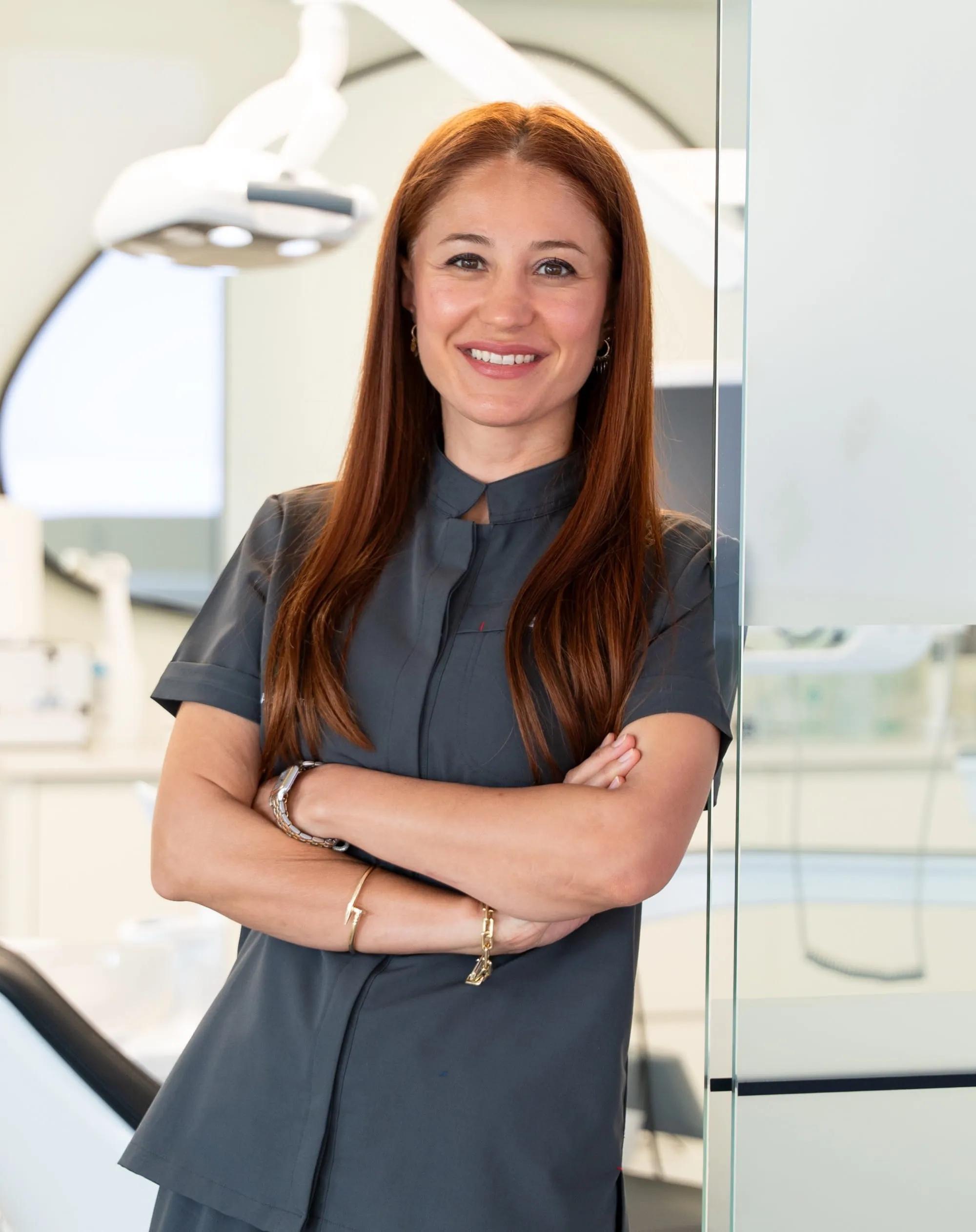
Dt. Dilek AKSU GÜLER
Dentist · Co-founder
Dt. Dilek AKSU GÜLER qualified from the Faculty of Dentistry at Süleyman Demirel University, Turkey, in 2005. She is the founding dentist of our clinic in Lara, Antalya. She works in aesthetic restorations (veneers and crowns), digital smile design and implant-supported prostheses, and speaks Turkish, English and German.
Sources
- Guidance on Scope of Practice (effective from 1 November 2025). General Dental Council (UK). 2025.↩gdc-uk.org
- Custom-made devices in Great Britain (guidance). Medicines and Healthcare products Regulatory Agency (MHRA), GOV.UK; updated 20 July 2026. 2020.↩gov.uk
- Intraoral scanners in dentistry: a review of the current literature. BMC Oral Health 2017;17(1):149 (Mangano F, Gandolfi A, Luongo G, Logozzo S). 2017.↩doi.org
- Trends in computer-aided manufacturing in prosthodontics: a review of the available streams. International Journal of Dentistry 2014;2014:783948 (Abduo J, Lyons K, Bennamoun M). 2014.↩doi.org
- A review of 3D printing in dentistry: technologies, affecting factors, and applications. Scanning 2021;2021:9950131 (Tian Y, Chen C, Xu X, Wang J, Hou X, Li K, Lu X, Shi H, Lee ES, Jiang HB). 2021.↩doi.org
- Lithium silicate-based glass ceramics in dentistry: a narrative review of composition and strength. Materials 2023;16(12):4398. 2023.↩doi.org
- Complete Dentures: information for patients (leaflet LN002837). Leeds Teaching Hospitals NHS Trust, Department of Restorative Dentistry, Leeds Dental Institute (UK); 4th edition, publication date 02/2025, review date 02/2028. 2025.↩flipbooks.leedsth.nhs.uk
- A clinician's perspective on the accuracy of the shade determination of dental ceramics: a systematic review. J Pers Med 2024;14(3):252. 2024.↩doi.org
- Color difference for shade determination with visual and instrumental methods: a systematic review and meta-analysis. Syst Rev 2023;12(1):95. 2023.↩doi.org
- Novel trends in dental color match using different shade selection methods: a systematic review and meta-analysis. Materials (Basel) 2022;15(2):468. 2022.↩doi.org
- Color comparison between intraoral scanner and spectrophotometer shade matching: a systematic review and meta-analysis. J Esthet Restor Dent 2025;37(2):361-377. 2024.↩doi.org
- Shade matching performance of normal and color vision-deficient dental professionals with standard daylight and tungsten illuminants. J Prosthet Dent 2010;103(3):139-47. 2010.↩doi.org
- Teeth Whitening (patient information). American Dental Association, MouthHealthy.↩mouthhealthy.org
- Flexural strength and translucency characterization of aesthetic monolithic zirconia and relevance to clinical indications: a systematic review. Dental Materials 2021;37(4):711-730 (Fathy SM, Al-Zordk W, E Grawish M, V Swain M). 2021.↩doi.org
- Tıbbi Cihaz Yönetmeliği (Medical Device Regulation, Turkey; consolidated text). Türkiye İlaç ve Tıbbi Cihaz Kurumu (TİTCK); Resmî Gazete 2/6/2021 No 31499 (mükerrer), amended RG 29/7/2022-31907, 2/4/2023-32151, 17/8/2024-32635. 2021.↩mevzuat.gov.tr
- Uluslararasi Saglik Turizmi ve Turistin Sagligi Hakkinda Yonetmelik. T.C. Saglik Bakanligi, Resmi Gazete 26/4/2025, No 32882. 2025.↩resmigazete.gov.tr
- Going abroad for dental treatment (patient information). General Dental Council, accessed 18 September 2026. 2026.↩gdc-uk.org
- Going abroad for medical treatment. NHS (England), accessed 21 September 2026.↩nhs.uk