
What are implants for several missing teeth, and who are they for?
When two or more teeth are missing, implants can replace them in two main ways. Each missing tooth can have its own implant and crown. Or a bridge can be fixed on implants, using fewer implants than there are missing teeth. It is surgery, and it does not suit everyone.
This page covers several missing teeth in a jaw that still has teeth of its own. The dental implants overview explains implants in general, and the single-tooth implant page covers one gap. If all the teeth in a jaw are missing, or none can be saved, see full-mouth dental implants.
The treatment is carried out at our clinic in Antalya, Turkey, by the clinic's dentists; on this page "we" means that clinic. Your written plan names the clinic you contract with and the dentist who treats you. A healing period separates the surgery from the final teeth, so the treatment usually needs at least two visits to Antalya. Every study figure on this page is linked to its source. Those figures come from published studies, not from our own records.
- Several missing teeth can be replaced with an implant for each tooth or with a bridge on fewer implants. There is no fixed number, and it is surgery.
- In published reviews, implant survival did not differ significantly between bridges on implants and single implants. Problems with the bridge, such as chipped porcelain, were common.
- For back teeth, the bone and, in the upper jaw, the sinus often decide the plan. A graft or a sinus lift adds time and risk.
- A conventional bridge, a partial denture or leaving some gaps are real options too. All of them are also available in the UK.
- Healing separates the surgery from the final teeth, so plan for at least two visits to Antalya. In England and Wales, NHS free repair does not cover work done abroad.
Who it suits, and who it does not
Where implants may be suitable
- Adults with two or more missing teeth, or teeth that cannot be saved, whose general health allows surgery and healing
- Remaining teeth that are healthy, or have been treated, so the plan can be built around them
- Enough bone height and width for the implants, or bone that can be added (see "Assessment" below)
- Gum disease treated and under control, with regular care to keep it that way
- People who want fixed teeth without grinding down healthy neighbouring teeth for a bridge
- People who can clean around implants, and under a bridge, every day
When another option may make more sense
- Teeth that can be saved. If root canal treatment, gum treatment or a crown could keep a tooth, that is assessed first. Before you agree to an extraction, ask about each tooth's outlook.
- Neighbouring teeth that already need crowns. If the teeth at each end of a short gap have large fillings or need crowns anyway, a conventional bridge may be worth discussing.
- Only back teeth (molars) missing. If your front teeth and premolars are in place, you may manage without replacing the molars. A review of adults in this situation, called a shortened dental arch, found it encouraging for function, satisfaction and cost-effectiveness1. Whether this suits you depends on your remaining teeth.
- Cleaning you cannot keep up. If the area under a bridge cannot be cleaned, the risk of inflammation around the implants rises2. A removable partial denture may then suit better.
- Active gum disease, infection or an uncontrolled medical condition. These are dealt with first.
- A jaw that is still growing. Implants usually wait until growth is complete. If you are asking for someone under 18, ask us first whether and when we would treat them.
What is associated with higher risk
The figures below are pooled results of published observational studies, not our own records. They show association, not proven causation.
- Smoking. People who smoked more than 20 cigarettes a day had about 2.5 times the risk of implant loss per implant3 compared with non-smokers. In that review the risk rose with the number of cigarettes, and no level of smoking was shown to be free of extra risk.
- A history of periodontitis (gum disease that has damaged the bone around the teeth). This matters here because, in a review of why adults' teeth are taken out, decay and periodontitis were the most common reasons4. Across 14 prospective studies, implants were lost at about 1.75 times the rate5 seen in people without a history of periodontitis. This is a hazard ratio, which compares rates over time; it is not an absolute risk. These were treated patients; implants are not placed while the disease is active.
- Clenching or grinding. Across 27 studies, people judged likely to clench or grind had about 2.2 times the odds of implant loss6 (an odds ratio). Like the hazard ratio above, it is not an absolute risk. These studies did not test whether a night guard prevents implant loss.
- Diabetes, blood-thinning medicines, bone-strengthening medicines and radiotherapy to the head and neck. Each needs a careful look at your medical history, and sometimes planning with your own doctors. With blood-thinning medicines, Scottish guidance for dentists counts surgery that raises a flap of gum as a higher bleeding risk7 than a simple extraction. The evidence on the others is set out on the dental implants overview. Do not stop any medicine without asking the doctor who prescribed it.
Suitability is decided by an examination, a 3D scan and your medical history. A plan based on photographs or a panoramic X-ray is not final; it is a preliminary assessment.
Patterns of missing teeth, and what can replace them
Where the gaps are shapes the choices. Each gap is planned on its own, so one plan may combine more than one option.
Two or more teeth missing side by side
A gap of several teeth can be filled with an implant for each tooth. Or a bridge can be fixed on implants placed under some of the missing teeth. If there are sound teeth at both ends, a conventional bridge fixed to them is another option. One NHS hospital leaflet notes that usually only one or two teeth can be replaced8 on a bridge fixed to neighbouring teeth. A removable partial denture is a further option.
Gaps in different places
One gap might suit an implant and another a conventional or resin-bonded bridge. A partial denture can replace teeth in several gaps with one piece, without surgery.
Back teeth missing at the end of the row
If there is no tooth behind the gap, a conventional bridge has nothing to rest on at that end. A bridge on natural teeth held from one side only (a cantilever bridge) is possible in some cases. In a 2007 review, about 80 in 100 of these were still in place after ten years9. For bridges supported at both ends the figure was about 899. The review gave no figures for resin-bonded bridges. We could not check whether these figures were counted per bridge or per patient. The review's authors regard the cantilever design as a second option. So at the end of the row, the choice is often between implants, a partial denture and leaving the gap. Upper back teeth sit below the sinus, and lower back teeth above a nerve; both affect implant planning (see "Assessment" below).
Front teeth
If front teeth are among those missing, the gum and the bone decide how natural the result looks. Not all of that can be controlled. The single-tooth implant page explains this for one front tooth. Ask how the result is likely to look in your mouth before you agree to a plan.
Separate implants or a bridge on implants?
For two or more missing teeth there is no rule of one implant per tooth. The plan depends on how many teeth are missing and where, the bone, the sinus and the nerve, your bite and your habits.
- An implant for each missing tooth. Each tooth has its own implant and crown. The crowns are not joined, so you can clean between them with floss or interdental brushes. A problem with one crown can often be dealt with on its own. It needs enough bone and room for every implant, so it can mean more surgery.
- A bridge on implants. Fewer implants carry a bridge that spans the gap. This can avoid placing an implant where the bone is thin or close to the sinus or the nerve. You clean under the bridge every day with bridge floss, interdental brushes or a water flosser. If one implant fails, the whole bridge may have to be remade.
- A bridge joined to a natural tooth and an implant. This is possible in some cases. In the 2007 review, about 78 in 100 of these were still in place after ten years9. For bridges on implants alone it was about 879. We could not check whether these figures were counted per bridge or per patient. The review's authors regard this design as a second option.
What the evidence says
A review of 74 articles, most published between 1995 and 2003, compared these designs in people missing some of their teeth. After more than six years, about 98 in 100 implants under implant bridges and about 96 in 100 single implants10 were still in place. For implants under bridges joined to natural teeth the figure was about 9110. None of these differences was statistically significant, which does not show that the designs are equal. The authors found the evidence too thin for firm guidelines. Only two of the 74 articles were randomised trials. So the figures compare different groups of patients and gaps, not the same gap treated both ways, and cannot tell you which design suits yours.
How many implants?
The studies we use give no number of implants for a given gap, and this page gives none. The number is decided from the 3D scan, the bone, the length of the gap and your bite. One NHS hospital leaflet, written for its own patients, notes that fewer implants usually mean more biting and chewing force through the implants8. It adds that this can potentially lead to more frequent complications of both the bridges and the implants. More implants, on the other hand, mean more surgery and may need a graft.
Your written plan states the number of implants, where they go and why. If two clinics propose different numbers, ask each of them to explain, and ask a dentist in the UK for an independent opinion.
If most of the teeth in a jaw are missing or failing, the choices change. The full-mouth dental implants page compares implant-retained dentures, fixed bridges on four or six implants and several shorter bridges on more implants.
Other options: bridges, partial dentures and leaving a gap
Implants are not the only way to replace several missing teeth. All of these options are also available from dentists in the UK, and a UK dentist can give you an independent opinion before you decide.
- Leaving some gaps. Not every missing tooth has to be replaced. A review of 83 articles found that having about 20 teeth, front teeth included, was associated with adequate chewing11 for most people. Those teeth formed about 9 to 10 pairs of upper and lower teeth meeting when biting11. People varied a great deal. The trade-off is that the teeth beside and opposite a gap can move. In one UK study of back teeth that had lost the tooth opposite them, 92 in 100 had moved towards the gap12. The bone in the gap also shrinks after the extraction (see "Assessment" below).
- A resin-bonded (adhesive) bridge. A false tooth held by a thin wing bonded to the inner surface of a neighbouring tooth. That tooth needs little or no drilling, and no surgery is needed. One NHS hospital leaflet on sinus lifts lists bridges glued directly onto the neighbouring tooth or teeth8 among the alternatives. Depending on your bite, it suits some single-tooth gaps, so it may fill one of several gaps. It can come loose and may need to be bonded again. The reviews we use give no survival figure for it.
- A conventional bridge. The teeth at each end of the gap are reduced and crowned, and the bridge is fixed to them. No surgery is needed and the treatment is short. The tooth tissue removed does not grow back, and the bridge needs sound teeth at both ends. The dental bridges page explains the designs.
- A removable partial denture. A plate carrying the missing teeth, held by clasps on your own teeth. It needs no surgery and little or no grinding, and one denture can fill several gaps. You take it out to clean it. As the gums and jawbone shrink or change over time, it may become loose13 and need adjusting. In a review of 46 studies, about 95 in 100 partial dentures with cast clasps were still in use after five years14. Cast clasps are metal arms that hold the denture on your own teeth. The teeth a denture holds on to had a higher chance of being taken out14 over time. That is an association, not proof that the denture caused it. Studies of partial dentures did not consistently report better quality of life or satisfaction15.
- Implants, with separate crowns or a bridge. The neighbouring teeth are not ground down to support them. They need surgery, a healing period and usually at least two visits to Antalya.
Bridges on implants and conventional bridges: how do they compare?
There are almost no head-to-head trials. The figures below come from separate groups of studies, mostly published before 2007, and are not our own results.
- In a 2007 review, about 89 in 100 conventional bridges and about 87 in 100 bridges on implants9 were still in place after ten years. We could not check whether these figures were counted per bridge or per patient.
- The problems differ. Within five years, about 39 in 100 patients with bridges on implants had a complication9, against about 16 in 100 with conventional bridges. With conventional bridges the problems were mainly decay and loss of vitality (the nerve inside the tooth dying) in the supporting teeth. Implant reconstructions had significantly more technical complications9.
So neither is better for everyone. If the teeth at each end of a gap already need crowns, a conventional bridge may make sense. If they are healthy, implants avoid grinding them down. If you have been offered only one option, ask why the others were ruled out.
| Removable partial denture | Conventional bridge | Separate implants | Bridge on implants | |
|---|---|---|---|---|
| What happens to your own teeth? | Clasps rest on them; grinding is usually minimal | The teeth at each end are reduced; the tissue removed does not grow back | They are not ground down to support the implants | They are not ground down to support the bridge |
| Surgery | None | None | Yes, one implant per missing tooth; more if bone is added | Yes, fewer implants; more if bone is added |
| Time and visits | Short | Short | Healing before the crowns; usually at least two visits to Antalya | Healing before the bridge; usually at least two visits to Antalya |
| Daily care | Take it out and clean it | Clean under the bridge | Clean around each implant and between the crowns | Clean under the bridge and around each implant |
| Further work | Relining, clasp repair, replacement | Decay or root canal problems in the supporting teeth; replacing the bridge | Screw loosening, chipped porcelain, replacing a crown | Chipped porcelain, screw loosening; if an implant fails, the bridge may need remaking |
| When it is less suitable | Strong gag reflex, or a denture that does not stay in place | Long gaps, or no tooth at one end | Not enough bone or room for every implant | When bone, gums or general health do not allow it |
Assessment: bone, the sinus, gums and bite
Before implants are planned, the dentist examines the gaps, your remaining teeth, your gums and your bite, and takes your medical history. X-rays and a 3D scan (cone beam CT) show the bone, and where the nerve canal and the sinus lie. Recommendations on 3D scans in implant dentistry say a scan could be justified for diagnosis and planning before surgery16. A 3D scan gives a higher radiation dose than a panoramic X-ray. The recommendations ask for the dose to be kept as low as is diagnostically acceptable16. They also say ordinary dental X-rays remain the main tool for checking implants afterwards. So a dentist in the UK who agrees to review your implants can use standard X-rays.
Bone
Bone shrinks after teeth are taken out, and the amount varies with the type of tooth17. We have found no good research showing that implants for several missing teeth prevent this shrinkage. Where there is too little bone, bone grafting may be considered; it lengthens treatment and carries its own risks. Adding bone height is not a small extra step. A Cochrane review found complications common, especially with vertical grafting18, which adds height. It found that, in a shrunken lower jaw, short implants appear to be a better alternative to vertical grafting. Those conclusions rest on few trials, often at high risk of bias.
Upper back teeth and the sinus
In the upper jaw the back teeth sit below the sinus, an air space next to the nose. One NHS hospital leaflet notes that many people who have lost the back teeth in their upper jaw do not have enough bone8 for implants. A sinus lift raises the lining of the sinus and adds bone below it, before or at the same time as the implants. A review of 11 studies looked at people with 6 millimetres of bone or less. They had a sinus lift through an opening in the side of the upper jaw. Over at least five years, implants were lost at 0.43 per cent per implant per year19. The same leaflet lists alternatives that may avoid a sinus lift: shorter implants, angled implants, or fewer implants placed further forward. Each has its own trade-offs.
Lower back teeth and the nerve
In the lower jaw a nerve runs through the bone below the back teeth. The 3D scan shows how much bone lies above it. Where there is little, shorter implants or a graft may be considered.
Gums
The gums need to be healthy before surgery, so gum disease is treated first. The teeth you keep matter too. A review looked at people treated for periodontitis who stayed in professional maintenance for at least five years. They lost on average about 0.1 teeth per patient each year20, and most lost none. Regular gum care protects the teeth you have as well as the implants.
Bite and the remaining teeth
When teeth have been missing for a while, the neighbouring teeth can tilt into the gaps. Opposing teeth can move towards them (see "Other options" above). This is planned for before the implants. If you clench or grind, this is taken into account in the design, and a night guard may be advised.
How the treatment runs
Treatment has two main stages, the surgery and the final crowns or bridge, with healing in between. The number of visits and the length of each depend on you and your plan; both are written in the plan. How the stages fit into visits to Antalya is explained under "Visits to Antalya, and the time between them" below. When the restoration is complete, probing measurements around each implant and an X-ray are taken as a baseline record21, as the consensus report recommends.
Examination, 3D scan and medical history
The gaps, the remaining teeth, the gums, the bite and the bone are assessed. We ask about smoking, diabetes, gum disease, clenching, medicines and radiotherapy, and write to your GP or hospital doctor if needed. The plan is given in writing, with the options, the number of implants and the reasoning.
Preparation
Decay, infection and gum disease are treated first. If teeth have to come out, the timing is decided here, including whether implants go in at the same session or after healing. A graft or a sinus lift may be done first, with its own healing time, or together with the implants. If you want sedation, it is first assessed against your medical history and medicines.
Surgery: placing the implants
The surgery is done under local anaesthetic, with conscious sedation if you want it and it suits you. The gum is opened, the sites are prepared in the bone and the implants placed. Whether all the implants go in at one session depends on the plan, and is stated in writing. Not every patient needs stitches.
Check after surgery
The areas are checked after surgery. If you have stitches that need removing, ask when and where that is done, and whether it falls before your flight home. You are given written eating and cleaning instructions for the healing period, including for any temporary teeth.
Healing
The implants need time to fuse with the bone. How long depends on the bone, the implants' positions, any graft or sinus lift and how you heal. You are told your own period after the examination. What you wear in the meantime is explained below.
Uncovering and healing caps
If the gum was closed over the implants while they healed, they are first uncovered in a minor procedure under local anaesthetic. Healing caps may then be fitted to shape the gum.
Impressions and try-in
An impression or a digital scan records the positions of the implants. For a bridge, the fit of the framework may be checked at a try-in before it is finished. Shade and shape are matched to your own teeth.
The final crowns or bridge
The crowns or the bridge are screwed or cemented onto the implants. The bite is adjusted, and you are shown how to clean around the implants and under any bridge. A screw-retained bridge can be removed by the dentist when needed.
Baseline and reviews
Probing measurements and an X-ray are recorded as a baseline; later changes are compared with this record. Your review interval is set by your risk and given in writing. If a dentist in the UK will see you for reviews, take this record to them.
What fills the gaps while they heal?
With several teeth missing, what you wear while the implants heal affects eating, speaking and how you look at home. You and your dentist choose one of these:
- The gaps are left empty. Some people choose this for back teeth that do not show.
- A removable temporary partial denture. A plate carrying the missing teeth. You take it out to clean it, and it is adjusted so that it does not press on the healing areas.
- A bonded temporary bridge. Where a short gap suits it, a temporary bridge attached to the neighbouring teeth.
- Temporary teeth on the implants. This is done only in selected patients, if the implants hold firmly enough in the bone at placement (primary stability). You are told what you can and cannot bite with them.
The last option is not for everyone. Ask the dentist to explain its risks for you, and whether it is in your plan. A Cochrane review of 26 randomised trials found no convincing difference22 within one year between loading implants immediately and waiting. Most of its trials were at high or unclear risk of bias. Another review of 39 randomised trials reported slightly lower implant survival23 with immediate loading. The decision depends on how firmly the implants hold during surgery, and on you.
This is what you will live with at home in the UK between visits, so have it written in your treatment plan before you book.
Implant parts and how the teeth are fixed: what to ask
Implant systems differ in surface, screw design and parts, and the 2017 consensus report noted that there is no generic implant21. A bridge on implants is either screwed onto them or cemented. A 2012 review found no clear difference in five-year survival24 between cemented and screw-retained bridges on implants. Its authors noted that screw-retained work is easier to remove, so complications can be treated more easily. Cement left under the gum is a possible risk indicator25 for inflammation around implants. Ask which your plan uses, and why.
When you receive a quote, ask for these in writing:
- Which implant system is planned, how many implants, and in which diameter and length?
- Will you have separate crowns or a bridge, and will it be screwed or cemented?
- Are the connecting parts (abutments) from the same system?
- Will a dentist in the UK be able to obtain these parts years from now?
- Will I be given an implant card or a similar record, showing the batch (lot) number?
A brand name alone does not decide the result. We give you the system planned for you, in writing, in your treatment plan.
Risks and benefits
Risks
The figures below come from published studies, not from our own records.
- Implant loss. A review of 32 studies looked at bridges on implants. Of every 100 implants under them, about 96 were still in place after five years and about 93 after ten26. It is not always possible to place a new implant where one was lost. Under a bridge, losing one implant can affect the whole bridge.
- Problems with the bridge. In the same review, about a third of patients had some complication within five years26. The most common was fracture of the veneering material, such as chipped porcelain, at 13.5 per cent26. Peri-implantitis and other soft-tissue problems followed at 8.5 per cent26. Loss of the filling over a screw hole was 5.4 per cent, and loose screws 5.3 per cent26. Regular reviews are needed to find these problems.
- Inflammation around the implants. Peri-implant mucositis is inflammation of the soft tissue around an implant. Peri-implantitis is that inflammation together with loss of the supporting bone. Its treatment may need surgery, and if it is not controlled, further bone loss can lead to losing the implant. A 57-study review reported peri-implantitis in about 20 in 100 patients and about 12 in 100 implants27. An older 11-study review found mucositis in about 43 in 100 patients28. The rates vary widely with the definition used.
- Surgical risks. Bleeding, swelling, bruising and infection can occur. In the lower jaw, a nerve runs close to where back implants are placed, so the lip, chin or tongue can go numb. It is usually temporary; rarely, it does not go away. The root of a neighbouring tooth can be damaged while an implant site is prepared. In the back of the upper jaw the sinus is close. The sinus lining can tear, sinusitis can develop, or an opening can form between the mouth and the sinus. A 3D scan and careful planning reduce these risks; they do not remove them.
- A graft or a sinus lift. Each adds its own risks and lengthens treatment; they are set out on the bone grafting and sinus lift pages.
- Limits of appearance. At the front of the mouth, the gum, the bone and your smile line decide the result. The gum can recede over time, and the metal edge of an implant can then show.
Benefits
- When implants alone carry the crowns or bridge, the neighbouring teeth are not ground down to hold them.
- The teeth are fixed: you do not take them out, and there are no clasps. A screw can still loosen or porcelain chip, as the figures above show. They do not feel or work exactly like natural teeth.
- A bridge on implants can replace several teeth with fewer implants than missing teeth.
After surgery and daily care
The first days
- Swelling and bruising usually increase over the first 48 to 72 hours, then settle. Use cold packs and the medicines prescribed.
- Choose soft, lukewarm food for the first days, and do not chew on the surgical sites.
- Do not stop cleaning your mouth. Clean the surgical areas the way your dentist shows you, and the rest as usual.
- If you had a sinus lift, follow the written instructions you are given. One NHS hospital leaflet advises not blowing your nose for two weeks8 after the procedure.
- If you had sedation, do not drive or operate machinery for as long as the sedation team tells you. Whether you need an escort depends on the method. For adults, every form of sedation other than inhalation sedation requires a responsible adult as an escort29 under the UK standards for dental sedation. Without an escort, treatment under sedation is not given. If you are travelling alone, ask before you book how this works for you. Before you leave the clinic after surgery, you and your escort should have written aftercare instructions. You should also know how to reach the clinic, including out of hours.
- Smoking is associated with poorer healing and with implant loss (see "Who it suits, and who it does not" above). At the very least, do not smoke during the healing period.
Daily care
- Brush twice a day with a soft brush and fluoride toothpaste. Pay particular attention to the line where the implants meet the gum.
- Clean between the teeth, and under any bridge, every day with interdental brushes, bridge floss or a water flosser. Your dentist shows you which works in your mouth.
- Look after the teeth you still have. Keeping them healthy is part of keeping the plan working.
- If you clench, a night guard may be advised to protect the crowns or bridge. It has not been shown to prevent implant loss, and we hold no study showing how well it protects them.
- Reviews. Follow-up for implants is different from a general dental check-up. The consensus report recommends that an X-ray and probing measurements be taken as a baseline21 when the restoration is complete. The European Federation of Periodontology guideline calls for a structured supportive care programme30 once implants are in use. The NICE guideline on dental recall covers check-ups in general, not implants. It asks for the interval between reviews to be set for each patient31, based on a risk assessment and discussed with the patient. If your reviews will be with a dentist in the UK, give them your baseline record.
How long does it last?
The rates below are not promises, and they come from published studies, not from our own records. They are pooled estimates from studies with different lengths of follow-up. What happens in your case depends on your bone, your gum health, your habits and your care. Different reviews give somewhat different figures, because they include different studies and follow people for different lengths of time.
- The implants under a bridge. In the 32-study review, of every 100 implants, about 96 were still in place after five years and about 93 after ten26.
- The bridge itself. In the same review, about 95 in 100 bridges on implants were in use after five years and about 80 after ten26. Leaving out bridges with a gold-acrylic veneer, about 96 in 100 metal-ceramic bridges were in use at five years and about 94 at ten26. The rate for the implants is not the same as the rate for the bridge on top of them.
- Separate implants. For an implant and crown per tooth, the figures are on the single-tooth implant page.
- No one can promise a lifetime result. The reviews we use give five- and ten-year estimates, and none of them promises a lifetime result.
- Being in place is not the same as being trouble-free. Chipped porcelain and loose screws need repairs, and a bridge may have to be remade. Ask beforehand whether these are included in your plan, and who will do them once you are back in the UK.
Visits to Antalya, and the time between them
We have found no good research comparing implant treatment squeezed into a few days with treatment spread over months; we say so plainly. The nearest evidence, the Cochrane review of loading times22, followed patients for a year at most, so it cannot settle the question. The timing first has to meet clinical requirements: how firmly the implants hold and how you heal. Beyond that, judge it on practical grounds. How is healing checked? Who do you contact if something goes wrong? What aftercare does the plan include?
First visit: examination and surgery
On the first visit you have the examination and 3D scan, and usually the implant surgery, with any extractions that are needed. Some people need extractions, gum treatment, a graft or a sinus lift as a separate first step. That step must heal before the implants go in, which can mean an extra visit. How many days each visit needs depends on your plan, and is stated in writing before you book travel. A 2023 narrative review suggests waiting at least 72 hours32 after implant placement before flying. After a sinus lift it suggests at least two, and ideally six, weeks32. These intervals assume no pain, swelling or bleeding at the treated site32. If your plan includes a sinus lift, ask whether that means a longer stay or a separate visit. The authors say the research is limited and comes mostly from military aviation. Treat these intervals as a starting point for a conversation with the dentist who treated you, not as clearance.
You can say no, or ask to stop, at any stage, including after the examination. Ask before you travel what you would pay if the examination shows that implants do not suit you.
At home: healing before the final teeth
The implants need time to fuse with the bone before the final crowns or bridge are made. How long depends on the bone, the implants' positions, any graft and how you heal; you are told your own period after the examination. For orientation, the Cochrane review calls teeth fitted more than two months after placement22 conventional loading. Do not shorten the healing period to fit travel plans. Ask how healing will be checked before you book the second visit, and what happens if it is not complete.
The NHS website for England advises you to discuss your plans with a GP33 before making any final decisions about travel or medical arrangements. The GDC says it is always a good idea to speak to your own dentist34 before treatment abroad. They may be able to advise you from your dental history. Ask them now whether they will see you between the visits and afterwards. If you do not have a regular dentist, find one in the UK, NHS or private, before you travel. A check with a dentist in the UK between the visits can be written into your plan. If so, ask for the records of the first visit before you fly home, so that dentist can see what was done.
Second visit: the crowns or bridge
Once healing is confirmed, an impression or digital scan is taken and the crowns or bridge are made and fitted. The bite is adjusted, and you are shown how to clean around the implants. Some plans need a further visit, for example when a try-in shows that a change is needed. You leave with your records and a written review interval.
If an implant or bridge fails after you are home
Once you are back in the UK, the first person to see a problem may be a dentist near you rather than us. Plan for that before you travel. The British Dental Association advises patients to get advice on what to do if problems occur after they return35.
- A loose screw, chipped porcelain, or a crown or bridge that comes loose. These are the usual technical problems (see "Risks and benefits" above). Contact us through the route in your plan, and see a dentist near you with your records. Whether the repair is done in the UK or on another visit to Antalya depends on the problem.
- Inflammation around an implant. Bleeding, swelling or pus around an implant needs assessment soon. See a dentist near you with your baseline record, and tell us.
- An implant that fails. It is not always possible to place a new implant in the same place. Under a bridge, the bridge may have to be remade or replaced by another design. Further surgery, a bone graft or a partial denture may be needed instead, and that may mean another visit to Antalya.
- Who pays. Our written remake terms state who pays for further treatment and travel (see "Is the work guaranteed?" below).
- Reviews. Reviews can be done in Antalya or, where your plan says so, with a dentist in the UK. Ask who will do yours and who pays for them.
What the NHS does and does not do
NHS guidance for dentists in England and Wales says a patient treated abroad is dealt with like any patient previously treated by another provider. If you are accepted for NHS care, treatment that is clinically necessary within NHS services is provided, with your consent. But where another provider did the original work, further treatment within two months and free repair or replacement do not apply36. That guidance does not say an implant, crown or bridge will be repaired or replaced on the NHS. It covers England and Wales. Scotland and Northern Ireland have their own NHS rules, and we hold no record for them. The NHS also states that it is not liable for negligence or failure of treatment33 you receive abroad.
Insurance
The NHS warns that most travel insurance policies will not cover you for planned treatment abroad33, so you may need specialist cover. Ask your insurer, in writing, before you book.
What the GDC and the NHS suggest you ask
The UK General Dental Council lists thirteen questions34 to ask before dental treatment abroad, and the NHS has its own checklist. Below are the ones that matter most for implants replacing several teeth, each with our answer. Where our answer is a commitment rather than something you can check today, it says so. Ask us the full list, and ask for the answers in writing.
Who will treat me, and how can I check their registration?
Before you commit, we name in writing the dentist who will place your implants. If someone else will fit the crowns or bridge, or do a graft or sinus lift, we name them too. In Turkey a dentist in private practice must register with the local dental chamber37 within a month of starting, and cannot practise privately without it. The Turkish Dental Association's website offers a search of registered dentists by name and province38. Ask us for the treating dentist's registration details. Registration in Turkey is separate from the UK register: the GDC states that only people registered with it can legally practise dentistry in the UK39.
How often do you do this, and what are your complication rates?
The GDC suggests asking how many times the procedure has been carried out, and the success, complication and infection rates34. The figures on this page come from published reviews, not from our own patient records. We publish no implant figures of our own yet, so ask us for them, how complications were defined and over what period.
Is the clinic licensed and regulated?
In Turkey a dental clinic cannot open without a licence or treat patients without an operating permit. It is inspected at least once a year40. To treat international patients, a facility also needs an authorisation certificate from the Ministry of Health41. The Ministry publishes a register of authorised facilities42 that you can check yourself. We give you our authorisation details before you commit. A licence or authorisation is a legal minimum, not a statement about the result of your treatment. The GDC itself cannot guarantee that a regulator like it exists in another country34.
Will I get the plan in writing?
Yes. The GDC says you should be assessed by a qualified dentist before being given a treatment plan and cost estimate34. Your written plan states the number of implants and where they go, and whether you will have separate crowns or a bridge, with the reasons. It names the implant system, any graft or sinus lift, the temporary teeth and the alternatives considered, and how many visits are needed. It also states what the plan covers and does not cover. A plan made from photographs or X-rays you send is preliminary. It is confirmed after the examination and 3D scan, and we tell you before anything in it changes. You can take the written plan to a dentist in the UK for an independent opinion before you commit.
Is the work guaranteed?
The GDC suggests asking whether the work is guaranteed and for how long34. It also suggests asking whether further treatment is included if there are complications, and who pays for extra flights, hotel and remedial work34. The GDC sets no minimum period itself. Before you commit, we give you our complication route and remake terms in writing. They state what is covered, for how long and what is excluded, for the implants and for the crowns or bridge separately. They also state what you must do to keep the cover, such as attending reviews, and who pays for further treatment and travel. Read that document before you decide, rather than relying on the word "guarantee" on any web page.
Am I insured if something goes wrong?
The GDC lists insurance among its questions. In Turkey a facility treating international patients must take out complication insurance for surgical and interventional procedures carried out in an operating theatre41. That does not by itself tell you whether your implant surgery is covered, so ask which procedures in your plan fall under it. Ask us in writing whether the clinic or the treating dentist holds insurance for complications or errors. Travel insurance is covered in the section on problems after you are home, above.
Who do I contact after treatment?
Your written plan names the contact route for questions and problems once you are home, and your review interval. For urgent symptoms, get emergency care where you are first (see "When to contact a dentist" below).
What records will I take home?
The NHS lists exchanging medical records and arranging aftercare back home33 among the things to consider. In Turkey you are entitled to an itemised bill, and on request to free copies of the records of materials, tests and imaging41. You may also examine your file and take a copy43. At the end of treatment we give you your records in a form a UK dentist can use. They include the plan, X-rays and scan, each implant's system, diameter and length, the parts used, and the baseline measurements.
What if I am unhappy, and where can I complain?
We give you our written complaints procedure before treatment. A complaint goes to the clinic first; private dental polyclinics, centres and hospitals in Turkey must have a patient rights unit40. If the clinic does not resolve it, you can apply in writing to the provincial health directorate's Patient Rights Board43. The Board decides within thirty days, but it does not assess allegations of medical error. The dental chamber can also open disciplinary proceedings37 against a dentist. Do not expect the UK regulator to settle it. The GDC states that it cannot resolve complaints or help with refunds39; its investigations are about whether dental professionals are fit to practise.
Will the team speak English?
The GDC suggests asking whether the team speaks your language and, if not, whether a translator is provided34. We confirm in writing, before you commit, who will explain the plan, the consent form and the aftercare instructions to you in English.
Do you treat under-18s?
Implants usually wait until the jaw has stopped growing. This page does not yet set out whether, or from what age, we treat patients under 18. If you are asking for a teenager, ask us before you travel, and talk to their own dentist too.
Warning signs, including for us
The NHS checklist names five signs to think twice about before booking. They are a hard sell, a lack of information, pressure to make a quick decision, no discussion of possible complications, and no mention of aftercare44. Apply them to us too. If you feel pushed to decide quickly, wait.
When to contact a dentist
After surgery, or at any time later, contact us and see a dentist near you in these cases.
- Pain or swelling increases after the third day, or bleeding does not stop
- A high temperature, or swelling of the face that keeps growing
- Numbness of the lip, tongue or chin lasts beyond the expected duration of the anaesthetic
- An implant, crown or bridge moves, a screw feels loose, or a piece cracks or breaks
- Bleeding, a bad smell, pus or receding gum around an implant
- Pain on biting, or the bite feels high
- Nasal discharge, a blocked nose or sinus pain on the side of an implant in the back of the upper jaw
Before you fly home. If any of these starts while you are still in Turkey, tell us before you travel.
Once you are home. Contact us through the route written in your plan. See a dentist near you as well if bleeding does not stop, numbness persists, pain or swelling keeps increasing, or an implant or bridge moves. Do not wait for our reply. In England, if you do not have a dentist or cannot get an emergency appointment, the NHS says to call 111 or use 111 online45. Elsewhere in the UK, check the local arrangements.
Emergencies. In the UK, call 999 or go to A&E45 if you have any of the signs below. Do not wait for our reply. In Turkey, call 112.
- It is hard to breathe, speak or swallow
- There is a lot of swelling in your mouth, or it is hard to open your mouth
- Your eye is swollen or painful, or your eyesight changes suddenly
- Your neck is swollen46
What determines the cost?
This page carries no prices. The main things that shape a plan for several missing teeth are:
- How many teeth are missing and where; whether extractions are needed
- The number of implants, and whether you have separate crowns or a bridge
- Whether bone grafting or a sinus lift is needed
- The implant system and the connecting parts
- The material of the crowns or bridge, and whether it is screwed or cemented
- The temporary teeth used during healing
- Sedation; the number of visits and the review programme
- The remake terms if there is a complication
Ask for three things in writing. What does your plan include? Which items are left 'to be decided later'? Who pays for further treatment and extra travel if there is a complication? Add your own travel for every visit, and reviews with a dentist in the UK, to see the whole cost. If you are comparing with a UK quote, check the number of implants and the design in each. Then compare what each one includes, item by item.
Which option suits your missing teeth?
Send a panoramic X-ray or scan if you have one, and photographs of your teeth. Our dentists will reply in writing with a preliminary view on the options, including a bridge or a partial denture, how many visits are likely, and whether bone support may be needed. This is not a treatment plan: the plan follows an examination and a 3D scan.
Frequently Asked Questions
Do I need an implant for every missing tooth?
No. Several missing teeth can be replaced with a bridge carried by fewer implants, or with an implant for each tooth. The number depends on the gap, the bone, the sinus or the nerve, and your bite. There is no fixed number, and this page gives none. Your written plan states how many implants, where they go and why. If two clinics propose different numbers, ask each of them to explain.
Is a bridge on implants better than separate implants?
Neither is better for everyone. In reviews, implant survival did not differ significantly between the two. But the studies compared different groups of patients, and the evidence is thin. Separate crowns can be cleaned between like natural teeth, and a problem with one crown can often be dealt with on its own. A bridge needs fewer implants and can avoid areas of thin bone. But if one implant under a bridge fails, the bridge may have to be remade.
Should I have a bridge on implants or a conventional bridge?
A conventional bridge needs no surgery and is quicker. But it needs a sound tooth at each end of the gap, and those teeth are reduced. Implants alone do not need the teeth beside the gap to be reduced, but they need surgery, healing and usually at least two visits. In reviews, most of both were still in place after ten years, and bridges on implants had more technical problems. If the end teeth already need crowns, a conventional bridge may make sense.
I have been told I need a sinus lift. Why?
In the upper jaw, the back teeth sit below the sinus. After they are lost, there is often too little bone under it for implants. A sinus lift raises the lining of the sinus and adds bone. It lengthens treatment, has its own risks and needs a longer wait before flying. Ask whether shorter or angled implants, or fewer implants placed further forward, could avoid it in your case, and what each would mean.
Will I have gaps while the implants heal?
Not necessarily. You can have a removable temporary partial denture or, for a short gap, a temporary bridge bonded to the neighbouring teeth. In selected patients, temporary teeth go on the implants if they hold firmly enough at placement. The research is mixed on whether this lowers implant survival. Settle which you will have, in writing, before you book.
How many visits to Antalya will I need? Another clinic said two.
Usually at least two, because the implants have to heal before the final crowns or bridge are made. Some plans need a third, for example after a graft or a sinus lift, or when a try-in shows that a change is needed. Ask whether the teeth fitted are temporary or final; they are not the same thing. Before you compare the number of visits, ask in writing which stages each visit covers and how long the gap between them is.
How long does a bridge on implants last?
Published reviews report that most implants under bridges, and most of the bridges, were still in use after many years. The figures are in "How long does it last?" above. They come from published studies, not from our own records. Chipped porcelain and loose screws were common, so maintenance is part of the treatment. An offer that promises a lifetime result is not based on evidence.
Can my teeth be saved instead?
This question comes before the implants. If root canal treatment, gum treatment, repair of a fracture or a crown could keep a tooth, that is assessed first. Ask for the reason for each extraction: a root fracture, advanced bone loss, or decay that cannot be repaired. Ask to be shown the reason on the scan and at the examination. If it is still unclear, ask a dentist in the UK for a second opinion.
What decides the cost?
This page gives no prices. The main items are how many teeth are missing, extractions, bone support, the number of implants and whether you have separate crowns or a bridge. The implant system, the material, the temporary teeth, sedation, the number of visits and the review programme also count. When you compare two quotes, compare the scope. What is included, what is left for later, and who pays for further treatment and travel after a complication?
What if something goes wrong after I am back in the UK?
Call 999 or go to A&E, then tell us, if it is hard to breathe, speak, swallow or open your mouth. The same applies if there is a lot of swelling in your mouth, your eye or neck is swollen, or your eyesight changes suddenly. For a high temperature or bleeding that does not stop, contact a dentist straight away; in England, if you cannot reach one, use NHS 111. For other problems, contact us through the route in your plan. If numbness persists, pain or swelling keeps increasing, or an implant or bridge moves, also see a dentist near you without waiting for our reply. Take your records with you. Who pays for further treatment and travel is set out in our written remake terms before you commit.
Will the NHS fix implant work done abroad?
Not as a free repair. Guidance for dentists in England and Wales says that if an NHS practice accepts you, clinically necessary treatment within NHS services is provided. But free repair or replacement does not apply to work another provider carried out. The guidance does not say an implant, crown or bridge will be repaired or replaced on the NHS. It covers England and Wales; Scotland and Northern Ireland have their own rules. Settle who pays for repairs with the clinic, in writing, before treatment.
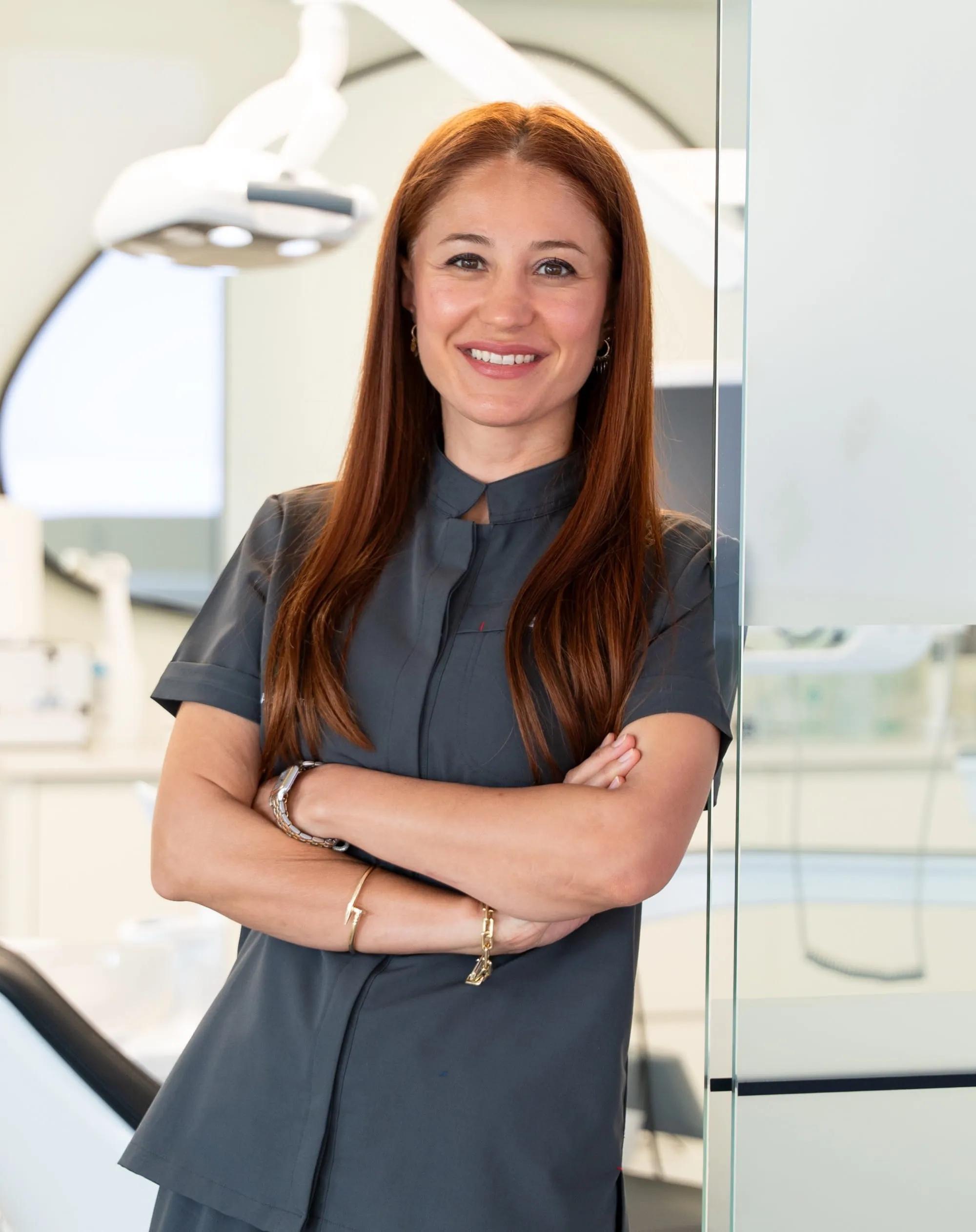
Dt. Dilek AKSU GÜLER
Dentist · Co-founder
Dt. Dilek AKSU GÜLER qualified from the Faculty of Dentistry at Süleyman Demirel University, Turkey, in 2005. She is the founding dentist of our clinic in Lara, Antalya. She works in aesthetic restorations (veneers and crowns), digital smile design and implant-supported prostheses, and speaks Turkish, English and German.
Sources
- Differences in functional outcomes for adult patients with prosthodontically-treated and -untreated shortened dental arches: a systematic review. PLoS One 2014;9(7):e101143. 2014.↩doi.org
- Peri-implantitis (narrative review for the 2017 World Workshop on the Classification of Periodontal and Peri-Implant Diseases and Conditions). Journal of Clinical Periodontology 2018;45 Suppl 20:S246-S266. 2018.↩doi.org
- Levels of smoking and dental implants failure: systematic review and meta-analysis (23 articles). Journal of Clinical Periodontology 2020;47(4):518-528. 2020.↩doi.org
- Reasons for tooth removal in adults: a systematic review. Int Dent J 2022;72(1):52-57. 2021.↩doi.org
- Effectiveness of implant therapy in patients with and without a history of periodontitis: systematic review with meta-analysis of prospective cohort studies (14 studies, >=36 months). Journal of Periodontal Research 2025;60(6):524-543. 2025.↩doi.org
- Bruxism and dental implants: systematic review and meta-analysis (27 studies; 2,105 implants in probable bruxers, 10,264 in non-bruxers). Journal of Oral Rehabilitation 2024;51(1):202-217. 2024.↩doi.org
- Management of Dental Patients Taking Anticoagulants or Antiplatelet Drugs, 2nd edition. Scottish Dental Clinical Effectiveness Programme (SDCEP), 2022. 2022.↩sdcep.org.uk
- Sinus lift procedures (patient information leaflet, document 101925, version 3). Cambridge University Hospitals NHS Foundation Trust (UK), Oral and Maxillofacial Surgery, approved 15 July 2024, accessed 2 October 2026. 2024.↩cuh.nhs.uk
- Comparison of survival and complication rates of tooth-supported FDPs and implant-supported FDPs and single crowns. Clin Oral Implants Res 2007;18 Suppl 3:97-113. 2007.↩doi.org
- Does the type of implant prosthesis affect outcomes in the partially edentulous patient?. Int J Oral Maxillofac Implants 2007;22 Suppl:140-72. 2007.↩pubmed.ncbi.nlm.nih.gov
- What dentition assures oral function?. Clinical Oral Implants Research 2007;18 Suppl 3:34-45. 2007.↩doi.org
- Occlusal changes following posterior tooth loss in adults. Part 1: a study of clinical parameters associated with the extent and type of supraeruption in unopposed posterior teeth. Journal of Prosthodontics 2007;16(6):485-494. 2007.↩doi.org
- Dentures (false teeth). NHS (England). 2025.↩nhs.uk
- Long-term assessment of the periodontal health of removable partial denture wearers: a systematic review and meta-analysis. J Prosthet Dent 2025;134(5):1664-1685. 2024.↩doi.org
- Factors influencing removable partial denture patient-reported outcomes of quality of life and satisfaction: a systematic review. J Prosthodont 2017;26(1):5-18. 2016.↩doi.org
- Cone beam computed tomography in implant dentistry: recommendations for clinical use. BMC Oral Health 2018;18(1):88 (Jacobs R, Salmon B, Codari M, Hassan B, Bornstein MM). 2018.↩doi.org
- Post-extraction dimensional changes: a systematic review and meta-analysis. Journal of Clinical Periodontology 2021;48(1):126-144. 2021.↩doi.org
- Interventions for replacing missing teeth: horizontal and vertical bone augmentation techniques for dental implant treatment (Cochrane review, 13 RCTs). Cochrane Database of Systematic Reviews 2009;(4):CD003607. 2009.↩doi.org
- Long-term effectiveness of maxillary sinus floor augmentation: systematic review and meta-analysis (11 prospective studies, follow-up at least 5 years). Journal of Clinical Periodontology 2019;46 Suppl 21:307-318. 2019.↩doi.org
- Predictors of tooth loss during long-term periodontal maintenance: an updated systematic review. J Clin Periodontol 2021;48(8):1019-1036. 2021.↩doi.org
- Peri-implant diseases and conditions: consensus report of workgroup 4 of the 2017 World Workshop on the Classification of Periodontal and Peri-Implant Diseases and Conditions. Journal of Clinical Periodontology 2018;45 Suppl 20:S286-S291. 2018.↩doi.org
- Interventions for replacing missing teeth: different times for loading dental implants (Cochrane review, 26 RCTs, 1,217 participants, 2,120 implants). Cochrane Database of Systematic Reviews 2013;(3):CD003878. 2013.↩doi.org
- Immediate versus early or conventional loading dental implants with fixed prostheses: systematic review and meta-analysis of randomized controlled trials (39 RCTs). Journal of Prosthetic Dentistry 2019;122(6):516-536. 2019.↩doi.org
- Cemented and screw-retained implant reconstructions: a systematic review of the survival and complication rates (59 studies). Clinical Oral Implants Research 2012;23 Suppl 6:163-201. 2012.↩doi.org
- Excess cement and the risk of peri-implant disease: a systematic review (26 publications). Clinical Oral Implants Research 2017;28(10):1278-1290. 2017.↩doi.org
- A systematic review of the survival and complication rates of implant-supported FDPs after a mean observation period of at least 5 years. Clin Oral Implants Res 2012;23 Suppl 6:22-38. 2012.↩doi.org
- What is the prevalence of peri-implantitis? A systematic review and meta-analysis (57 articles, 2005-2021). BMC Oral Health 2022;22(1):449. 2022.↩doi.org
- Peri-implant health and disease. A systematic review of current epidemiology (11 studies). Journal of Clinical Periodontology 2015;42 Suppl 16:S158-S171. 2015.↩doi.org
- Standards for Conscious Sedation in the Provision of Dental Care (V1.1). Intercollegiate Advisory Committee for Sedation in Dentistry, Dental Faculties of the Royal Colleges of Surgeons and the Royal College of Anaesthetists, 2020. 2020.↩saad.org.uk
- Prevention and treatment of peri-implant diseases: the EFP S3 level clinical practice guideline. Journal of Clinical Periodontology 2023;50 Suppl 26:4-76. 2023.↩doi.org
- Dental checks: intervals between oral health reviews (clinical guideline CG19). National Institute for Health and Care Excellence, published 27 October 2004. 2004.↩nice.org.uk
- Dental tourism and the risk of barotrauma and barodontalgia (narrative review with guiding principles). British Dental Journal 2023;234(2):115-117. 2023.↩doi.org
- Going abroad for medical treatment. NHS (England), accessed 21 September 2026.↩nhs.uk
- Going abroad for dental treatment (patient information). General Dental Council, accessed 18 September 2026. 2026.↩gdc-uk.org
- Dental tourism: Patients need to know the risks. British Dental Association, accessed 21 September 2026.↩bda.org
- What can I provide a patient on the NHS who has just recently returned after having dental treatment abroad? (Knowledge Base article KA-02010). NHS Business Services Authority, accessed 18 September 2026. 2026.↩faq.nhsbsa.nhs.uk
- Türk Diş Hekimleri Birliği Kanunu, Law No. 3224 (consolidated text). Resmî Gazete 25/6/1985 No 18792; consolidated PDF, mevzuat.gov.tr. 1985.↩mevzuat.gov.tr
- Türk Dişhekimleri Birliği website: Find a Dentist. Türk Dişhekimleri Birliği (TDB).↩tdb.org.tr
- How to make a complaint or get a refund. General Dental Council, accessed 21 September 2026.↩gdc-uk.org
- Ağız ve Diş Sağlığı Hizmeti Sunulan Özel Sağlık Kuruluşları Hakkında Yönetmelik (consolidated text). T.C. Sağlık Bakanlığı; Resmî Gazete 6/10/2022 No 31975, amended RG 5/3/2024-32480 and 15/12/2024-32753. 2022.↩mevzuat.gov.tr
- Uluslararasi Saglik Turizmi ve Turistin Sagligi Hakkinda Yonetmelik. T.C. Saglik Bakanligi, Resmi Gazete 26/4/2025, No 32882. 2025.↩resmigazete.gov.tr
- Yetkili Saglik Tesisleri ve Araci Kuruluslar. T.C. Saglik Bakanligi, Saglik Turizmi Daire Baskanligi, list updated 20 August 2026. 2026.↩shgmturizmdb.saglik.gov.tr
- Hasta Hakları Yönetmeliği (consolidated text). T.C. Sağlık Bakanlığı; Resmî Gazete 1/8/1998 No 23420, amended RG 8/5/2014-28994, 23/12/2016-29927, 16/1/2019-30657. 1998.↩mevzuat.gov.tr
- Treatment abroad checklist. NHS (England), accessed 21 September 2026.↩nhs.uk
- NHS: Dental abscess. NHS (nhs.uk). 2026.↩nhs.uk
- NHS: Toothache. NHS (nhs.uk). 2024.↩nhs.uk