
How should I look after my child's teeth?
Start brushing as soon as the first tooth appears, twice a day, with a fluoride toothpaste: a smear for children under 3 and a pea-sized amount from 3 to 6. Let your child spit out the toothpaste after brushing rather than rinse. Brush for them while they are small and keep helping or watching until at least age 7. Take them to a dentist when the first teeth come through, or by their first birthday.
- Brush twice a day from the first tooth, including last thing at night, with a fluoride toothpaste.
- Use a smear of toothpaste under 3 and a pea-sized amount from 3 to 6; spit, don't rinse.
- Brush for young children and help or watch them until at least age 7.
- First dental visit when the first teeth appear, or before the first birthday.
Children's teeth start to come through at different ages. The NHS says most babies start teething at around 6 months1, some before 4 months and some after 12 months, and that most children have all their milk teeth by the time they are 2 to 3 years old. There is no need to wait for a full set before you start cleaning: care starts with the first tooth.
Toothpaste: how strong and how much
Fluoride toothpaste is the main tool against tooth decay in children. The guidance is not to avoid fluoride but to use the right amount for the child's age.
- Under 3 years. The NHS advises a toothpaste with no less than 1,000ppm of fluoride2 and only a smear of it, unless a dentist advises a family toothpaste with more fluoride (1,350ppm to 1,500ppm).
- 3 to 6 years. A toothpaste with 1,000ppm to 1,500ppm of fluoride, and only a pea-sized amount.
- 7 and over. A toothpaste with 1,350ppm to 1,500ppm of fluoride.
Why so little for toddlers? Young children swallow some of the toothpaste. The American Academy of Pediatric Dentistry advises no more than a smear or rice-sized amount3 under 3, which may decrease the risk of fluorosis, faint white marks on the adult teeth from too much fluoride while they are forming, and no more than a pea-sized amount from 3 to 6.
Strength matters too. A Cochrane review of trials found that toothpaste with 1,450 to 1,500ppm slightly reduces decay4 in children's permanent teeth compared with 1,000 to 1,250ppm, at moderate certainty. So check the fluoride content on the packaging and ask your dentist which strength suits your child.
After brushing, your child should spit out the toothpaste and not rinse with water. The NHS says: spit out after brushing and don't rinse2, so the fluoride stays on the teeth.
Who brushes, and until what age
Brush twice a day. One of the two should be last thing at night, before bed.
For babies and toddlers, an adult does the brushing. Between 3 and 6, the NHS suggests encouraging your child to brush their own teeth while you supervise. From 7, most children can brush on their own, but the NHS says it is still a good idea to watch them2.
The European Academy of Paediatric Dentistry advises that parents should help with or supervise brushing, and put the toothpaste on the brush for their child, until at least 7 years of age5. Many children want to do it themselves earlier; letting them have a go and then finishing the job yourself is a practical way to do both.
A few habits make brushing easier to keep up:
- Same time, every day: Make brushing part of the bedtime and morning routine, so it is not negotiated each time.
- Brush together: Children copy what they see; brushing your own teeth at the same time helps.
- Every surface: Clean the biting surfaces and the sides of the back teeth, not only the front teeth you can see.
- Finish the job: Let your child brush first, then go over their teeth yourself while they still need help.
The first dental visit and regular check-ups
The NHS advises taking your child to the dentist when their first milk teeth appear, or before they are 12 months old2. The American Academy of Pediatric Dentistry similarly recommends a regular dentist for infants by 12 months of age6; it states that where data were insufficient its recommendations rest on expert and consensus opinion, and it gives no evidence grade for this one.
An early visit is mostly about prevention. The dentist can look at the teeth and gums, show you how to brush a small child's teeth, and talk about toothpaste and eating habits.
How often your child needs a check-up after that depends on their own risk of decay. UK guidance says the interval should be set for each patient7, from 3 months at the shortest to no longer than 12 months for anyone under 18. Ask the dentist when the next visit should be and why.
Food and drink also matter for children's teeth, especially sugary snacks and drinks between meals and at bedtime. Your dentist can advise on your child's diet.
Fissure sealants: what they can and cannot do
The biting surfaces of the back teeth have deep grooves (fissures) where food and plaque collect. A fissure sealant is a thin plastic coating that a dentist paints into these grooves to protect them.
The evidence is strongest for the first permanent back teeth (the adult molars that come through behind the baby teeth). In a Cochrane review, resin sealants on these teeth in children aged 5 to 10 reduced decay on the biting surfaces over two years8 compared with no sealant, based on moderate-quality evidence. A benefit was still seen at about four years, but with fewer trials and lower-quality evidence. How much a sealant helps depends on how much decay the child would otherwise get: a child at low risk gains less.
Some limits are worth knowing:
- Sealants protect the grooves on the biting surface, not the sides of the teeth or the gaps between them. Brushing with fluoride toothpaste is still needed.
- They are not permanent. The NHS describes a sealant as lasting up to 4 years; a dentist checks them at check-ups and can repair or replace them.
- The trials in this review looked at permanent teeth, not baby teeth.
- Whether a sealant or a fluoride varnish (a concentrated fluoride coating a dentist paints on the teeth) works better has not been settled; the evidence comparing them is of very low certainty.
Ask your dentist whether sealants make sense for your child's teeth and risk of decay.
When to see a dentist
Apart from the first visit and regular check-ups, make an appointment if you notice:
- white, brown or dark spots or holes on your child's teeth
- toothache, or your child avoiding chewing on one side
- a tooth that has changed colour
- sore or bleeding gums
The NHS lists a child with sore, bleeding gums9 among the reasons to get an urgent dental appointment. Toothache with swelling of the gum, face or jaw, or with a fever, needs an urgent dental appointment: a dental abscess needs urgent treatment by a dentist10 and will not go away on its own.
After a knock to the mouth, see a dentist straight away if a tooth is knocked out, and the same day if a tooth is chipped, loose or pushed out of place.
Emergencies. Call 112 or go to the nearest emergency department if your child:
- finds it hard to breathe, speak or swallow10
- has a swollen or painful eye, sudden problems with their eyesight, or swelling in their neck11
- has a lot of swelling inside their mouth
- finds it hard to open their mouth
Frequently asked questions
When should I start brushing my baby's teeth?
As soon as the first tooth comes through, usually at around 6 months. Brush twice a day, including last thing at night, with a smear of fluoride toothpaste.
How much toothpaste should a child use?
A smear for children under 3 and a pea-sized amount from 3 to 6. Using more increases the fluoride a young child swallows, which can raise the risk of faint white marks (fluorosis) on the adult teeth.
Should children use fluoride-free toothpaste?
The guidance does not advise it. It recommends a fluoride toothpaste from the first tooth, in a small, age-appropriate amount. Ask your dentist which strength suits your child.
Until what age should I help my child brush?
European paediatric dentists advise helping with or supervising brushing until at least age 7. Even after that, it is a good idea to check now and then.
When should my child first see a dentist?
When the first milk teeth appear, or before the first birthday. After that, the dentist sets the check-up interval by your child's risk of decay, at least once a year.
Are sealants put on baby teeth?
The reviews behind this article studied permanent back teeth only, so they do not show whether sealing baby teeth helps. Sealants protect the biting surfaces only, so brushing is still needed. Ask your dentist whether any of your child's teeth would benefit.
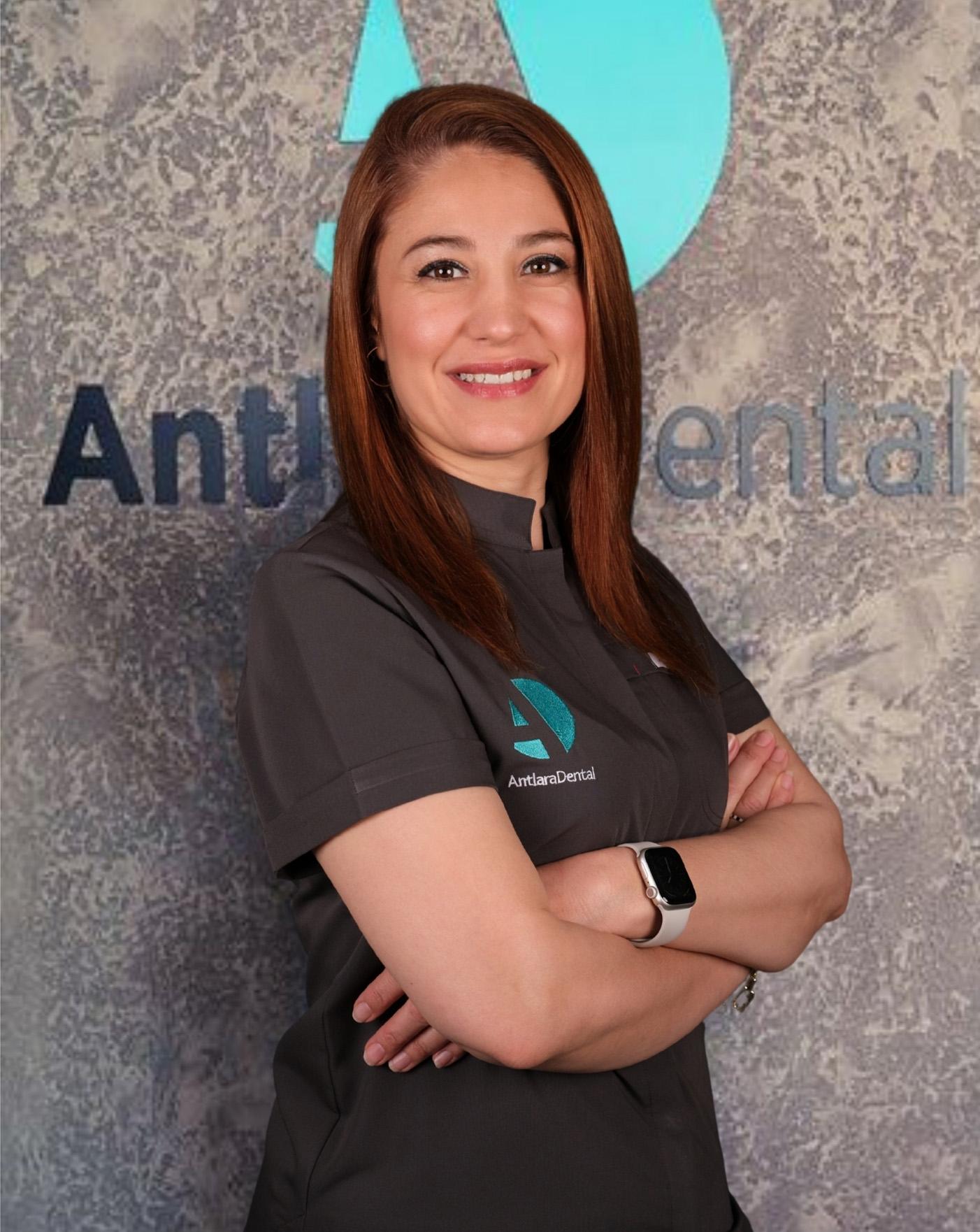
Dt. Dilek AKSU GÜLER
Dentist · Co-founder
Dt. Dilek Aksu Güler graduated from Süleyman Demirel University Faculty of Dentistry in 2005 and is the founding dentist of Antlara Dental in Lara, Antalya. She focuses on aesthetic restorations (veneers and crowns), digital smile design and implant-supported prostheses, and speaks Turkish, English and German.
Sources
- Baby teething symptoms. NHS (nhs.uk), page last reviewed 14 May 2026. 2026.↩nhs.uk
- Children's teeth. NHS (nhs.uk), page last reviewed 30 June 2025. 2025.↩nhs.uk
- Fluoride therapy (Reference Manual of Pediatric Dentistry). American Academy of Pediatric Dentistry, Reference Manual 2025:372-8, latest revision 2023.↩aapd.org
- Fluoride toothpastes of different concentrations for preventing dental caries (Cochrane review). Cochrane Database of Systematic Reviews 2019;3:CD007868 (Walsh T et al.). 2019.↩doi.org
- Guidelines on the use of fluoride for caries prevention in children: an updated EAPD policy document. European Archives of Paediatric Dentistry 2019;20(6):507-516. 2019.↩doi.org
- Perinatal and infant oral health care (Reference Manual of Pediatric Dentistry). American Academy of Pediatric Dentistry, Reference Manual 2025:337-41, latest revision 2025.↩aapd.org
- Dental checks: intervals between oral health reviews (clinical guideline CG19). National Institute for Health and Care Excellence, published 27 October 2004. 2004.↩nice.org.uk
- Pit and fissure sealants for preventing dental decay in permanent teeth. Cochrane Database of Systematic Reviews 2017;7:CD001830. 2017.↩doi.org
- Gum disease. NHS, page last reviewed 20 April 2026. 2026.↩nhs.uk
- NHS: Dental abscess. NHS (nhs.uk). 2026.↩nhs.uk
- NHS: Toothache. NHS (nhs.uk). 2024.↩nhs.uk