
How does tooth decay lead to root canal treatment?
Decay starts as mineral loss from the tooth's surface, often without symptoms. Early on, fluoride can sometimes stop or reverse it. Once a hole forms, you will probably need a filling. If decay reaches the pulp, the soft tissue with the nerve inside the tooth, the usual options are root canal treatment or removing the tooth; sometimes only part of the pulp is removed.
- Early decay can sometimes be stopped; a hole in the tooth needs a dentist.
- Fluoride toothpaste twice a day and less frequent sugar are the best-supported home measures.
- How deep a cavity really goes is sometimes clear only during treatment.
- Swelling near the eye or in the neck, or trouble breathing or swallowing, is an emergency.
How decay starts
Bacteria on the teeth turn sugar into acid, which draws minerals out of the enamel; saliva and fluoride help put them back. UK prevention guidance explains that in the early stages, decay can be reversed1. When mineral loss wins for long enough, decay spreads into the dentine, the softer layer under the enamel, until the surface breaks down and a cavity forms.
How often and how much sugar you have matters. A 2022 systematic review found moderate-quality evidence that decay is lower when sugars make up less than 10% of daily energy2, and low-quality evidence for a stricter limit of 5% for free sugars.
Early decay may not cause any symptoms at first3. Once a hole forms, it can cause toothache, a sharp pain with hot, cold or sweet things, and white, brown or black spots on the tooth.
The stages, and what each one usually needs
1. Early decay, before there is a hole. Fluoride toothpaste helps, and a dentist can prescribe or apply stronger fluoride treatments3, such as a varnish or a mouthwash, to help reverse early decay. A review of 44 trials ranked the options that work without drilling by type of lesion. For early decay in the grooves of back teeth, for example, sealants combined with fluoride varnish4 were among the most effective, with low to moderate certainty.
2. A cavity. Once there is a hole, you will probably need a filling3.
3. A deep cavity close to the nerve. For a deep cavity in a tooth with no symptoms, or only brief pain when something triggers it, European guidance suggests removing the decay selectively5, leaving some softened dentine over the nerve, or in two stages, rather than drilling until only hard dentine is left. The aim is to avoid exposing the nerve; the recommendation is conditional and the evidence very low in certainty. The same guidance says that in extremely deep decay, exposing the nerve should be anticipated. So the need for nerve treatment sometimes becomes clear only during the filling.
4. Decay has reached the pulp. If decay reaches the pulp, you may need root canal treatment3, and sometimes the tooth has to be removed. In root canal treatment the dentist removes the inflamed or infected pulp, cleans the canals inside the roots and seals them, then restores the tooth with a filling or a crown.
There is a third option for some teeth. When the nerve is exposed while decay is being removed, and the tooth had no pain or only pain when triggered, removing only part of the pulp (a pulpotomy) seems to be as effective as root canal treatment5 in the research so far. That evidence is of low certainty; for pain after treatment it rests on one trial of 54 people, and the guidance itself assumes that not every dentist does this in adult teeth.
Saving the tooth or taking it out
Root canal treatment keeps your own tooth. In pooled studies, about 86 to 93 in 100 root-treated teeth were still in place6 2 to 10 years later; most of those studies looked back at patient records. Still in place does not mean trouble-free. Complete healing seen on an X-ray is a different, stricter measure: a review of 63 studies published between 1922 and 2002 found pooled success rates of 68% to 85%7 on the strictest criterion. The two sets of figures come from different studies and cannot be compared directly. After treatment, the NHS says the area may feel swollen and sore8, but it should get better in a couple of weeks.
Is an implant a better choice? A review of 143 studies found that the long-term survival of root-treated teeth and of single implant crowns was similar9, although the two were rarely compared directly. The same review found limited data suggesting that removing a tooth without replacing it had worse effects on people's well-being.
After root canal treatment, teeth that received a crown survived longer in observational studies. The one trial in a Cochrane review that compared a crown with a filling could not show a difference10 in failures after 3 years. It was small (117 people), included only premolars restored with a post and had a high risk of bias, so it cannot show that the two do equally well. Your dentist decides with you, based on how much of the tooth is left.
What you can do at home
- Brush twice a day with fluoride toothpaste. UK guidance advises adults to brush last thing at night and at one other time, with a toothpaste of 1,350 to 1,500 ppm fluoride11, and to spit out rather than rinse, so the fluoride is not washed away. Young children use less: only a smear of toothpaste under 3 years and a pea-sized amount from 3 to 6.
- Know what toothpaste does. In adults, fluoride toothpaste reduced new decay compared with toothpaste without fluoride12, with moderate certainty. That is prevention; the review did not test whether toothpaste reverses decay that has started.
- Have sugar less often. Keep sugary food and drinks to fewer, smaller occasions, and avoid them at bedtime. The same UK guidance recommends this.
- Ask about stronger fluoride if you keep getting decay. For adults with active decay, a dentist may consider prescribing a higher-fluoride toothpaste11 until the decay is under control.
Home remedies: an honest verdict. Xylitol is not established as a treatment for decay: the main evidence13 is a fluoride toothpaste with added xylitol in children, from two studies by the same authors, with low certainty, and the evidence in adults is inconclusive. Trials of propolis reported less plaque and fewer bacteria, but that evidence is very uncertain, and decay itself was rarely measured14. Home "silver" products are not the same as silver diamine fluoride, a professional treatment that a dentist applies to decay.
UK guidance found no evidence that any particular check-up interval1 changes how decay develops. Ask your dentist how often you should be seen.
When to see a dentist
Book an appointment if you notice a hole or a dark or chalky spot on a tooth, food catching in one place, or pain with hot, cold or sweet things.
See a dentist if toothache lasts more than 2 days or does not go away with painkillers15. Ask for an urgent appointment if your face, cheek or jaw is swollen or you have a high temperature.
While you wait, painkillers such as ibuprofen or paracetamol can help, if they are safe for you. Follow the pack and do not go over the maximum daily dose. Swallow the tablets16: holding one against the tooth or gum can damage the tissue. This self-care advice covers the first 24 hours. If you still need pain relief after that, ask a pharmacist, and keep trying to get a dental appointment.
Emergencies. Call 112 or go to the nearest emergency department if you have swelling that makes it hard to breathe, speak or swallow, a swollen or painful eye or sudden problems with your eyesight, swelling in your neck, a lot of swelling inside your mouth17, or if you find it hard to open your mouth.
Frequently asked questions
Can tooth decay heal on its own?
Early decay, before there is a hole, can sometimes be stopped or reversed, helped by fluoride toothpaste, less frequent sugar and fluoride treatments from a dentist. Once a cavity has formed, it needs a dentist.
Does a cavity always lead to a root canal?
No. Most cavities are treated with a filling. If decay reaches the pulp, root canal treatment may be needed, or in some cases removing only part of the pulp. In a very deep cavity, how close the decay is to the nerve may only become clear during treatment.
How do I know if decay has reached the nerve?
You cannot tell for certain at home. Toothache that lasts, or pain that does not settle with painkillers, needs a dentist, who judges how deep the decay is from an examination and, where needed, X-rays.
Is it better to remove the tooth and have an implant?
Not necessarily. Studies found similar long-term survival for root-treated teeth and single implant crowns, although the two were rarely compared directly. Your dentist can explain what suits your tooth.
Do I need a crown after root canal treatment?
Not always. Teeth with a crown survived longer in observational studies. The one trial comparing a crown with a filling was small and at high risk of bias, and could not show a difference. It depends on how much of the tooth is left.
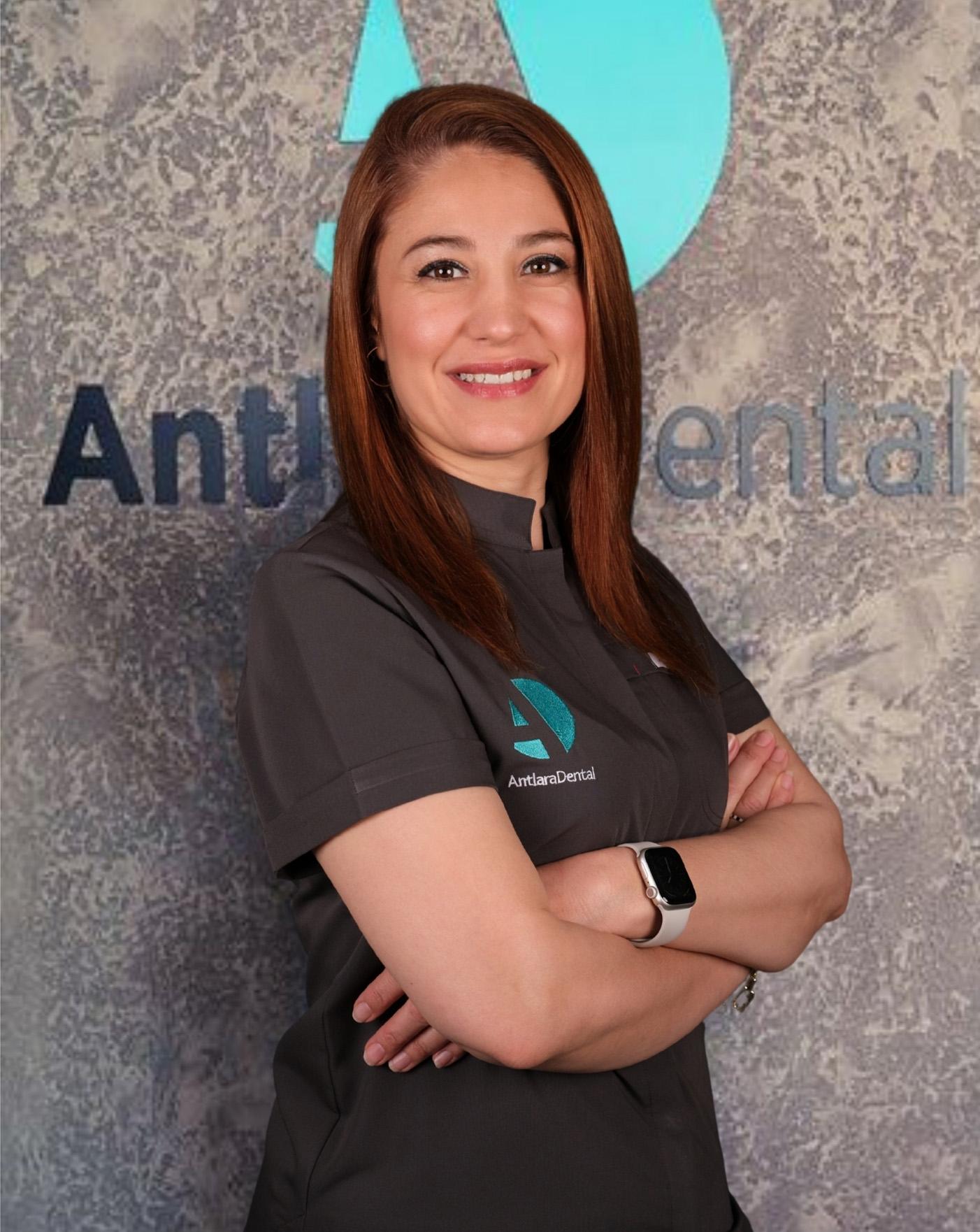
Dt. Dilek AKSU GÜLER
Dentist · Co-founder
Dt. Dilek Aksu Güler graduated from Süleyman Demirel University Faculty of Dentistry in 2005 and is the founding dentist of Antlara Dental in Lara, Antalya. She focuses on aesthetic restorations (veneers and crowns), digital smile design and implant-supported prostheses, and speaks Turkish, English and German.
Sources
- Delivering Better Oral Health, chapter 4: dental caries. Office for Health Improvement and Disparities / DHSC, NHS England et al.. 2025.↩gov.uk
- Systematic review of the effect on caries of sugars intake: ten-year update. Journal of Dental Research 2022;101(9):1034-1045 (Moores CJ, Kelly SAM, Moynihan PJ). 2022.↩doi.org
- NHS: Tooth decay. NHS. 2025.↩nhs.uk
- Nonrestorative treatments for caries: systematic review and network meta-analysis. Journal of Dental Research 2019;98(1):14-26 (Urquhart O et al.). 2018.↩doi.org
- Deep caries management: EFCD-ESE-ORCA S3-level clinical practice guideline. Caries Research 2026 (Schwendicke F et al.; co-published in Int Endod J and Clin Oral Investig). 2026.↩doi.org
- Tooth survival following non-surgical root canal treatment: a systematic review of the literature. International Endodontic Journal 2010;43(3):171-189 (Ng YL, Mann V, Gulabivala K). 2010.↩doi.org
- Outcome of primary root canal treatment: systematic review of the literature, part 1. International Endodontic Journal 2007;40(12):921-939 (Ng YL et al.). 2007.↩doi.org
- NHS: Root canal treatment. NHS. 2025.↩nhs.uk
- Outcomes of root canal treatment and restoration, implant-supported single crowns, fixed partial dentures, and extraction without replacement: a systematic review. Journal of Prosthetic Dentistry 2007;98(4):285-311 (Torabinejad M et al.). 2007.↩doi.org
- Single crowns versus conventional fillings for the restoration of root filled teeth (Cochrane review). Cochrane Database of Systematic Reviews 2012;(5):CD009109 (Fedorowicz Z et al.). 2012.↩doi.org
- Delivering Better Oral Health, chapter 2: summary guidance tables for dental teams. Office for Health Improvement and Disparities / DHSC, NHS England et al.. 2025.↩gov.uk
- Fluoride toothpastes of different concentrations for preventing dental caries (Cochrane review). Cochrane Database of Systematic Reviews 2019;3:CD007868 (Walsh T et al.). 2019.↩doi.org
- Xylitol-containing products for preventing dental caries in children and adults (Cochrane review). Cochrane Database of Systematic Reviews 2015;(3):CD010743 (Riley P et al.). 2015.↩doi.org
- Propolis-containing formulations in caries prevention: a systematic review and meta-analysis. Clinical Oral Investigations 2026;30(9):388 (Berto LP et al.). 2026.↩doi.org
- NHS: Toothache. NHS (nhs.uk). 2024.↩nhs.uk
- SDCEP Management of Acute Dental Problems: Analgesia (supporting tool). Scottish Dental Clinical Effectiveness Programme (SDCEP). 2026.↩acutedentalproblems.sdcep.org.uk
- NHS: Dental abscess. NHS (nhs.uk). 2026.↩nhs.uk