
Who should not have an implant?
An implant is surgery, and it does not suit everyone. It is usually not appropriate at the high doses of bone medicines used in cancer treatment. It is put off while there is active infection, untreated gum disease or an uncontrolled medical condition, and until the jaw has stopped growing. Smoking, a history of gum disease and clenching are associated with more implant loss.
- At the high doses of bone medicines used in cancer treatment an implant is usually not appropriate; the decision is made with the oncology team.
- Active infection, untreated gum disease and uncontrolled medical conditions are treated first; a growing jaw waits.
- Heavy smoking, a history of gum disease and clenching are associated with more implant loss; in diabetes the findings are mixed.
- Even when an implant suits you, staying in place is not the same as trouble-free, and no one can promise a lifetime result.
When an implant is not the right step, or has to wait
In a few situations an implant is usually not appropriate. More often, something else has to come first.
- High-dose bone medicines for cancer. In people on high-dose antiresorptive treatment for cancer, elective implant surgery is usually avoided. That includes bisphosphonates given by drip and denosumab given by injection. The decision is made together with your oncology team.
- Radiotherapy to the head and neck. Implants are lost more often in irradiated bone. Surgery there also carries a risk of wounds that do not heal and of bone death (osteoradionecrosis). Your dentist needs to know the field and dose of the radiotherapy, and planning is done with your oncology team.
- Active infection, untreated gum disease or an uncontrolled medical condition. These are treated first. An implant is not placed while gum disease is active.
- A jaw that is still growing. An implant does not move with the jaw as natural teeth do. In young patients, implants wait until growth is complete.
- Not enough bone. A bone graft or a sinus lift may be needed. Both can lengthen treatment and carry their own risks.
- A tooth that can be saved. If root canal treatment, gum treatment or a crown could keep the tooth, that comes first. An extraction cannot be undone.
- Daily cleaning is not possible. An implant needs cleaning every day and regular reviews for as long as it is in the mouth. If that cannot be managed, another option may suit you better.
Suitability is decided by an examination, a 3D scan and your medical history.
What raises the risk, and by how much
The figures below are pooled results of observational studies. They show an association, not proven cause and effect. They are averages from different countries and groups of patients, not your personal risk.
- Smoking. In people smoking more than 20 cigarettes a day, implant loss was about 2.5 times as likely per implant1 as in non-smokers. Per patient it was about 4 times as likely. A separate review of 32 studies looked at early failure; its per-implant odds ratio was about 2.62, which is not directly a risk multiple. No safe number of cigarettes has been shown. Whether stopping brings the risk down was not tested. Tell your dentist that you smoke and how much, and ask when to stop and for how long.
- A history of gum disease. The studies concern periodontitis, gum disease that has damaged the bone around the teeth. Across 14 prospective studies, implants were lost at about 1.75 times the rate3 seen in people without that history (a hazard ratio). After fast-progressing disease the rate was about 6 times higher. Peri-implantitis was about 3 times more common; for inflammation of the soft tissue alone, no significant difference was found. These were treated patients. A history of gum disease does not on its own rule out an implant.
- Clenching or grinding. Across 27 studies, people judged likely to clench or grind their teeth were compared with people who do not. In the first group, the odds of implant failure were about 2.2 times higher4 (an odds ratio). Whether a night guard prevents this was not tested.
- Diabetes. The findings are mixed. Two of three reviews found no significant difference in implant loss (2021 review5; 2016 review6). The third reported an odds ratio of about 1.8 per implant7. The 2021 review, in type 2 diabetes, ties its result to strictly maintained oral hygiene. All three found more bone loss around implants in people with diabetes. Diabetes does not rule out an implant; blood-sugar control and regular reviews matter.
- Bone-strengthening medicines (bisphosphonates, denosumab). The risk depends on why, at what dose and for how long the medicine is taken. Doses used for osteoporosis are assessed separately from those used in cancer treatment. A 21-study review found that in people taking bisphosphonates, implant loss was about 1.7 times more likely per implant8. Jaw osteonecrosis, the death of jaw bone linked to the medicine, was about 3.5 times more likely per patient. The per-patient analysis of implant loss found no significant difference. These figures are for bisphosphonates and cannot be applied to denosumab; the certainty of the evidence is very low.
Tell your dentist about every medicine you take. Do not stop one without asking the doctor who prescribed it.
If an implant suits you: what can still go wrong
Being suitable does not make an implant trouble-free. A review of 46 studies looked at implants carrying a single crown. Of every 100, about 97 were still in the mouth after five years and about 95 after ten9. The crown on the implant is a separate part. In the same review, about 96 in 100 crowns were still in use after five years and about 89 after ten. Over five years it reported screw loosening in 8.8 per cent and soft-tissue problems in 7.1 per cent. Chipped porcelain was reported in 3.5 per cent. We could not confirm whether these rates are counted per implant or per crown. A loose screw can be tightened and a damaged crown repaired or replaced; soft-tissue problems need assessment and treatment.
Surgery has its own risks. Bleeding, swelling, bruising and infection can occur. In the lower jaw, because the nerve canal is close, the lip and chin can go numb; this is usually temporary and rarely permanent. In the back of the upper jaw the sinus is close. Its membrane can tear, sinusitis can develop, or an opening can form between the mouth and the sinus. A 3D scan and careful planning reduce these risks; they do not remove them.
Peri-implantitis is inflammation around an implant with loss of the supporting bone. A 57-study review found it in about 20 in 100 patients10; the rate depends on the definition used. Its treatment may need surgery, and if it progresses the implant can be lost.
No one can promise a lifetime result. The reviews used here give five- and ten-year figures. The ten-year values were modelled from studies whose follow-up averaged about five years9; they were not observed directly over ten. An offer that promises an implant for life is not based on evidence.
Alternatives to an implant
If an implant is not right for you, or not yet, there are other ways to deal with a missing tooth. The list starts with the option that removes the least tissue.
- Doing nothing. For a single missing back tooth this is a reasonable choice for some people. Over time the neighbouring teeth can drift and the bone in the gap shrinks.
- Saving the tooth. If the tooth is still there, root canal treatment, gum treatment, a repair or a crown may keep it.
- A removable partial denture. No surgery is needed. You take it out to clean it, and getting used to it takes time.
- A resin-bonded bridge. For suitable single gaps, a bridge with a wing bonded to the back of a neighbouring tooth needs little or no grinding and no surgery. It can come loose and may need re-bonding.
- A conventional bridge. The teeth either side of the gap are reduced to carry it. No surgery is needed, but the tooth tissue removed does not grow back.
- For a whole jaw. A removable full denture needs no surgery. A denture that clips onto implants and a fixed bridge on four or six implants both need implant surgery and the same health assessment. The All-on-4 page sets these options side by side.
Which option suits you depends on the gap, the neighbouring teeth, the bone, your bite and your health. Implant treatment itself is explained on the dental implants page.
When to see a dentist
Before you decide
See a dentist for an examination before you decide, and mention any of these. They change the plan:
- Smoking, and how much
- Diabetes, and how well it is controlled
- Gum disease now or in the past
- Clenching or grinding
- Every medicine you take, especially bone-strengthening medicines
- Radiotherapy to the head or neck, or cancer treatment now or in the past
If you already have an implant
Contact your dentist if you notice any of these:
- Pain or swelling that increases after the third day following surgery, or bleeding that does not stop
- Numbness of the lip, tongue or chin that lasts beyond the expected duration of the anaesthetic
- The implant or crown moves, a screw feels loose, or a piece breaks
- Bleeding, a bad smell, pus or receding gum around the implant
- Pain on biting, or a bite that feels high
Emergencies. Difficulty breathing or swallowing, rapidly spreading swelling of the face or neck, high fever or swelling around the eye are serious signs. Do not wait for the clinic's reply: go to the nearest emergency department or call 112.
Frequently asked questions
I smoke. Can I still have an implant?
It can be done, but the risk rises. In people smoking more than 20 cigarettes a day, implant loss was about 2.5 times as likely per implant as in non-smokers. No safe number of cigarettes has been shown. Whether stopping lowers the risk was not tested; ask your dentist when to stop.
I have diabetes. Does that rule out implants?
Not on its own. The findings are mixed: two of three reviews found no significant difference in implant loss, and one found a higher rate. All three found more bone loss around implants. Blood-sugar control, daily cleaning and regular reviews matter.
I had gum disease. Can I have implants?
A history of gum disease (periodontitis) does not on its own rule out an implant, but active disease is treated first. In 14 prospective studies, implants were lost at about 1.75 times the rate in people with that history. Regular cleaning and reviews are part of the plan.
I take tablets for osteoporosis. Can I have implants?
Tell your dentist, and do not stop the medicine yourself. The risk depends on the medicine, why you take it, the dose and for how long. Osteoporosis doses are assessed separately from the high doses used in cancer treatment, where implants are usually not appropriate.
I grind my teeth. Will a night guard protect the implant?
In 27 studies, people judged likely to clench or grind their teeth had about 2.2 times higher odds of implant failure than people who do not (an odds ratio). A night guard may be advised to protect the crown or bridge from the forces of clenching. It has not been shown to prevent implant loss.
Sources
- Levels of smoking and dental implants failure: systematic review and meta-analysis (23 articles). Journal of Clinical Periodontology 2020;47(4):518-528. 2020.↩doi.org
- Smoking in relation to early dental implant failure: systematic review and meta-analysis (32 observational studies, 59,246 implants, 14,115 patients). Journal of Dentistry 2024;151:105396. 2024.↩doi.org
- Effectiveness of implant therapy in patients with and without a history of periodontitis: systematic review with meta-analysis of prospective cohort studies (14 studies, >=36 months). Journal of Periodontal Research 2025;60(6):524-543. 2025.↩doi.org
- Bruxism and dental implants: systematic review and meta-analysis (27 studies; 2,105 implants in probable bruxers, 10,264 in non-bruxers). Journal of Oral Rehabilitation 2024;51(1):202-217. 2024.↩doi.org
- Impact of hyperglycemia on the rate of implant failure and peri-implant parameters in patients with type 2 diabetes mellitus: systematic review and meta-analysis (9 studies). Journal of the American Dental Association 2021;152(3):189-201. 2021.↩doi.org
- The impact of diabetes on dental implant failure: a systematic review and meta-analysis. International Journal of Oral and Maxillofacial Surgery 2016;45(10):1237-1245. 2016.↩doi.org
- Diabetes mellitus and dental implants: systematic review and meta-analysis (89 publications; 5,510 implants in diabetic and 62,780 in non-diabetic patients). Materials 2022;15(9):3227. 2022.↩doi.org
- Effects of bisphosphonates and denosumab on dental implants: systematic review with meta-analysis (21 studies, ROBINS-I, GRADE). Oral Diseases 2025;31(10):2835-2847. 2025.↩doi.org
- Systematic review of the survival rate and the incidence of biological, technical and aesthetic complications of single crowns on implants (46 studies, mean follow-up 5 years). Clinical Oral Implants Research 2012;23 Suppl 6:2-21. 2012.↩doi.org
- What is the prevalence of peri-implantitis? A systematic review and meta-analysis (57 articles, 2005-2021). BMC Oral Health 2022;22(1):449. 2022.↩doi.org
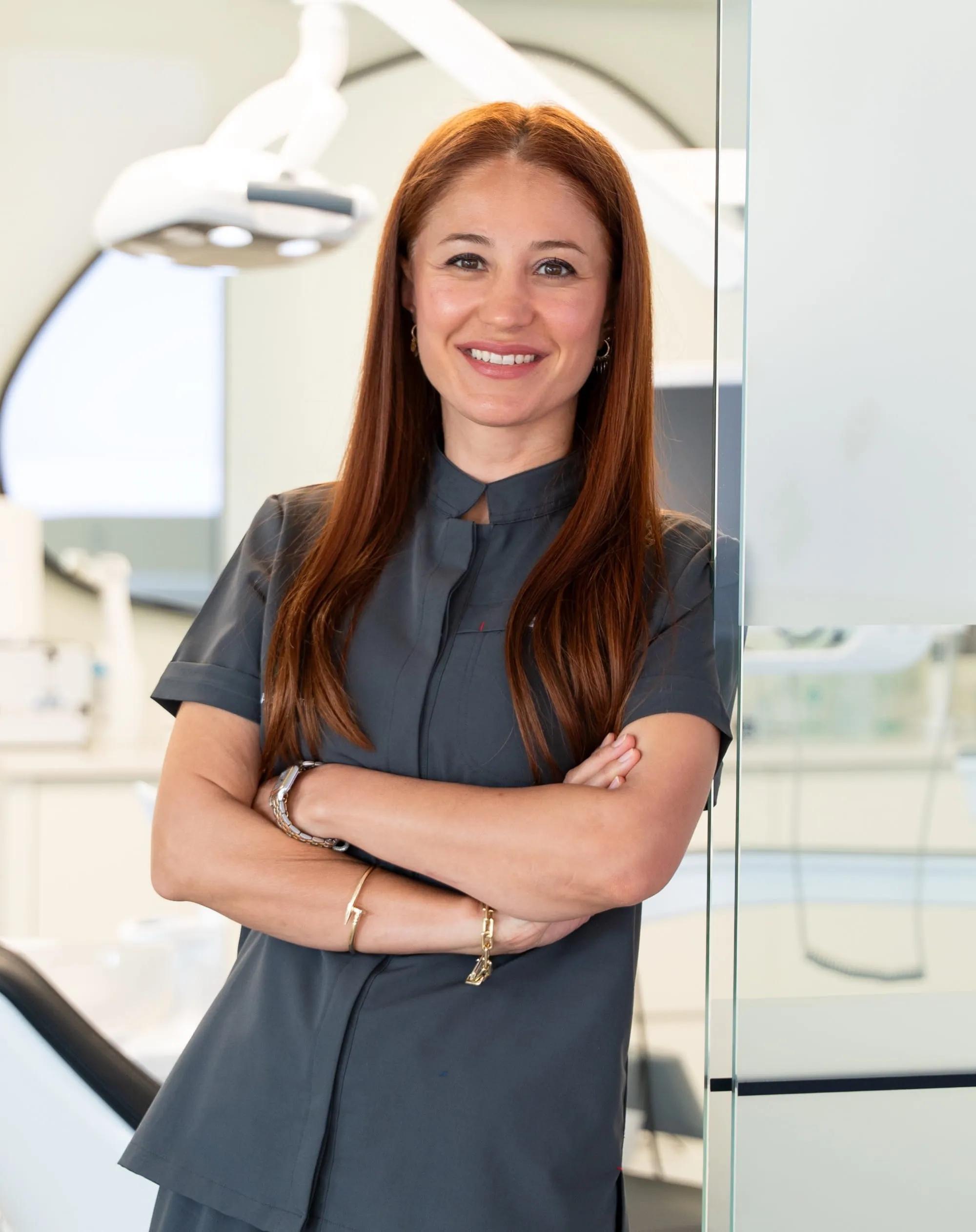
Dt. Dilek AKSU GÜLER
Dentist · Founder
She has completed advanced training in implantology and works in aesthetic restorations and smile design.