
What decides what dental treatment costs?
Your teeth decide much of it: how many teeth are treated, which treatment each tooth gets, what has to be treated first, whether a dental laboratory makes the restoration, the material, and the visits that follow. The clinic's own fees for time, laboratory work and materials differ too. But two quotes for the same mouth often differ because the plans do different things, not only because one clinic charges more.
The first bill is also not the whole cost. Crowns and veneers do not last for ever, and enamel removed for a veneer does not grow back1, so a tooth that has been veneered or crowned needs a restoration for the rest of its life. A plan that treats only the teeth that need it keeps that future cost as small as it can be.
- The number of teeth and the treatment chosen for each tooth are a large part of the cost, alongside the clinic's own fees.
- Decay and gum disease are treated first, so they belong in the plan and in the quote.
- A veneered or crowned tooth needs a restoration for life, so ask what a plan means over the years, not only now.
Why this article gives no prices
Health promotion in Turkey may not give fees, discounts or campaign information2; clinics authorised for health tourism have separate rules for sponsored promotion aimed abroad. A price quoted before an examination would not describe your teeth anyway. What this article can do is help you read the plan and the quote you are given.
What goes into the cost of a plan
- The examination and X-rays. They show what needs doing; X-rays are taken where they are needed for your teeth, not by routine. A plan made from photographs alone is a preliminary estimate, and it can change once your teeth are examined.
- Treatment that comes first. Decay, gum disease, an infected tooth or a tooth that cannot be kept are dealt with before cosmetic or replacement work. A quote that leaves them out is not the cost of the plan.
- How many teeth, and what each one gets. A filling, an onlay, a veneer and a crown are different amounts of work (see inlay, onlay or crown). Some are made in the mouth in one visit; others are made in a laboratory: inlays and onlays made in a laboratory, for example, need two appointments3.
- The material and the laboratory. Composite, glass-ceramic, zirconia and metal-ceramic differ in the work they need. A more expensive material is not automatically a longer-lasting one; the crown figures below show why. For one material in detail, see e.max crowns.
- Replacing missing teeth. Implants involve surgery and sometimes bone grafting before the crown or bridge on top. For a jaw without teeth (the evidence here comes from the upper jaw), a conventional complete denture costs less, needs no surgery and takes less time, while an implant-supported denture needs surgery and more maintenance4. See our dental implants page.
- Sedation, if you need it for a longer or more difficult procedure. See conscious sedation.
- Temporaries, adjustments and check-ups. Ask which of these the quote includes.
The cost over the years
A restoration is not a one-off purchase. The figures below are averages from studies of many patients, not a promise for your teeth, but they show why the first bill is only part of the cost.
- Crowns. A 2026 review of single crowns on natural teeth reported on four common material groups: monolithic lithium disilicate, layered zirconia, metal-ceramic and monolithic zirconia. About 97 to 99 in 100 of these crowns5 were still in the mouth after five years, although crowns made in one piece had fewer fractures and chips than layered ones. Similar survival cannot tell you which option will cost less over the years, so ask why the proposed material suits your tooth rather than paying for a name. These figures cover those four groups only, and do not apply to bridges or implant crowns.
- The nerve under a crown. In pooled studies of teeth that were alive before they received crowns, partial restorations or bridge supports, the nerve lost its vitality in about 5 in every 1006, over follow-up periods that varied between studies; in studies with more than ten years of follow-up the figure was about 7 in 100. The certainty of this evidence is low. Such a tooth needs root canal treatment to be kept, sometimes years later.
- Ceramic veneers. A review of 25 studies and 6,500 ceramic veneers found about 95 in 100 still in place at ten years7. Fracture and coming off were the main reasons for failure. This figure does not apply to composite veneers.
- Composite or porcelain. Composite veneers are easier to repair when they are damaged, but they resist staining and wear less well than porcelain1. Cheaper to make is not the same as cheaper to keep, and the reverse is not always true either.
- Whitening. Its effect is not permanent8; the colour partly returns over time, depending on habits such as diet and smoking.
- Dentures. There is no evidence that sets how often a denture should be relined or replaced9; it depends on how it fits and is decided at an examination.
Every tooth that is not treated is a tooth with no restoration to repair or replace later. That is the strongest reason to ask, for each tooth, whether it needs treatment at all.
Comparing two quotes
Compare the plans before you compare the totals.
- Are they for the same teeth? Put the two plans side by side, tooth by tooth.
- Does each tooth get the same treatment? A cheaper plan with crowns where the other proposes veneers or bonding may remove much more tooth. Ask whether the gentler option suits each tooth, and why each crown is needed. See crowns or veneers.
- What is included? X-rays, treatment of decay and gum disease, temporaries, follow-up visits, a night guard if you grind your teeth, and repairs.
- What happens if something breaks or comes off? Ask who deals with it and on what terms, in writing.
- Is it written down? In the UK, the dental regulator requires a written plan with the proposed treatment and a realistic indication of its cost before treatment starts10. If the plan changes, the patient must be told at once and given the updated plan in writing10. These are UK standards and we have not found an equivalent Turkish rule, but they are a fair standard to ask for: if findings change your plan, agree the revised treatment and cost in writing before the extra work begins. What a good plan contains is set out in our consultation checklist.
Some signs call for a pause: a quote for a set number of teeth or a "package", the same treatment on every tooth, crowns on healthy teeth with no reason given, or pressure to decide on the day. None of these proves a plan is wrong, but each is a reason to ask more or get a second opinion.
If a treatment you paid for turns out to be faulty, under the consumer protection law a consumer can ask for the service to be redone, a free repair, a price reduction or to withdraw from the contract11. Whether a particular dental dispute counts as a consumer dispute is a legal question. Where to turn is explained in our guide to choosing a dental clinic.
When to see a dentist
Do not wait for a full plan or a second quote if you have:
- toothache that keeps you awake or does not settle
- swelling of the gum or face, or a bad taste with pus
- a broken tooth, or a crown, veneer or filling that has come off (keep the restoration, and do not glue it back yourself)
- a tooth that has suddenly become loose
Emergencies. Throbbing pain, facial swelling or a fever: see a dentist without waiting. Difficulty breathing or swallowing, fast-spreading swelling in the mouth or neck, or swelling around the eye: go to an emergency department or call 112.
Let us go through a quote with you
Send us the plan or quote you were given. Our dentists will go through it tooth by tooth and tell you what each item is for, starting from the option that removes the least.
Frequently asked questions
Why do two clinics quote such different amounts?
Often because the plans are not the same: different numbers of teeth, crowns instead of veneers, different materials, or items such as X-rays, gum treatment or follow-up left out. Compare the plans tooth by tooth before you compare the totals.
Is a more expensive material always better?
No. In a 2026 review, single crowns in four common material groups were still in place at five years at similar rates. The right material depends on the tooth, your bite and where it sits in the mouth, so ask why a material is suggested for you.
Why don't dental adverts show prices?
Health promotion in Turkey may not include fees, discounts or campaigns; clinics authorised for health tourism have separate rules for promotion aimed abroad. A cost for your own treatment should follow an examination, any X-rays your teeth need, and a written plan.
Will I have to pay again later?
Possibly. Veneers and crowns can break or come off, a crowned tooth sometimes needs root canal treatment later, and whitening fades. Ask in writing what is included if something goes wrong, and keep your records.
Can treatment be done in stages?
Often, yes. Pain, infection, decay and gum disease come first; cosmetic or replacement work can follow. Ask which parts of the plan are needed now and which can wait.
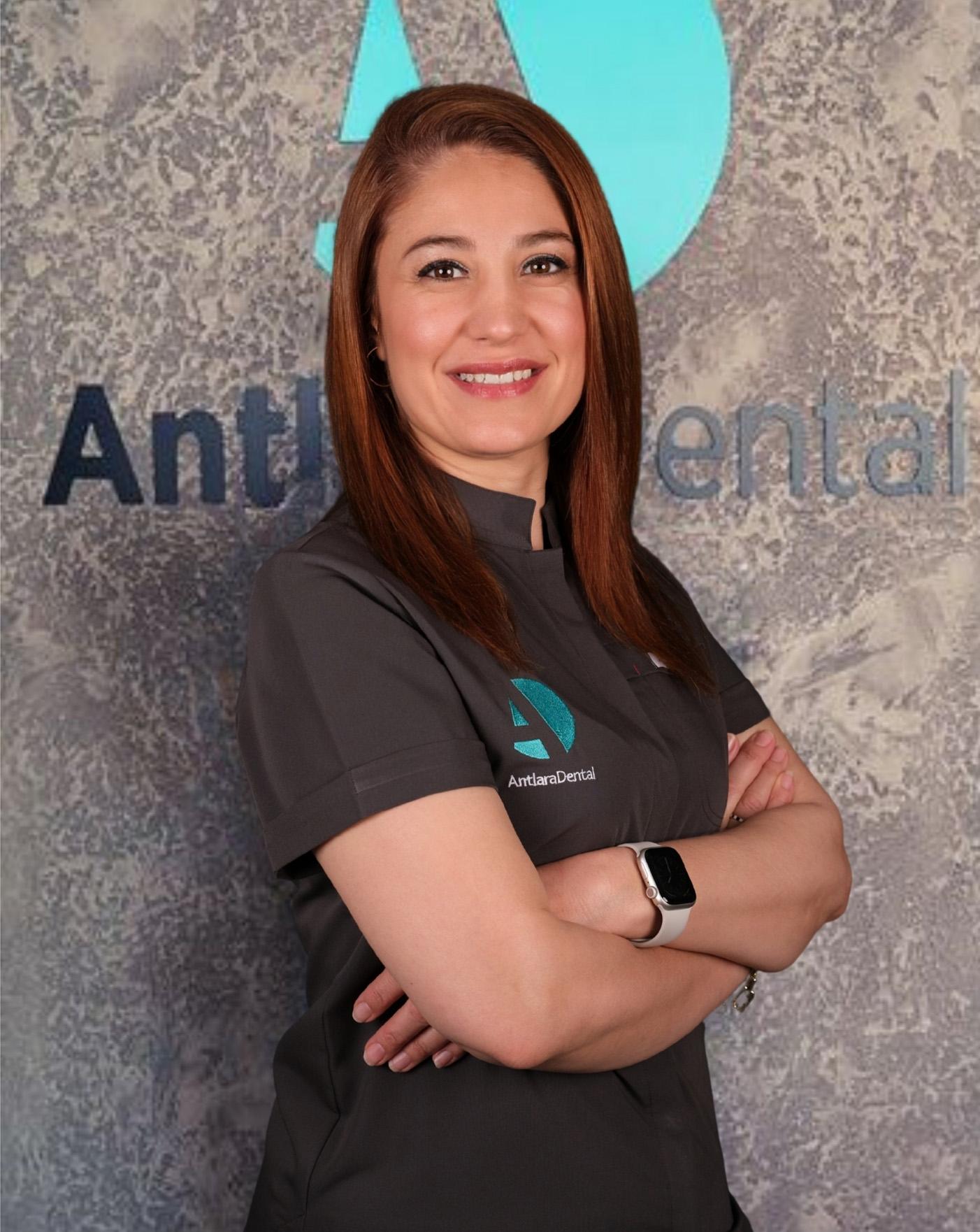
Dt. Dilek AKSU GÜLER
Dentist · Co-founder
Dt. Dilek Aksu Güler graduated from Süleyman Demirel University Faculty of Dentistry in 2005 and is the founding dentist of Antlara Dental in Lara, Antalya. She focuses on aesthetic restorations (veneers and crowns), digital smile design and implant-supported prostheses, and speaks Turkish, English and German.
Sources
- Veneers. American Dental Association, MouthHealthy.↩mouthhealthy.org
- Sağlık Hizmetlerinde Tanıtım ve Bilgilendirme Faaliyetleri Hakkında Yönetmelik. T.C. Sağlık Bakanlığı; RG 12/11/2025 No 33075. 2025.↩resmigazete.gov.tr
- Dental fillings. healthdirect Australia (government-funded health information), last reviewed February 2025. 2025.↩healthdirect.gov.au
- Consensus Report of Group 4 of the 1st Global Consensus for Clinical Guidelines for the Rehabilitation of the Edentulous Maxilla. Clin Oral Implants Res 2026;37 Suppl 30:S81-S107. 2026.↩doi.org
- Survival of monolithic lithium disilicate, monolithic zirconia and metal-ceramic single crowns: systematic review. International Journal of Prosthodontics 2026;39(3):308-324. 2026.↩doi.org
- Incidence of pulp necrosis and periapical pathosis after indirect restorations: systematic review and meta-analysis (37 studies, 11,615 teeth). BMC Oral Health 2023. 2023.↩pmc.ncbi.nlm.nih.gov
- Survival and failure causes of ceramic laminate veneers: systematic review (25 studies, 6,500 veneers, 3-21 years). Journal of Clinical Medicine 2021;10(5):1074. 2021.↩pmc.ncbi.nlm.nih.gov
- Tooth bleaching: umbrella review of 28 systematic reviews (416 randomised trials). Heliyon 2024. 2024.↩pmc.ncbi.nlm.nih.gov
- The frequency of denture replacement (position statement). American College of Prosthodontists; approved 20 Oct 2015, reaffirmed 30 Oct 2018. 2015.↩prosthodontics.org
- Standards for the Dental Team, Principle 2: communicate effectively with patients. General Dental Council (UK).↩standards.gdc-uk.org
- Tüketicinin Korunması Hakkında Kanun, Law No. 6502 (consolidated text). Resmî Gazete 28/11/2013 No 28835; consolidated PDF, mevzuat.gov.tr. 2013.↩mevzuat.gov.tr