
How long does a root canal take?
The NHS says root canal treatment usually takes two or more appointments, each lasting one to two hours or sometimes longer. Some teeth can be finished in a single visit. Research has found no clear difference in how well the tooth heals with one visit or several. Soreness afterwards is common and usually settles over the following days.
- The NHS describes two or more appointments of one to two hours each, sometimes longer.
- One visit or several: studies found no clear difference in healing.
- Pain in the first week was reported somewhat more often after one-visit treatment.
- A severe flare-up that needs an extra visit is uncommon, at about 3 in 100 cases.
How many appointments, and how long each takes
The NHS says that root canal treatment usually takes 2 or more appointments1, and that each appointment may last 1 to 2 hours, or sometimes longer. That describes usual practice in the UK health service, not a trial result, but it is a fair starting point.
The plan depends on the tooth. Back teeth have more canals than front teeth, and the canals can be narrow or curved, so they usually take longer. If there is an infection, the dentist may leave a medicine inside the tooth under a temporary filling and finish at a later visit.
The research we reviewed does not report how long each appointment takes. Any time in minutes is an estimate for a particular tooth, and your dentist can give you one after examining it.
What happens during treatment
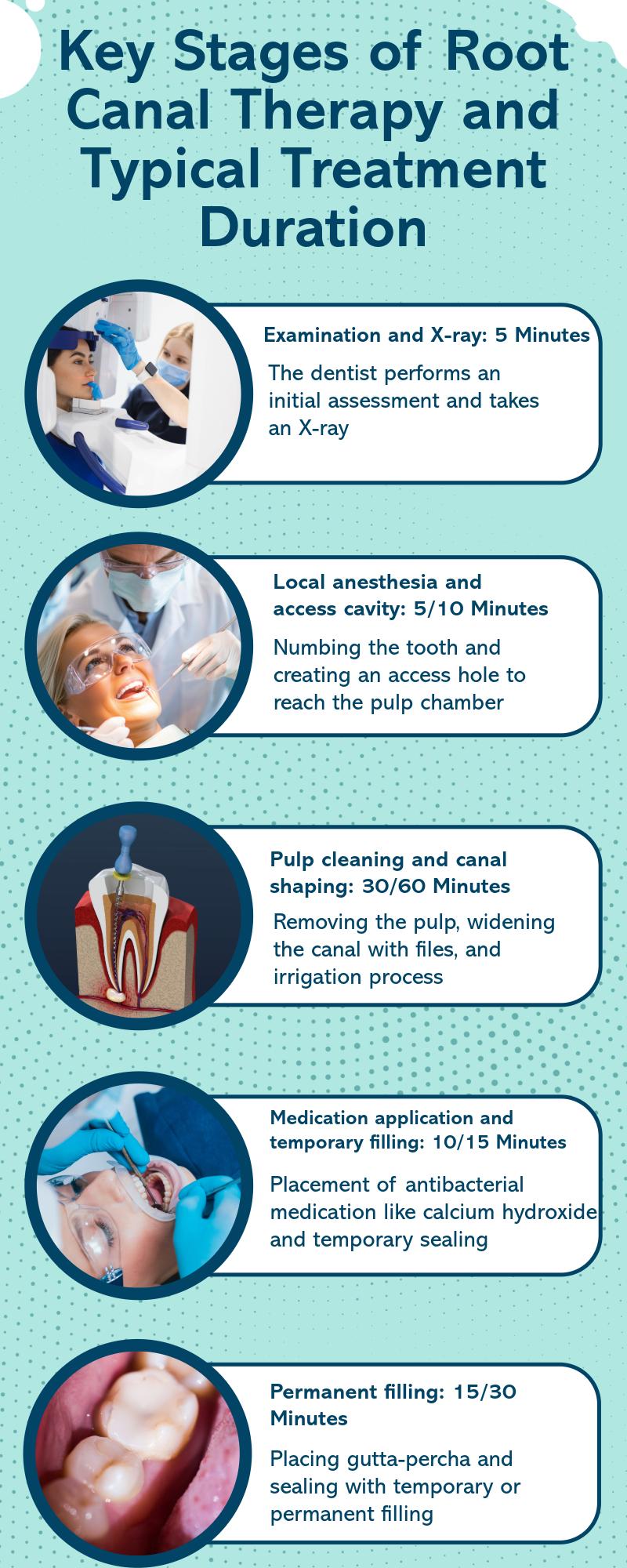
- Examination and X-ray. The dentist checks the tooth and the bone around the root.
- Local anaesthetic. The tooth is numbed, so you stay awake. If you still feel pain, say so. In studies of patients who were already in pain before treatment, extra anaesthetic injections were often needed2.
- Isolating the tooth. A thin rubber sheet, called a rubber dam, is placed around the tooth to keep it dry and clean. The trials in the Cochrane review below all used one.
- Cleaning the canals. The dentist opens the tooth, removes the inflamed or infected pulp, shapes the canals and rinses them with a disinfectant.
- Medicine and a temporary filling, if needed. When the treatment is split over visits, the tooth is sealed with a temporary filling in between.
- Filling the canals and sealing the tooth. The canals are filled and the tooth is closed with a filling. Some teeth then need a crown, which means further appointments after the root canal treatment itself.
One visit or several?
A Cochrane review of 47 trials compared finishing the treatment in one visit with spreading it over several. In the 13 trials that checked X-rays a year or more later (1,505 teeth), it found no clear difference in failure3, with moderate certainty. That does not prove the two are the same, but neither was shown to heal better.
There was one difference. People were somewhat more likely to report pain within the first week3 after one-visit treatment than after the first of several visits (moderate certainty). How strong the pain was up to 72 hours after the filling did not differ (low certainty), and there was no clear difference in swelling or flare-ups (very low certainty). The authors concluded that neither approach can prevent pain and other problems in the year after treatment.
So the number of visits is a practical decision about your tooth, not a question of which method is better. An infection that needs medicine between visits, or a tooth with many or difficult canals, are common reasons for more than one appointment.
Does it hurt, and how long does recovery take?
Pain is most common before treatment, not after it. A review of pain in root canal treatment averaged the studies that measured it at each point2: the share of patients with pain was 81% before treatment (30 studies), 40% a day after (11 studies) and 11% a week after (12 studies). The severity of the pain also fell sharply within a day. These are averages across studies, not your personal chance.
The NHS says the area may feel swollen and sore1 afterwards, but it should get better in a couple of weeks. It suggests paracetamol or ibuprofen if you are in pain. Follow your dentist's advice on pain relief, do not go over the maximum daily dose, and swallow the tablets4 rather than holding one against the gum. If you are managing the pain yourself and still need painkillers after 24 hours, ask a pharmacist or your dentist.
A flare-up means severe pain or swelling that needs an extra visit, usually within the first week. A review of 15 studies with 24,320 cases found this in about 3 in 100 cases5, ranging from under 1 to about 9 in 100 between studies. Flare-ups were more common when the tooth hurt on its own, or when tapping it hurt, before treatment. Each of those findings comes from only three non-randomised studies, so they are uncertain.
How long the tooth lasts afterwards
In pooled studies, about 86 to 93 in 100 root-treated teeth were still in place6 2 to 10 years after treatment; most of the studies looked back at patient records. Still in place does not mean trouble-free. Complete healing seen on an X-ray is a different, stricter measure: a review of studies published between 1922 and 2002 found pooled success rates of 68% to 85%7 on the strictest criterion. The two sets of figures come from different studies and cannot be compared directly.
Teeth that received a crown after treatment survived longer in observational studies. The one trial in a Cochrane review that compared a crown with a filling could not show a difference8 in failures after 3 years. It was small (117 people), included only premolars restored with a post and had a high risk of bias, so it cannot show that the two do equally well. Whether your tooth needs a crown depends on how much of it is left.
When to contact your dentist
Contact your dentist if, after treatment:
- pain or swelling gets worse instead of better, or becomes severe;
- soreness has not settled after a couple of weeks;
- the temporary filling comes out or the tooth breaks.
Ask for an urgent appointment if your face, cheek or jaw becomes swollen or you have a high temperature.
Before treatment, see a dentist if toothache lasts more than 2 days or does not go away with painkillers9.
Emergencies. Call 112 or go to the nearest emergency department if you have swelling that makes it hard to breathe, speak or swallow, a swollen or painful eye or sudden problems with your eyesight, swelling in your neck, a lot of swelling inside your mouth10, or if you find it hard to open your mouth.
Frequently asked questions
How long will the tooth last after a root canal?
In pooled studies, about 86 to 93 in 100 root-treated teeth were still in place 2 to 10 years later. That does not mean trouble-free, and no study can predict the result for one tooth.
Can my body fight off a tooth infection on its own?
The body can contain an infection for a while, but a dental abscess will not go away on its own. The cause stays in the tooth or gum until a dentist drains the pus and treats it.
Will antibiotics stop it becoming dangerous?
They help when an infection is spreading or makes you unwell, but they do not remove the cause. The tooth still needs draining and treatment. Warning signs need urgent care even if you are taking antibiotics.
Can I have teeth on the same day as implant surgery?
Sometimes, in selected patients: the implant has to hold firmly enough in the bone when it is placed. The tooth fitted then is usually temporary, and the final crown or bridge follows healing. This is decided during surgery, so ask what happens if it is not possible.
Why does an implant take so much longer than a crown?
A crown is made for a tooth that is already in place, so most of the wait is laboratory work. An implant replaces the root. It usually has to fuse with the jawbone before it carries the final tooth, and bone heals at its own pace.

Dt. Dilek AKSU GÜLER
Dentist · Founder
She has completed advanced training in implantology and works in aesthetic restorations and smile design.
Sources
- NHS: Root canal treatment. NHS. 2025.↩nhs.uk
- Pain prevalence and severity before, during, and after root canal treatment: a systematic review. Journal of Endodontics 2011;37(4):429-438 (Pak JG, White SN). 2011.↩doi.org
- Single versus multiple visits for endodontic treatment of permanent teeth (Cochrane review). Cochrane Database of Systematic Reviews 2022;12:CD005296 (Mergoni G et al.). 2022.↩doi.org
- SDCEP Management of Acute Dental Problems: Analgesia (supporting tool). Scottish Dental Clinical Effectiveness Programme (SDCEP). 2026.↩acutedentalproblems.sdcep.org.uk
- Factors associated with endodontic flare-ups: a systematic review and meta-analysis. International Endodontic Journal 2026;59(9):1778-1791 (Ohshima J et al.). 2026.↩doi.org
- Tooth survival following non-surgical root canal treatment: a systematic review of the literature. International Endodontic Journal 2010;43(3):171-189 (Ng YL, Mann V, Gulabivala K). 2010.↩doi.org
- Outcome of primary root canal treatment: systematic review of the literature, part 1. International Endodontic Journal 2007;40(12):921-939 (Ng YL et al.). 2007.↩doi.org
- Single crowns versus conventional fillings for the restoration of root filled teeth (Cochrane review). Cochrane Database of Systematic Reviews 2012;(5):CD009109 (Fedorowicz Z et al.). 2012.↩doi.org
- NHS: Toothache. NHS (nhs.uk). 2024.↩nhs.uk
- NHS: Dental abscess. NHS (nhs.uk). 2026.↩nhs.uk