
How long until a tooth infection becomes dangerous?
No one can give you a reliable number of days or weeks. The sources we checked give no timeline, and warning signs matter more than time. Serious complications can happen: an infection can spread into the face and neck and, rarely, cause sepsis. An abscess will not go away on its own, so see a dentist promptly, and get emergency help at once for the signs listed below.
- There is no reliable timeline; act on warning signs, not on how many days have passed.
- Swelling that affects breathing, swallowing, speaking, your eye or your neck needs emergency care now.
- A swollen face or jaw, or toothache with a high temperature, needs an urgent dental appointment.
- Early treatment of the tooth, draining the pus and removing the cause, deals with the infection at its source.
Why no one can give you a timeline
You may read that a tooth infection turns deadly within a set number of days or weeks. None of the guidance or studies we checked gives a reliable time for an untreated tooth infection to become dangerous. How an infection behaves depends on where it is, how the body responds to it, and whether it is treated.
What the guidance does give is a set of warning signs. Scottish dental prescribing guidance (SDCEP) and the NHS describe what a spreading infection looks like and when it becomes an emergency. Those signs are listed below, and they are the reason not to wait and see.
Some people are more vulnerable if an infection does spread. SDCEP's list for sepsis includes people under 1 or over 751, people who are frail, pregnant or have a weakened immune system, and people who have recently had surgery or repeated courses of antibiotics. If you are in one of these groups, have a tooth infection seen sooner rather than later.
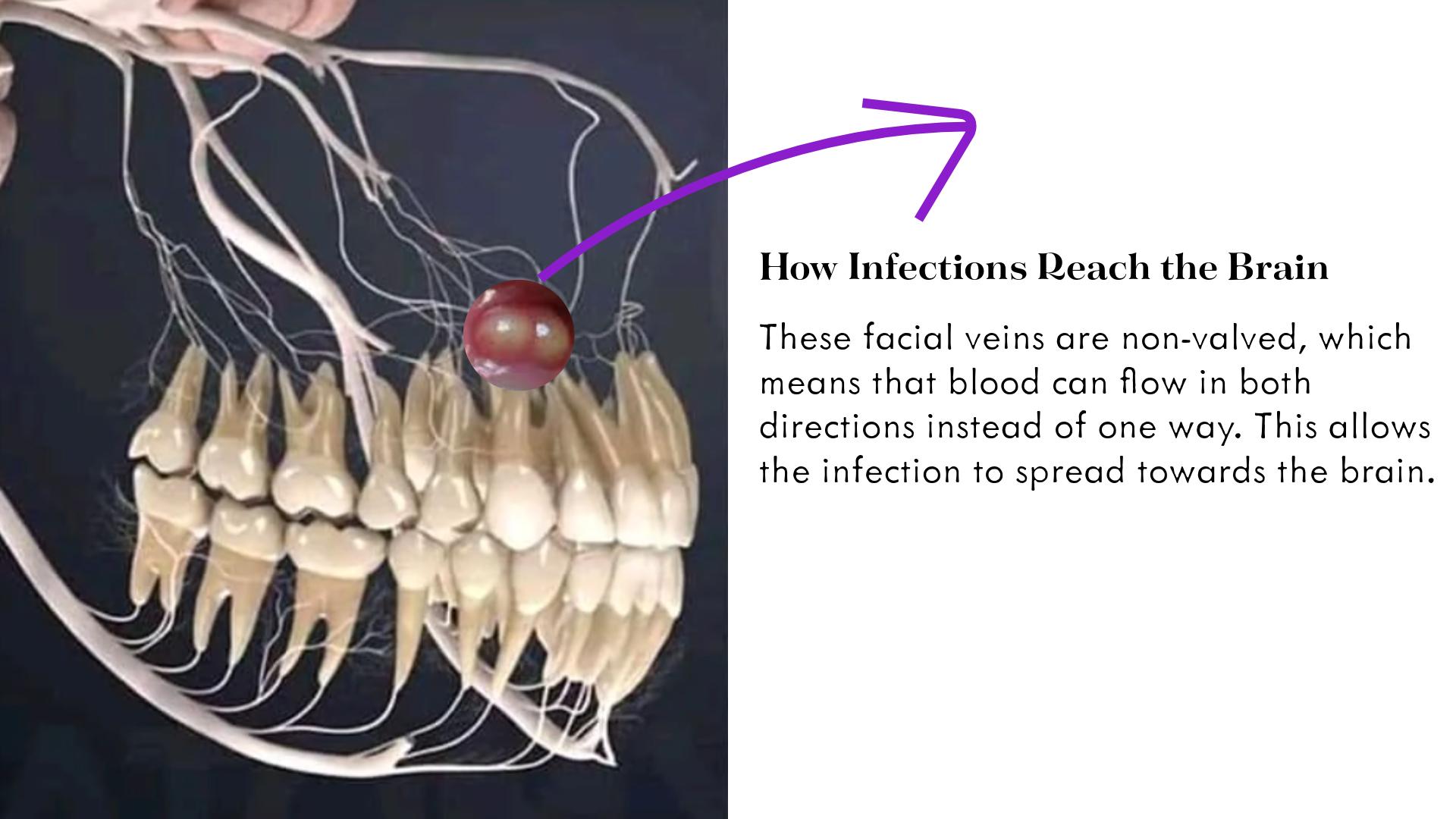
How a tooth infection can become serious
An abscess at the root of a tooth is a pocket of pus. The NHS says it will not go away on its own2 and needs urgent treatment by a dentist. Left untreated, the infection can spread.
- Into the face, jaw and neck. Swelling can spread under the skin (cellulitis) and into the spaces of the neck. SDCEP tells dentists to send patients to hospital as an emergency for swelling of the floor of the mouth, difficulty breathing or swallowing3, a jaw that will hardly open, or rapidly spreading swelling. Swelling under the tongue and jaw can narrow the airway; one named form of this is Ludwig's angina.
- Into the sinus and around the eye. An infected upper back tooth can cause sinusitis. A review of reported cases found 110 cases with complications beyond the sinus, about 70 in 100 of them around the eye4, most often from infection at the root of an upper molar. These were collected case reports, so they cannot tell us how often this happens.
- Through the whole body (sepsis). Sepsis is when the body's response to an infection starts to damage its own organs. SDCEP describes sepsis from a dental infection as rare but potentially life-threatening1.
How often does it become life-threatening?
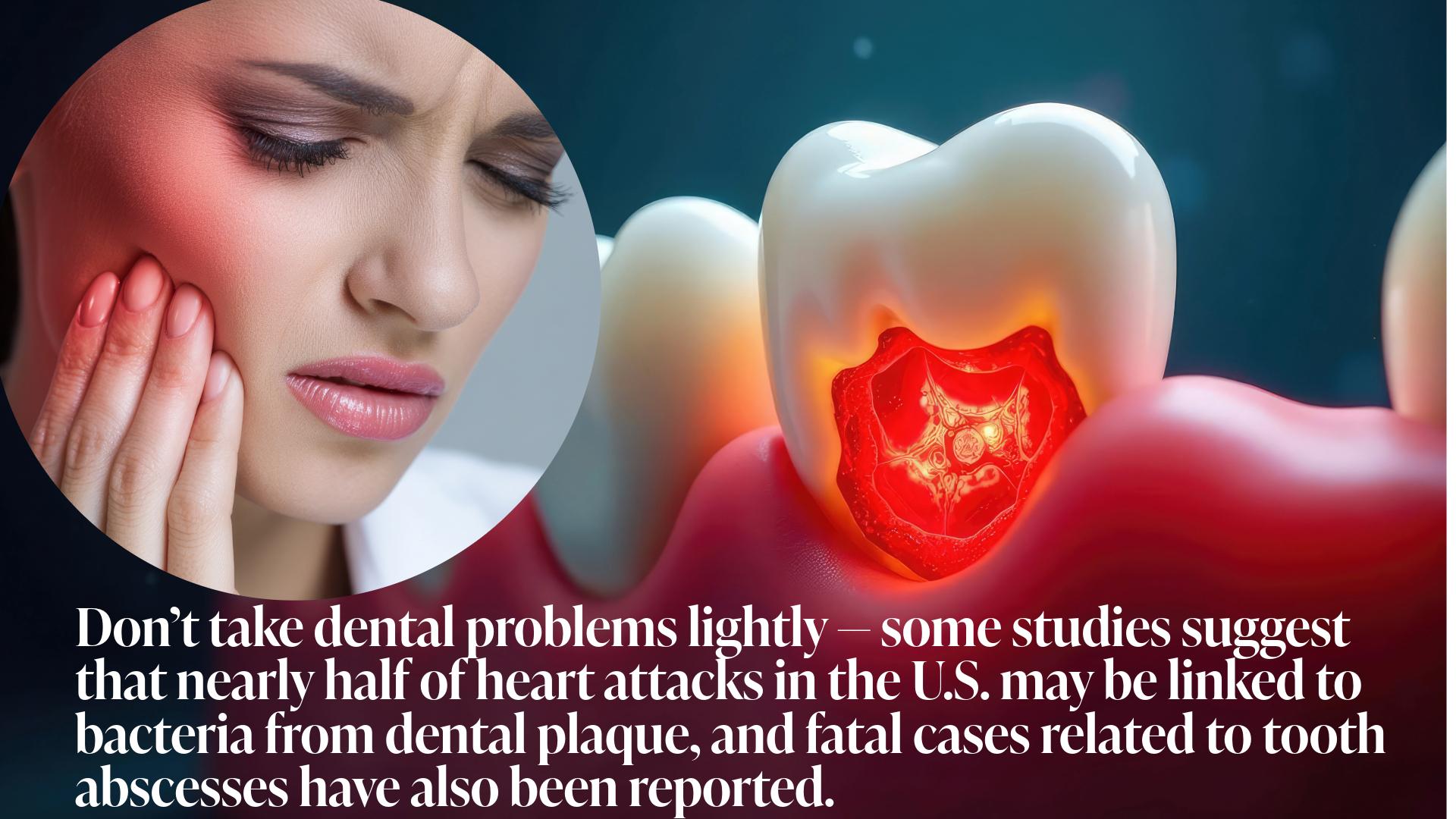
The figures that exist are few, and easy to misread. A US study looked at 61,439 hospital stays between 2000 and 2008 in which the main diagnosis was an abscess at the root of a tooth. 66 of those patients died in hospital5. That is about 1 in 1,000 of those hospital stays, by our own calculation. Most of the admissions (89 in 100) were emergencies or urgent, and the average stay was about 3 days.
This figure is not your risk. It counts only people who were already ill enough to be admitted to hospital in the US, not everyone with a tooth infection, and the study summary does not say whether the abscess caused each death. No source we checked gives the share of tooth abscesses that become dangerous, so we do not give one. What the figures do show is that people admitted with a tooth abscess can die, which is why the warning signs below matter.
Warning signs: when to act now
Call 112 or go to the nearest emergency department, without waiting for a dental appointment, if you have a tooth infection and:
- you find it hard to breathe, speak or swallow
- your eye is swollen or painful, or your eyesight changes suddenly
- your neck is swollen
- there is a lot of swelling inside your mouth
- you find it hard to open your mouth
- swelling in your face or mouth is spreading quickly
These signs come from the NHS abscess2 and toothache6 pages. Sepsis signs can be vague: SDCEP lists confusion, uncontrollable shivering (rigors), breathlessness, a fast heart rate, a very high or low temperature and mottled skin. If you have a dental infection and feel like this, get emergency help.
Ask for an urgent dental appointment, if none of the emergency signs above applies, when:
- you think you have an abscess
- your face or jaw is swollen
- you have toothache with a high temperature
The NHS lists these as reasons to see a dentist urgently rather than to call emergency services.
How the infection is treated
The infection is dealt with by treating the tooth. The dentist drains the pus under local anaesthetic and removes the cause, usually with root canal treatment or by taking the tooth out. SDCEP tells dentists to treat an abscess first with local measures3: drainage and, where possible, removing the cause.
Antibiotics have a place, but not instead of treatment. SDCEP says to consider them when there is cellulitis, spreading infection or systemic involvement7, or when local measures have not worked. If you are given antibiotics, the tooth still needs treatment. SDCEP advises a review after about 3 days; if you get worse before then, contact your dentist without waiting.
Until you are seen, ordinary painkillers such as ibuprofen or paracetamol can help if they are safe for you. Stay within the dose on the pack. Do not squeeze or prick a swelling yourself. Painkillers can make you feel better while the infection continues, so the warning signs above still apply.
Frequently asked questions
Will I have a temporary tooth while the implant heals?
Not always. The gap may be left empty, or you may have a removable temporary denture or a temporary bridge bonded to the neighbouring teeth. In selected patients, a temporary tooth goes on the implant. Your plan should say which.
Can a veneer that has come off be put back?
Keep it, and do not glue it back yourself. Whether it can be bonded again depends on whether it is intact and on the state of the tooth underneath. Your dentist decides after examining both.
Do composite veneers last as long as ceramic ones?
The only comparison we cite is a two-year trial in selected patients with several gaps between their teeth. Survival did not differ significantly: about 93 in 100 composite and 95 in 100 ceramic veneers, with repairs and fractures counted as failures. Composite edges discoloured more often.
How long does each appointment take?
The NHS says appointments may last one to two hours, or sometimes longer. Back teeth, with more canals, usually take longer than front teeth. Your dentist can give you an estimate after examining the tooth.
How long can I live with an infected tooth?
No source we checked gives a reliable timeline, and we will not guess one. An infection may stay in one place or spread, and you cannot tell which from the calendar, so have an infected tooth treated promptly and watch for warning signs.

Dt. Dilek AKSU GÜLER
Dentist · Founder
She has completed advanced training in implantology and works in aesthetic restorations and smile design.
Sources
- SDCEP Drug Prescribing for Dentistry: Sepsis. Scottish Dental Clinical Effectiveness Programme (SDCEP). 2026.↩sdcepdentalprescribing.nhs.scot
- NHS: Dental abscess. NHS (nhs.uk). 2026.↩nhs.uk
- SDCEP Drug Prescribing for Dentistry: Dental abscess. Scottish Dental Clinical Effectiveness Programme (SDCEP). 2026.↩sdcepdentalprescribing.nhs.scot
- Extrasinus complications from odontogenic sinusitis: a systematic review. Otolaryngology-Head and Neck Surgery 2022;166(4):623-632. 2022.↩doi.org
- Outcomes of hospitalizations attributed to periapical abscess from 2000 to 2008 (US Nationwide Inpatient Sample). Journal of Endodontics 2013;39(9):1104-1110. 2013.↩doi.org
- NHS: Toothache. NHS (nhs.uk). 2024.↩nhs.uk
- SDCEP Drug Prescribing for Dentistry: Bacterial infections. Scottish Dental Clinical Effectiveness Programme (SDCEP). 2026.↩sdcepdentalprescribing.nhs.scot