
What is an implant-supported bridge?
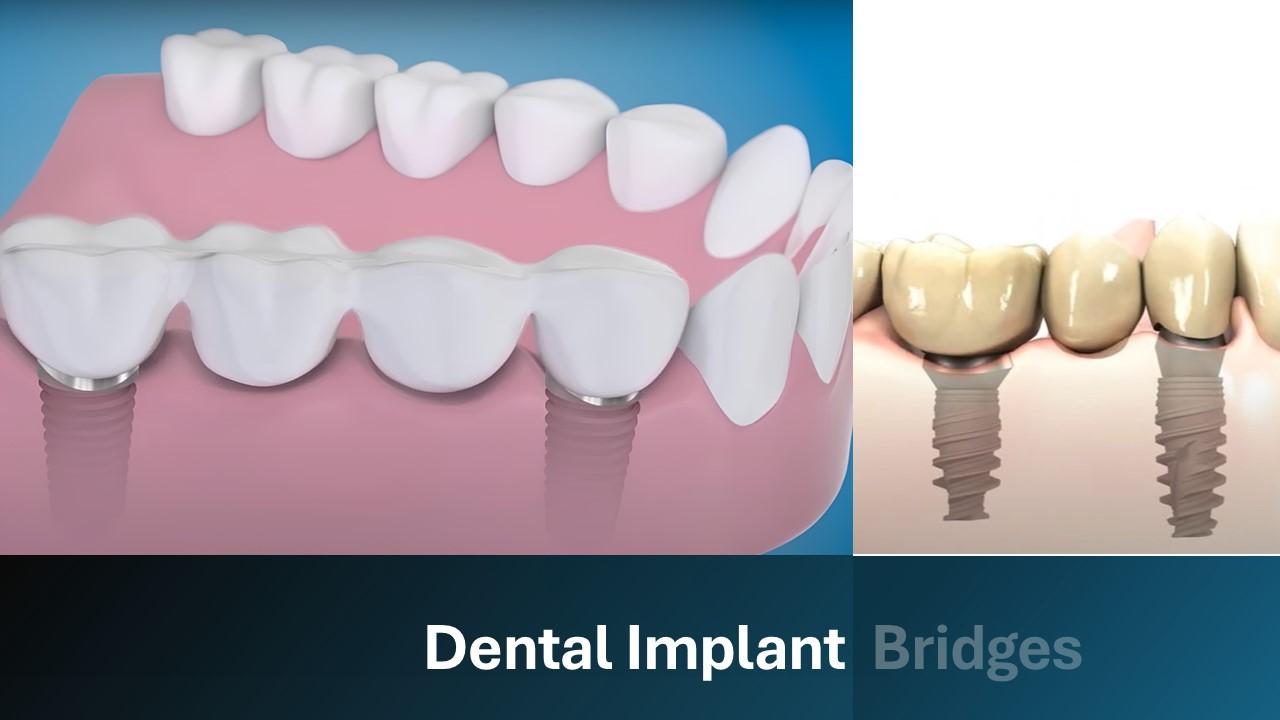
An implant-supported bridge is a row of false teeth fixed to implants in the jawbone instead of to natural teeth. It can replace several missing teeth in a row on fewer implants than teeth, or all the teeth in a jaw on four to six implants. The neighbouring natural teeth are not reduced to carry it. It needs implant surgery, healing, daily cleaning and regular reviews.
- It is a fixed bridge carried by implants, used for several missing teeth in a row or for a whole jaw.
- How many implants it needs is decided for your mouth; for a whole jaw, whether four or six is better has not been settled.
- For whole-jaw bridges, about 98 in 100 implants were in place after five years or more in a 55-study review, but the bridge itself needs maintenance.
- Screw loosening, chipped veneering and inflammation around the implants are the problems to watch for.
How it differs from an ordinary bridge
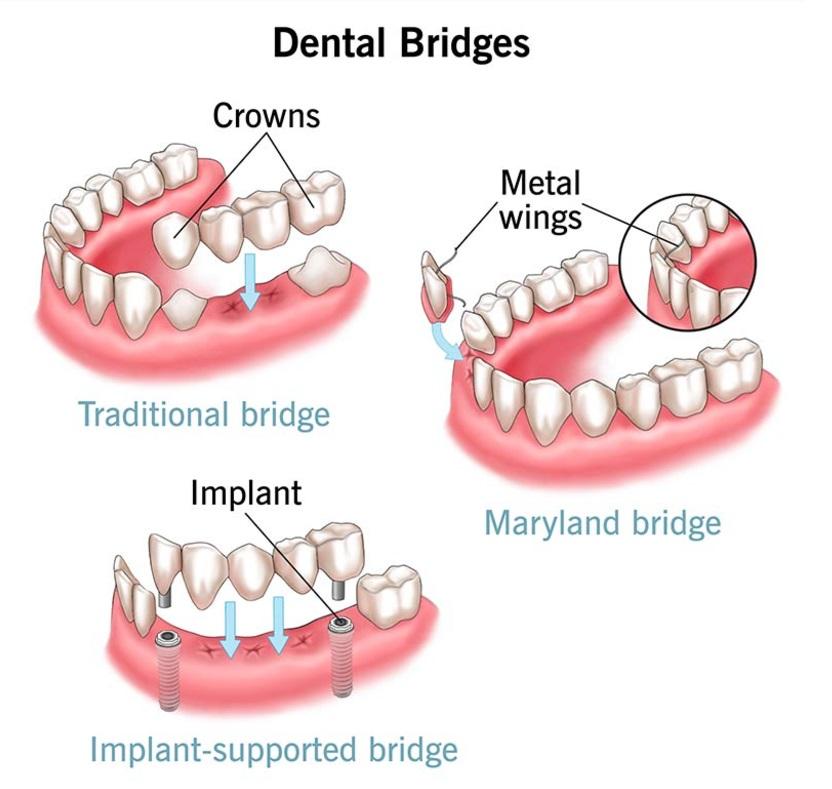
An ordinary (conventional) bridge is held by natural teeth, usually one at each end of the gap. Those teeth are reduced and crowned to carry it, and the tissue removed does not grow back. An implant-supported bridge is held by implants instead, so the neighbouring teeth are left as they are.
The trade-off is surgery. Implants are placed in the bone and have to heal before the final bridge is fitted. A conventional bridge usually needs no surgery, but it depends on the teeth at each end being strong enough to carry it.
An implant bridge is also different from one implant per tooth. With a bridge, fewer implants carry more teeth, and the false teeth between them span the gap. With one implant per tooth, each tooth has its own implant and crown.
The options without implant surgery are a conventional bridge, where the teeth at the ends of the gap can carry it, and a removable partial denture; for a whole jaw, a full denture. A denture that clips onto implants needs fewer implants than a fixed bridge. Each brings its own trade-offs in cleaning and comfort.
When it is used, and how many implants
An implant-supported bridge is usually considered for:
- Several missing teeth in a row, for example three teeth replaced on two implants.
- A long gap where the teeth at the ends cannot carry a conventional bridge, or there are no teeth at one end.
- All the teeth in a jaw. A full-arch bridge on four or six implants, known as All-on-4 or All-on-6.
How many implants a gap needs is a planning decision for your mouth; there is no fixed rule. It depends on the bone, the bite and where the gap is. For a whole jaw, reviews have not settled whether four or six implants is better: implant number did not significantly change implant or bridge survival1, and those comparisons were not randomised.
The conditions are the same as for any implant: enough bone (or bone added with a bone graft or sinus lift, before or during implant placement), healthy gums and a medical history that allows surgery. Tell your dentist about diabetes, any radiotherapy to the head or neck, and every medicine you take or have taken, especially bone-strengthening medicines, tablets or injections. The decision is made after an examination and a 3D scan.
What treatment involves
Treatment has two main stages, the implant surgery and the bridge, with healing in between. The dental implants page explains the steps in more detail.
In selected patients a temporary bridge can be fitted on the implants within a week. Research names three timings: immediate (within a week), early (one week to two months) and conventional (after two months)2. A Cochrane review found no convincing difference in failure between immediate and conventional loading, with follow-up of up to a year, but its result was imprecise and most of its trials were at high or unclear risk of bias, so it does not show that the two are equally safe. A review of 39 randomised trials reported slightly lower implant survival3 with immediate loading. Ask which timing your plan uses and why. However soon the teeth go in, follow your instructions on eating, cleaning the wound and painkillers in the first weeks: a temporary bridge fitted early does not mean you can chew normally on it straight away.
- Examination and 3D scan: Bone, gums, the remaining teeth and your medical history are assessed, and the plan is given in writing.
- Preparation: Decay and gum disease are treated first. Teeth that cannot be kept are removed, and bone is added if needed.
- Implant surgery: The implants are placed under local anaesthetic, with sedation if you want it and it suits you.
- Healing: The implants fuse with the bone over months. A temporary bridge or a removable denture may be worn meanwhile.
- The final bridge: A scan or impression is taken, the fit and bite are tried, and the bridge is screwed or cemented to the implants.
- Baseline record and reviews: An X-ray and gum measurements are taken when the bridge is complete, and regular reviews follow.
How long implant bridges last
The studies we use here are about whole-jaw bridges. A 2026 review of 55 studies found that of every 100 implants carrying a full-arch bridge, about 98 in All-on-4 and 97 to 98 in All-on-64 were still in place after five years or more. The bridges themselves were counted in a 2012 review of full-arch bridges on four to six implants. There, about 97 in 100 upper and 98 in 100 lower bridges were in use after five years, and about 95 and 96 after ten5.
Bridges on implants in general were counted in another 2012 review, of 32 studies: about 95 in 100 bridges were still in use after five years, but only about two in three patients had been free of any problem; the most common was chipped porcelain, in about 14 per cent6. The whole-jaw figures above should not be carried over to shorter bridges.
All of these are averages pooled from studies in different countries and groups of patients. They are not the result of one clinic or implant brand, and not your personal risk. None of the reviews gives figures beyond the follow-up they measured, so a bridge for life is not a promise the evidence supports.
What can go wrong
The bridge itself. An umbrella review of full-arch bridges, with 5 to 15 years of follow-up, reported screw loosening in 5 to 15 per cent, chipping of veneered zirconia in 15 to 35 per cent and fracture of the bridge's framework in under 5 per cent1, as far as the review summaries show; they do not make clear what these percentages were counted against. A loose screw can be tightened and a chip is often repaired, but repairs are part of owning one, and some bridges have to be remade.
Bone and gum around the implants. In the 55-study review, bone loss around the implants averaged about 1 millimetre per implant over five years4. That is an average across studies, not a safe limit: changes in your own bone level are judged against the baseline X-ray taken when the bridge is fitted. Peri-implantitis is inflammation with loss of the bone that supports an implant. In reviews of full-arch bridges it was reported in 4 to 18 per cent of patients1, as far as the review summaries show; across implant patients in general, a 57-study review found it in about 20 in 100 patients and about 12 in 100 implants7. The rate depends on the definition used.
Surgery. Bleeding, swelling, bruising and infection can occur. Sometimes an implant does not fuse with the bone and has to be removed; your dentist then explains the options. In the lower jaw, because the nerve canal is close, the lip and chin can go numb; this is usually temporary and rarely permanent. In the back of the upper jaw the sinus is close: its membrane can tear, sinusitis can develop, or an opening can form between the mouth and the sinus. A 3D scan and careful planning reduce these risks; they do not remove them.
What raises the risk. In people smoking more than 20 cigarettes a day, implant loss was about 2.5 times as likely per implant8 as in non-smokers, and about 4 times as likely per patient; the risk rose with the number of cigarettes, and no safe number has been shown. People treated in the past for gum disease that had damaged the bone (periodontitis) lost implants at about 1.75 times the rate9 of people without that history. In people likely to clench or grind, the odds of failure were about 2.2 times higher10. These are associations, not proven cause and effect.
What happens to a bridge if one of its implants is lost depends on the design and how many implants remain. That has not been measured in the reviews used here; ask your dentist what the plan would be.
Cleaning and reviews
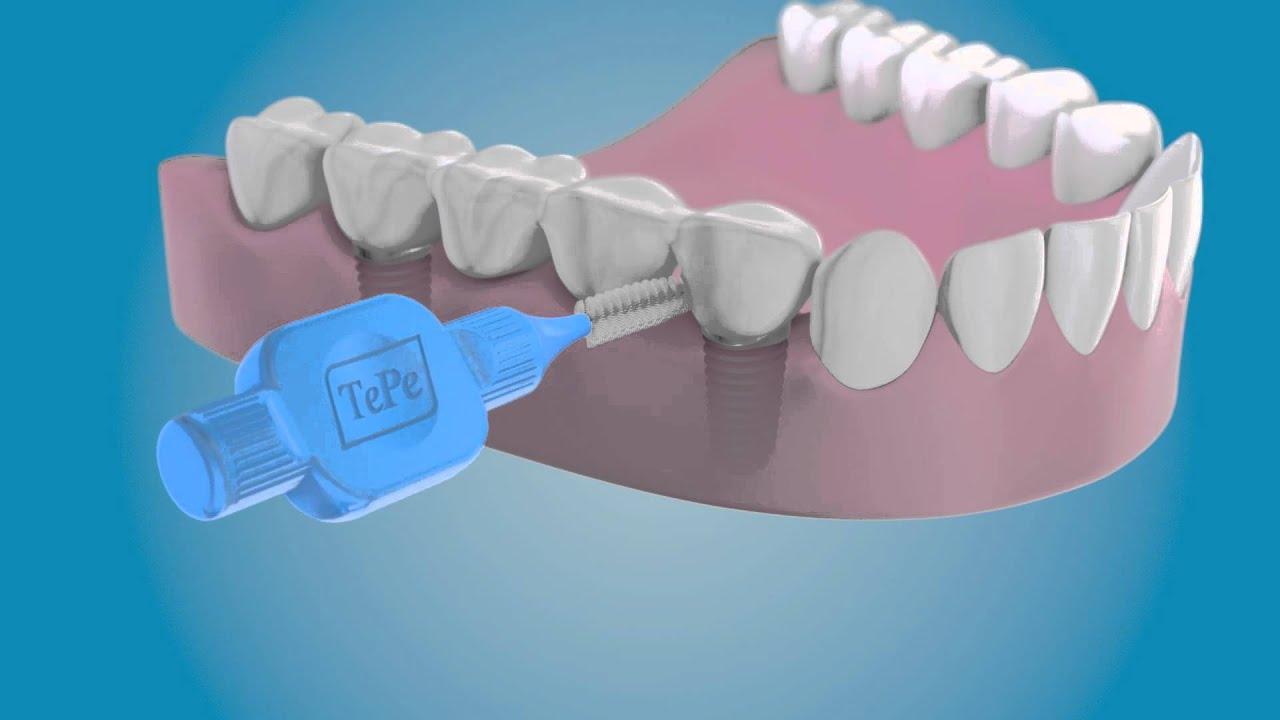
Plaque collects under an implant bridge and around the implants, just as it does on teeth. A toothbrush alone does not reach under the false teeth. Small interdental brushes and floss threaders are used there; your dentist or hygienist shows you what fits under your bridge.
When the bridge is complete, an X-ray and gum measurements should be taken as a baseline record11. Later changes are compared with it. After that, implants need a structured programme of regular checks12, set for your risk rather than taken from a routine check-up interval. If you clench or grind, a night guard may be advised to protect the bridge.
When to see a dentist
Contact your dentist if you notice any of these:
- The bridge moves, a screw feels loose, or a piece chips or breaks
- Bleeding, a bad smell, pus or receding gum around an implant
- Pain on biting, or a bite that suddenly feels different
- After surgery: pain or swelling that increases after the third day, bleeding that does not stop, or numbness that lasts beyond the anaesthetic (tell your dentist promptly)
Emergencies. Difficulty breathing or swallowing, rapidly spreading swelling of the face or neck, or high fever are serious signs. Go to the nearest emergency department or call 112.
Frequently asked questions
Does a root-filled back tooth always need a crown?
No. It can be restored with a filling, an onlay that covers the cusps, or a crown. The evidence does not show that one option is always best; the choice depends on how much sound tooth is left.
Is Invisalign as effective as braces?
For cases without extractions, reviews found no significant difference. Where teeth are removed, and in one review of adults overall, fixed braces gave a more precise result. The choice depends on the case, not the brand.
Which lasts longer, an onlay or a crown?
The studies cannot say. Over one to three years they found no clear difference, and there are no good long-term comparisons. A crown removes much more of the tooth, so it is chosen when the tooth needs it, not because it sounds stronger.
Is immediate placement riskier than waiting?
In one review, survival was slightly lower: about 95 in 100 implants placed straight into the socket, against about 98 in 100 in healed bone. The authors advise caution. Whether it suits you depends on the socket, the bone and your health.
What if the implant cannot go in on the day?
Sometimes this only becomes clear once the tooth is out, for example if a socket wall is damaged. The socket is then left to heal and the implant is placed later. Agree beforehand what happens in that case.

Dt. Dilek AKSU GÜLER
Dentist · Founder
She has completed advanced training in implantology and works in aesthetic restorations and smile design.
Sources
- Prosthetic complications of implant-supported complete arch prostheses: an umbrella review of systematic reviews (7 reviews, >=5-year follow-up). Journal of Prosthetic Dentistry 2026;136(1):52-59. 2026.↩doi.org
- Interventions for replacing missing teeth: different times for loading dental implants (Cochrane review, 26 RCTs, 1,217 participants, 2,120 implants). Cochrane Database of Systematic Reviews 2013;(3):CD003878. 2013.↩doi.org
- Immediate versus early or conventional loading dental implants with fixed prostheses: systematic review and meta-analysis of randomized controlled trials (39 RCTs). Journal of Prosthetic Dentistry 2019;122(6):516-536. 2019.↩doi.org
- All-on-4 and All-on-6 implant-supported fixed prostheses for the edentulous jaw: systematic review and meta-analysis (55 studies). International Journal of Oral and Maxillofacial Surgery 2026;55(9):1098-1112. 2026.↩doi.org
- What is the optimal number of implants for fixed reconstructions: a systematic review (9 studies, per prosthesis). Clinical Oral Implants Research 2012;23 Suppl 6:217-228. 2012.↩doi.org
- A systematic review of the survival and complication rates of implant-supported FDPs after a mean observation period of at least 5 years. Clin Oral Implants Res 2012;23 Suppl 6:22-38. 2012.↩doi.org
- What is the prevalence of peri-implantitis? A systematic review and meta-analysis (57 articles, 2005-2021). BMC Oral Health 2022;22(1):449. 2022.↩doi.org
- Levels of smoking and dental implants failure: systematic review and meta-analysis (23 articles). Journal of Clinical Periodontology 2020;47(4):518-528. 2020.↩doi.org
- Effectiveness of implant therapy in patients with and without a history of periodontitis: systematic review with meta-analysis of prospective cohort studies (14 studies, >=36 months). Journal of Periodontal Research 2025;60(6):524-543. 2025.↩doi.org
- Bruxism and dental implants: systematic review and meta-analysis (27 studies; 2,105 implants in probable bruxers, 10,264 in non-bruxers). Journal of Oral Rehabilitation 2024;51(1):202-217. 2024.↩doi.org
- Peri-implant diseases and conditions: consensus report of workgroup 4 of the 2017 World Workshop on the Classification of Periodontal and Peri-Implant Diseases and Conditions. Journal of Clinical Periodontology 2018;45 Suppl 20:S286-S291. 2018.↩doi.org
- Prevention and treatment of peri-implant diseases: the EFP S3 level clinical practice guideline. Journal of Clinical Periodontology 2023;50 Suppl 26:4-76. 2023.↩doi.org