
Are ceramic implants as good as titanium?
Nobody can say yet. In studies that compared the two directly in healthy patients, there was no significant difference in how many implants stayed in place over one to five years. Beyond five years there is too little comparative data. The evidence is strongest for one-piece implants replacing one to three teeth. Titanium remains the standard, with a much longer record.
- 'No significant difference' in small, short studies is not proof that ceramic and titanium implants last equally long.
- Most research is on one-piece ceramic implants; two-piece designs are newer and have little long-term data.
- For removable dentures held by implants, ceramic implants did worse in the studies available.
- A ceramic implant does not prevent gum inflammation or peri-implantitis; it needs the same cleaning and reviews.
- A suspected titanium allergy is rarely documented; a guideline says ceramic may be considered, on low-level evidence.
What a ceramic implant is
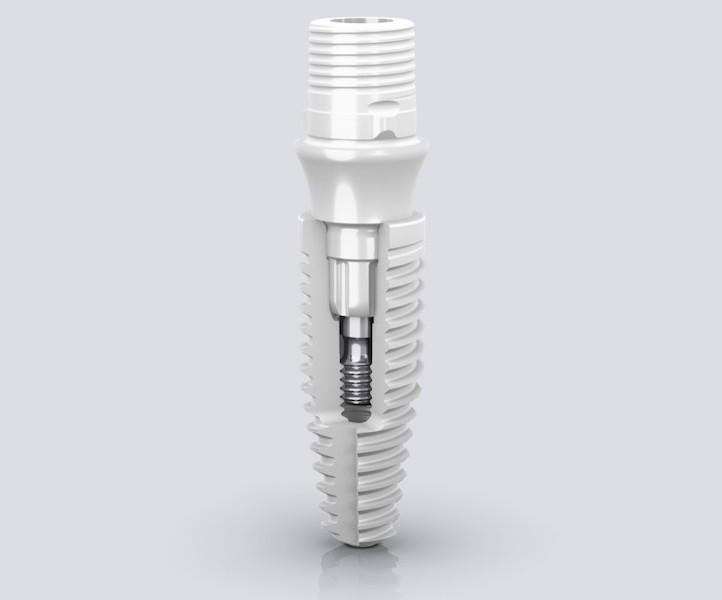
A ceramic dental implant is made of zirconia (zirconium dioxide), a white ceramic, instead of titanium. Like a titanium implant, it is a post in the jawbone that fuses with the bone and carries a crown or a bridge. Titanium is regarded as the international standard1 for implants and has a much longer record.
Ceramic implants come in two designs:
- One-piece. The part in the bone and the part that carries the crown are a single piece, so it heals with that part showing through the gum. Because the crown-carrying part is built in, there is little room to correct its angle or position afterwards, which calls for precise planning and an experienced team2.
- Two-piece. The connector (abutment) is a separate part fixed later. The German guideline notes that this allows bone to be added at the same time and the implant to heal without load.
Most of the research is on one-piece implants; the evidence for two-piece implants is limited3. The early signals are mixed. In the 2026 review described below, two-piece ceramic implants had slightly lower one-year survival than titanium4 in a subgroup analysis, which the authors called a potential difference. A 2023 review that pooled studies of different designs and product generations counted more losses with two-piece than with one-piece implants5 (7.5 against 4.1 per cent); those studies were not built to compare the two, so this is a signal, not a proven difference.
How ceramic and titanium implants compared in studies
A 2026 review pooled 9 studies that compared the two materials directly, with 435 implants, and found no significant difference in implant survival4 at one year, three years and five years or more. Bone level on X-rays differed by a fraction of a millimetre: about 0.16 mm more loss around ceramic implants at one year, a gap that shrank when the less reliable studies were set aside, and no clear difference at five years or more. The authors limit their conclusion to healthy patients, follow-up of up to five years and older implant systems, part of which are no longer sold.
A trial in several centres, published after that review's literature search, placed 61 two-piece ceramic and 61 titanium implants, each carrying one crown. One year after the crowns were fitted, 100 per cent and 96.5 per cent were in place6, a difference that was not significant, and bone levels were similar. The authors found no clinical superiority for either and called the ceramic implant a viable alternative for a single tooth. The trial tested one screw-retained design for one year, and its authors declared grants from the manufacturer.
'No significant difference' does not mean 'just as good'. These studies are small and short, so they cannot show that ceramic implants last as long as titanium.
What studies of ceramic implants alone show
Most studies of ceramic implants have no titanium group. Their figures describe ceramic implants only and cannot be set against titanium figures from other studies.
- Five years. A review prepared for an international implant consensus pooled 6 groups of patients with 277 implants from systems currently on the market. About 97 in 100 were still in place after five years7, with about 1.1 mm of bone loss on average. Still in place is not the same as trouble-free.
- When losses happen. A review of 25 studies with 4,017 implants counted 172 losses (4.3 per cent). 124 of the 172 happened in the first year5.
- Older products. Implants from systems no longer sold, or used only in studies, were lost more often than those on the market: 11.3 against 2.5 per cent. This is an association.
- Fracture. A ceramic implant can break, but in this review it was uncommon: 26 of 4,017 implants. 18 of the 26 came from one study, and 15 of those were very narrow implants (3.25 mm). Implants whose top had been reshaped with a drill were also lost more often. This is not a fracture rate for today's implants of standard width.
The same review also gives a ten-year survival estimate. It is a statistical (life-table) estimate from studies with different lengths of follow-up; most implants were followed for less than ten years, so it is not the observed ten-year result of everyone in the review. The German guideline notes that frequent product changes make it impossible to judge ceramic implants beyond five years1.
Which missing teeth ceramic implants are used for
Expert groups say ceramic implants can be an alternative to titanium in selected cases3. The European Association for Osseointegration found comparable evidence for one-piece implants replacing one to three missing teeth with fixed crowns or a small bridge2.
- Small bridges. A 2025 review of 13 studies reported about 93 in 100 implants in place under three-unit bridges8 after about four years on average. The authors considered them favourable where appearance matters and biting forces are low.
- Removable dentures held by implants. Results were weaker. In the same review about 70 in 100 implants (69.5 per cent) were in place after an average of 12 months, and the authors called this less predictable. In the one randomised trial, 71.2 per cent of ceramic and 82.1 per cent of titanium implants9 were in place after 12 months, and three ceramic implants fractured in the first year against none of the titanium ones.
- Crowns and bridges on top. The EAO paper reported more chipping of the veneering porcelain2 on layered crowns and bridges. That is a problem with the crown or bridge, which may need repair or replacement, not the loss of the implant.
How implant treatment runs, stage by stage, is explained on the dental implants page.
Gum health and appearance
Inflammation of the gum around an implant (peri-implant mucositis) and peri-implantitis, inflammation with loss of the supporting bone, occur around ceramic implants as they do around titanium. A review of comparative studies found no difference in biological complications10, with moderate certainty. At one year the gum bled more often when gently probed around ceramic implants; this finding has low certainty and was not matched by differences in plaque or pocket depth. A 2026 review of 19 studies found peri-implantitis affecting about 2 in 100 ceramic implants in studies of up to five years and about 8 in 100 in longer ones11. The statistical uncertainty was wide (for the longer studies, anywhere from 0 to 23 per cent), definitions differed, and the comparison with titanium showed no significant difference. A ceramic implant does not prevent peri-implantitis and needs the same daily cleaning and regular reviews.
Ceramic implants are often presented as looking more natural. In the comparative review there was no significant difference at one year4 in the pink aesthetic score, which rates the gum around the crown, or in what patients reported. An international consensus suggests, as expert opinion, that ceramic parts passing through the gum might be preferred where appearance matters most. A better appearance with ceramic implants has not been shown in studies.
Titanium allergy and healthy titanium implants
Some people ask for a ceramic implant because they worry about a metal allergy. The German guideline on titanium hypersensitivity says a ceramic implant may be considered when titanium intolerance is suspected12; that recommendation rests on low-level evidence. The same guideline notes that titanium intolerance is not adequately documented and that other metals must be considered too. Skin patch tests and blood (lymphocyte) tests do not help to assess it, and patch testing people before treatment just in case is advised against.
If you have titanium implants that are working well, no source supports removing them to replace them with ceramic. The guideline says that removing an implant for suspected intolerance should be decided on very strict grounds.
What is not known
- How ceramic implants compare with titanium after five years.
- Whether two-piece ceramic implants hold up as well as one-piece ones over the years. The German guideline says a two-piece ceramic implant should be used only after the patient has been told in detail1 that long-term data are missing.
- How ceramic implants do in people who smoke, have diabetes, take bone-strengthening medicines or have had radiotherapy. The comparative studies were in healthy patients. Choosing ceramic does not replace the usual assessment before any implant: gum disease, smoking, diabetes, the medicines you take and past radiotherapy are discussed as they would be for titanium.
- Results with a temporary tooth fitted straight away, with narrow implants for back teeth or under a fixed bridge across a whole jaw. The sources used here give no figures for these.
- Any benefit for general health. No source we used supports it.
If a ceramic implant is proposed to you, ask why it suits your case rather than titanium, whether it is one-piece or two-piece, how often the team places this system and what would happen if it failed.
When to see a dentist
Contact your dentist if an implant or the tooth on it feels loose, if a crown chips or cracks, or if the gum around an implant bleeds, swells, recedes or releases pus. Do not wait for your next planned review. After surgery, call your dental team the same day if bleeding does not stop with pressure or if numbness lasts after the anaesthetic should have worn off.
Emergencies. Heavy bleeding that will not stop, difficulty breathing or swallowing, rapidly spreading swelling of the face or neck, high fever or swelling around the eye are serious signs. Do not wait for the clinic's reply: go to the nearest emergency department or call 112.
Frequently asked questions
Are ceramic implants better than titanium?
Studies have not shown that. In healthy patients followed for up to five years, comparative studies found no significant difference in how many implants stayed in place. Beyond five years there is too little data. Titanium remains the standard, with the longest record.
I think I am allergic to titanium. Should I choose ceramic?
A German guideline says ceramic may be considered when titanium intolerance is suspected, on low-level evidence. It also says such intolerance is poorly documented and that skin patch or blood tests do not help to assess it. Discuss your history with your dentist and doctor.
Can a ceramic implant break?
It can, but in pooled studies it was uncommon: 26 of about 4,000 implants, most of them from one study of very narrow implants. The porcelain on a crown can also chip; that may need repair or a new crown, but the implant is not lost.
Do ceramic implants prevent gum infection?
No. Gum inflammation and peri-implantitis occur around ceramic implants too, and studies found no clear difference from titanium. A ceramic implant needs the same daily cleaning and regular reviews as any other.
Should I replace my titanium implants with ceramic ones?
Not if they are healthy. No source supports replacing working titanium implants with ceramic, and a German guideline says removing an implant for suspected intolerance should be decided on very strict grounds.
Dt. Dilek AKSU GÜLER
Dentist · Founder
She has completed advanced training in implantology and works in aesthetic restorations and smile design.
Sources
- German S3 guideline on the use of dental ceramic implants. International Journal of Implant Dentistry 2022;8(1):43. 2022.↩doi.org
- EAO Position Paper: Current Level of Evidence Regarding Zirconia Implants in Clinical Trials. International Journal of Prosthodontics 2022;35(4):560-566. 2022.↩doi.org
- Group 3 ITI Consensus Report: Materials and antiresorptive drug-associated outcomes in implant dentistry. Clinical Oral Implants Research 2023;34 Suppl 26:169-176. 2023.↩doi.org
- Survival and Clinical Performance of Zirconia Compared to Titanium Implants: A Systematic Review and Meta-Analysis (ZrO Summit 2025, Group 1). Int J Oral Maxillofac Implants, online ahead of print 15 May 2026. 2026.↩doi.org
- Clinical outcomes of zirconia implants: a systematic review and meta-analysis. Clinical Oral Investigations 2023;28(1):15. 2023.↩doi.org
- One-Year Analysis of Clinical and Radiological Outcomes of Two-Piece Zirconia Compared to Titanium Implants: A Multicenter Prospective Randomized Clinical Trial. Clinical Oral Implants Research 2026;37(4):496-508. 2026.↩doi.org
- Clinical and radiographic outcomes of zirconia dental implants: A systematic review and meta-analysis. Clinical Oral Implants Research 2023;34 Suppl 26:112-124. 2023.↩doi.org
- Clinical outcomes of zirconia implants supporting multi-unit and complete arch prostheses: A systematic review and meta-analysis. Journal of Prosthetic Dentistry 2025;134(5):1631.e1-1631.e8. 2025.↩doi.org
- Survival and success of zirconia compared with titanium implants: a systematic review and meta-analysis. Clinical Oral Investigations 2023;27(11):6279-6290. 2023.↩doi.org
- Biological Complications and Peri-implant Tissue Response of Zirconia Compared with Titanium Dental Implants: A Systematic Review and Meta-analysis of Clinical Evidence (ZrO Summit 2025, Group 4). Int J Oral Maxillofac Implants, online ahead of print 17 Apr 2026. 2026.↩doi.org
- Prevalence of Peri-Implantitis Around Zirconia Implants: A Systematic Review and Meta-Analysis of Current Evidence. Clinical Implant Dentistry and Related Research 2026;28(4):e70176. 2026.↩doi.org
- The German S3 guideline on titanium hypersensitivity in implant dentistry: consensus statements and recommendations. International Journal of Implant Dentistry 2022;8(1):51. 2022.↩doi.org