What are braces, and which option suits whom?
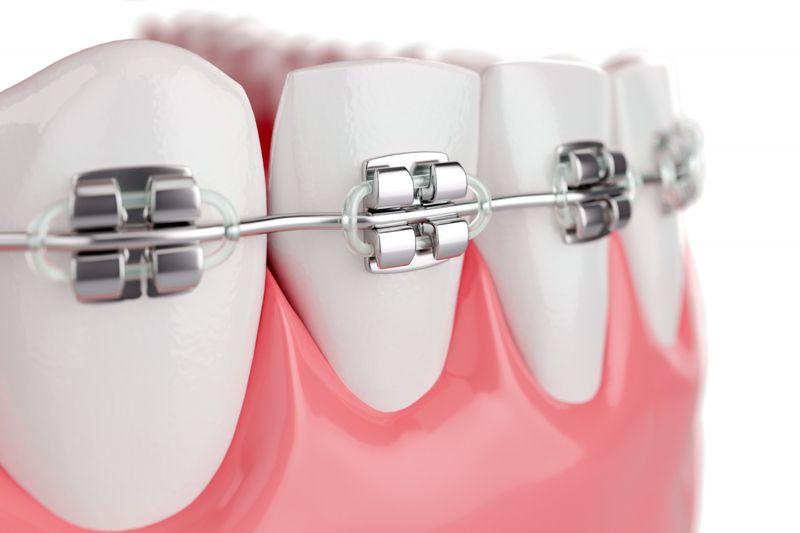
Braces (fixed orthodontic treatment) move teeth into a new position over time using small brackets glued to the teeth and wires that run through them. They are used for crooked teeth, gaps between teeth and a bite where the upper and lower teeth do not meet properly. The brackets can be metal or tooth-coloured (ceramic); they can also be fitted to the back surface of the teeth (lingual braces). The other option is clear aligners, which you take out and put back in yourself.
Which one suits you depends on how complex your case is and, if aligners are being considered, whether you can wear them consistently. In cases where teeth have to be taken out to make room, fixed braces have shown better treatment quality than clear aligners; in cases without extractions, no clear difference has been seen1 between the two. When treatment ends, a retainer is used to keep the teeth in place.
- Whether braces or aligners suit you depends on how complex your case is and whether you can wear aligners consistently; in cases that need extractions, fixed braces have shown better treatment quality.
- When braces are fitted or adjusted, teeth can be tender for a few days; pain is usually at its worst in the first days.
- White spots (early decay) are common on teeth while fixed braces are on; careful brushing and cutting down on sugar are recommended.
- When treatment ends, a retainer is used; your orthodontist decides how long you wear it.
Who is it considered for, and when is something else discussed first?
When braces may be considered
- Teeth that are crooked because there is not enough room for them in the jaw.
- Gaps between teeth.
- Lower teeth that close in front of the upper teeth, a crossbite, or front teeth that do not touch when the mouth is closed.
- Upper front teeth that sit well in front of the lower teeth (increased overjet). This is not only about appearance. In observational studies, children with an overjet larger than 5 mm had odds of injuring their front teeth about 1.81 to 2.43 times higher, depending on age2. This is an odds ratio; it does not mean twice as many injuries.
Orthodontic treatment is not only for children; it is also done in adults.
Early treatment in children
In children whose upper front teeth stick out noticeably, treatment started early, between the ages of 7 and 11, with a functional appliance reduced new injuries to the front teeth. In a Cochrane review, about 30 in every 100 children in the group that waited until adolescence reported a new injury, compared with about 19 in the early-treatment group3. This comparison included 332 children, and the quality of the evidence was moderate.
According to the same review, early treatment of prominent upper front teeth has not been shown to have any other advantage. By the time both groups had finished treatment, there was no meaningful difference in the final overjet or in how the jaws related to each other. Early treatment has two phases, and a second course of treatment may still be needed later.
A long-lasting thumb-sucking or dummy habit is linked to bite problems, and the risk rises the longer it goes on4. But it is not the only cause; genetics, injuries and losing teeth early or late can also play a part5. We cannot give a specific age for a first orthodontic assessment on this page. Ask your dentist about your child's bite at dental check-ups; general information about children is on the paediatric dentistry page.
When something else is discussed first
- Decay or gum disease. The state of your teeth and gums is assessed at an examination before treatment. If there is decay or gum disease, how it will be dealt with before orthodontic treatment starts is discussed. This page does not explain how orthodontic treatment is planned for adults with gum disease; general information about gum disease is on the gum disease page.
- When the problem lies in the position of the jaw bones. In adolescents, functional appliances reduced overjet by about 4.62 to 5.46 mm compared with no treatment3. These results come from small studies, and the quality of the evidence is low. There is no source showing that these appliances guide jaw growth in adults. In people who have stopped growing, adding jaw surgery to orthodontic treatment may be discussed for some jaw mismatches. We cannot say on this page when this is needed; your orthodontist explains the options after the examination.
- Only a small gap, or a shape problem in a single tooth. Sometimes a shorter route, such as adding composite to the tooth, can also be discussed.
Options: how do the appliances differ?
- Not having treatment. If crowding or a gap is only about appearance, not having treatment is also an option. A marked overjet, however, especially in children, is linked to a higher chance of injuring the front teeth (above).
- Fixed braces with metal brackets. The brackets are glued to the front surface of the teeth and stay in the mouth throughout treatment; you cannot take them out.
- Ceramic (tooth-coloured) brackets. They work in the same way as metal brackets and are less noticeable. We cannot say on this page how metal and ceramic brackets differ in how often they come off or in their effect on the tooth surface. Ask your orthodontist whether ceramic brackets suit your bite.
- Lingual braces. The brackets are glued to the back surface of the teeth and cannot be seen from outside. With lingual braces, tongue soreness has been reported clearly more often than with braces on the front of the teeth, and cheek and lip soreness less often. One review6 and another review published after it7 both reached this conclusion. No meaningful difference was found in overall pain in the first months. Changes in speech are much more common6 with lingual braces.
- Clear aligners. Clear trays that you take out and put back in yourself, replaced one after another. One review pooled 11 studies in adults (887 patients). In the 3 studies in that review that scored how the teeth were lined up and how they met at the end of treatment, the result with aligners was weaker than with fixed braces8; the quality of the evidence is moderate. In a newer review of 15 studies, fixed braces gave better results in cases where teeth had to be taken out, and in cases without extractions no clear difference was found1. For mild to moderate crowding, treatment time was found to be similar9 with the two methods; the certainty of this evidence is low. More detail is on the clear aligner treatment page.
- Closing a gap at home with elastic bands is not an option. In one published case, an elastic band used by an 8-year-old child slipped under the gum, more than 75 per cent of the bone holding the teeth was lost, and two front teeth could not be saved10. This is a single case, not a rate.
| Metal or ceramic brackets | Lingual braces | Clear aligners | |
|---|---|---|---|
| Where does it go? | On the front of the teeth | On the back of the teeth | Fits over the teeth |
| Can you take it out? | No | No | Yes |
| Can it be seen from outside? | Yes; less so with ceramic | No | A little |
| When you eat | Stays in | Stays in | Taken out |
How does braces treatment go?
How long treatment takes depends on the state of your teeth, how severe the problem is and which appliance is chosen. According to the patient information page of the American Dental Association (ADA), most people are in treatment for one to three years5. This range comes from general patient information, not from research. Your orthodontist tells you the likely length of your treatment and how often you will need check-ups after the examination.
Examination and records
Your teeth, gums and bite are examined. Photographs and impressions or a digital scan are taken; any X-rays needed are requested based on the examination findings.
Treatment plan
Which appliance suits you, whether any teeth need to be taken out and the likely length of treatment are discussed. If there is decay or a gum problem, how it will be dealt with before treatment starts is planned too.
Fitting the brackets
The tooth surfaces are prepared, the brackets are glued to the teeth and the wire is threaded through the brackets. With lingual braces, the brackets are glued to the back surface of the teeth.
Adjustment appointments
At set intervals the wires are changed or adjusted; sometimes elastics are used too. Teeth can be tender for a few days after an adjustment.
Removing the brackets
When the teeth have reached their planned position, the brackets are taken off and the tooth surfaces are cleaned.
Retention
A fixed or removable retainer is made to keep the teeth in their new position. Your orthodontist tells you how long to wear it.
Risks and benefits
Risks and disadvantages
- Pain and tenderness. When braces are first fitted or adjusted, your teeth can feel tender and under pressure for a few days. In studies that followed the first week, pain was usually at its highest in the first 24 to 48 hours and eased within about a week11.
- White spots (early decay). While fixed braces are on, plaque builds up around the brackets. In an analysis of orthodontic patients, based on 44 studies, new white spots developed during treatment in about 34 in every 100 patients12. The same analysis reported that white spots were seen in about 55 in every 100 orthodontic patients and about 29 in every 100 people who had not had treatment12. These two figures come from different groups of studies. The longer treatment lasted, the more common the spots were. These figures are not a personal risk estimate. This is why careful brushing and cutting down on sugary food and drinks are recommended.
- Teeth shifting after treatment. After orthodontic treatment ends, teeth tend to move back13 towards where they started. This is why the retention phase is part of treatment (below).
- Tongue soreness and speech changes with lingual braces. These side effects are described above, in the options section.
- Gum recession. Orthodontic treatment, poor oral hygiene and thin gums are listed among the factors that may raise14 the risk of the gums pulling back. This is an expert opinion and does not give a rate. Where the gum shows no disease, the same paper considers monitoring the area the appropriate approach.
- Loose brackets and poking wires. A bracket can come away from the tooth, or the end of a wire can poke into your cheek. If this happens, contact your orthodontist.
- Long treatment and regular check-ups. Treatment takes months, often years, and needs you to come to adjustment appointments regularly.
- Other possible side effects. Other side effects, such as shortening of the tooth roots during treatment (root resorption), can also happen. We cannot say on this page how often they happen; ask your dentist at the examination.
Benefits
- Treatment aims to improve tooth alignment and the bite, and to close gaps where appropriate.
- In children whose upper front teeth stick out noticeably, early treatment reduced new injuries to the front teeth (above).
Daily life and care while wearing braces
If you have pain
- Over-the-counter painkillers reduced orthodontic pain compared with taking no medicine. This result comes from a Cochrane review covering 32 studies; the quality of the evidence is moderate15. No painkiller has been shown to be better than another. Follow the instructions on the pack; if you are not sure, ask your pharmacist or doctor.
- Non-drug methods such as chewing gum, bite wafers and vibration devices have not been shown16 to reduce orthodontic pain; the evidence on this is of very low quality.
- In the first days, soft foods may be easier to chew.
Eating and drinking
- Avoiding chewing gum during fixed braces treatment is recommended; gum can stick to the braces17. It is also best to avoid hard, crunchy and sticky foods.
- Cut down on sugary food and drinks; sugar can lead to plaque building up5 around the brackets.
Cleaning
- Brush your teeth twice a day with fluoride toothpaste; take care around the brackets and along the gumline.
- Clean between the teeth and under the wires, not only where food gets caught. Ask your dentist which small brush or floss to use.
- Alongside your orthodontic check-ups, keep having regular check-ups with your dentist. How often you need them is set according to your risk of decay and gum disease18.
Speech
In a review that looked at all kinds of orthodontic appliances, most changes in speech cleared up within a few weeks19. A lisp on the 's' sound, however, sometimes lasted more than 3 months. The evidence in this review is of low quality.
Is the result permanent? The retention phase
When treatment ends, teeth tend to move back towards where they started. A retainer is used to hold the teeth17 in their new position.
- Which retainer? There are fixed wires glued behind the teeth and removable retainers. A Cochrane review covering 47 studies has not shown any one of them to be clearly better13 at keeping teeth straight. Each has pros and cons in terms of breakages, comfort and the gums; the certainty of the evidence is low or very low.
- For how long? Your orthodontist decides how long you wear the retainer17. According to an opinion piece published in the UK, the British Orthodontic Society (BOS) has given patients the message that retainers should be worn for life20. The author of the piece, a dentist, argues that research does not support this general advice; in his view, most retention studies lasted 6 to 24 months20. There is no evidence-based fixed length of time, and no retention method has been shown to hold teeth completely still for life.
- A fixed retainer wire can come loose. In studies, bond failure with multistrand twisted wires has been reported at between 12 and 50 per cent21. This is not a single rate but the lowest and highest values reported in different studies; the quality of the evidence is low.
- A gap between the front teeth can open again. A small retrospective study followed 30 patients. A closed gap between the two upper central incisors had reopened, on average 5 to 6 years after retention stopped, in 6 in every 10 patients22. The reopening averaged 0.49 mm across the whole group and 0.78 mm in the patients whose gap reopened22. This rate does not apply to other gaps between teeth; gaps between the central and side incisors reopened less often.
Who carries out the treatment?
Orthodontics is one of the nine dental specialties set by law in Turkey23. You can ask who will plan and carry out your treatment, and what their title is. You can find our dentists' titles on the Our dentists page.
When should you contact your orthodontist or dentist?
Contact your orthodontist if any of the following happens:
- Pain that lasts more than a few days17 after braces are fitted or adjusted
- A bracket that has come off a tooth, or the end of a wire poking into your cheek or tongue
- A fixed retainer wire that feels loose or has broken
- A removable retainer that no longer fits or has broken
- White spots around the brackets, or gums that bleed or are swollen
- A knock to the front teeth during or after treatment
If you think you have a dental abscess, do not wait; an abscess does not go away on its own and needs urgent dental treatment24. If you have swelling in your face or jaw, or a fever, see a dentist the same day.
Emergencies. The following need urgent medical help24. Do not wait for a dental appointment; go to an emergency department or call 112:
- Swelling that makes it hard to breathe, speak or swallow
- Swelling that spreads to the eye or the neck25
- Swelling or pain in the eye, or sudden problems with your sight
- Major swelling inside the mouth
- Difficulty opening your mouth
What determines the cost?
This page carries no prices. The treatment plan is prepared for you after an examination. The main factors that shape it are:
- The appliance chosen: metal or ceramic brackets, lingual braces or clear aligners
- How severe the problem is and the likely length of treatment
- Extra procedures, such as taking teeth out, or fillings or gum treatment before orthodontic treatment
- The number of check-up appointments
- The retainer after treatment and its check-ups
Ask for it in writing: what your plan includes, and especially whether the retainer and its check-ups are included.
Frequently Asked Questions
Braces or aligners?
The answer depends on how complex your case is and whether you can wear aligners consistently. In cases where teeth have to be taken out to make room, fixed braces have shown better treatment quality; in cases without extractions, no clear difference has been found between the two. Your orthodontist tells you which suits you after the examination.
Do braces hurt?
When braces are fitted and adjusted, your teeth can feel tender and under pressure for a few days. Pain is usually at its worst in the first days and then eases. Over-the-counter painkillers can help; if the pain lasts more than a few days, contact your orthodontist.
Do braces cause decay?
While braces are on, plaque builds up around the brackets and white spots (early decay) on the teeth are common. Careful brushing, fluoride toothpaste and cutting down on sugary food and drinks are recommended to lower this risk.
Can adults have braces?
Yes. Orthodontic treatment is not only for children. Before treatment, the state of your gums and teeth is assessed at an examination. If the problem lies in the position of the jaw bones, your orthodontist explains the options.
How long does braces treatment take?
It depends on the state of your teeth, how severe the problem is and which appliance is chosen. General information is above, in the section on how treatment goes. Your orthodontist tells you the likely length of your treatment after the examination.
Will my teeth move back after treatment?
Teeth tend to move back towards where they started. A retainer is used to prevent this, and your orthodontist decides how long you wear it. There is no evidence-based fixed length of time, and no method has been shown to hold teeth completely still; it is important to wear the retainer as advised and for as long as advised.

Dt. Dilek AKSU GÜLER
Dentist · Founder
She has completed advanced training in implantology and works in aesthetic restorations and smile design.
Sources
- Quality and stability of orthodontic treatment outcomes with clear aligners versus fixed appliances: a systematic review and meta-analysis. European Journal of Orthodontics 2025;47(6):cjaf091. 2025.↩doi.org
- The association of overjet size and traumatic dental injuries - a systematic review and meta-analysis. Dental Traumatology 2019;35(4-5):217-232. 2019.↩doi.org
- Orthodontic treatment for prominent upper front teeth (Class II malocclusion) in children and adolescents. Cochrane Database of Systematic Reviews 2018;3:CD003452. 2018.↩doi.org
- Establishing the association between nonnutritive sucking behavior and malocclusions: a systematic review and meta-analysis. Journal of the American Dental Association 2016;147(12):926-934.e6. 2016.↩doi.org
- Braces. American Dental Association, MouthHealthy.↩mouthhealthy.org
- Comparison of adverse effects between lingual and labial orthodontic treatment. The Angle Orthodontist 2013;83(6):1066-1073. 2013.↩doi.org
- Adverse effects of lingual and buccal orthodontic techniques: a systematic review and meta-analysis. American Journal of Orthodontics and Dentofacial Orthopedics 2016;149(6):820-829. 2016.↩doi.org
- Treatment outcome with orthodontic aligners and fixed appliances: a systematic review with meta-analyses. European Journal of Orthodontics 2020;42(3):331-343. 2020.↩doi.org
- Duration of orthodontic treatment with clear aligners versus fixed appliances in crowding cases: a systematic review. Clinical Oral Investigations 2024;28(5):249. 2024.↩doi.org
- The Risks of DIY Braces: An Orthodontic Case Study. American Association of Orthodontists. 2024.↩aaoinfo.org
- Comparison of pain intensity and impacts on oral health-related quality of life between orthodontic patients treated with clear aligners and fixed appliances: a systematic review and meta-analysis. BMC Oral Health 2023;23(1):920. 2023.↩doi.org
- Prevalence, incidence and risk factors of white spot lesions associated with orthodontic treatment - a systematic review and meta-analysis. Orthodontics & Craniofacial Research 2025;28(2):379-399. 2025.↩doi.org
- Retention procedures for stabilising tooth position after treatment with orthodontic braces. Cochrane Database of Systematic Reviews 2023;5:CD002283. 2023.↩doi.org
- Mucogingival conditions in the natural dentition: narrative review, case definitions, and diagnostic considerations. Journal of Clinical Periodontology 2018;45 Suppl 20:S190-S198. 2018.↩doi.org
- Pharmacological interventions for pain relief during orthodontic treatment. Cochrane Database of Systematic Reviews 2017;11:CD003976. 2017.↩doi.org
- Non-pharmacological interventions for alleviating pain during orthodontic treatment. Cochrane Database of Systematic Reviews 2016;12:CD010263. 2016.↩doi.org
- Braces. NHS (UK). 2026.↩nhs.uk
- Dental checks: intervals between oral health reviews (clinical guideline CG19). National Institute for Health and Care Excellence, published 27 October 2004. 2004.↩nice.org.uk
- Speech and orthodontic appliances: a systematic literature review. European Journal of Orthodontics 2018;40(1):29-36. 2018.↩doi.org
- British Orthodontic Society's initiative on orthodontic retention, a GDP's perspective. British Dental Journal 2018;224:481-486 (Mc Crory PV). 2018.↩nature.com
- Failure of fixed orthodontic retainers: a systematic review. Journal of Dentistry 2015;43(8):876-896. 2015.↩doi.org
- Stability of orthodontic midline diastema closure: 30 patients, mean 5.6 years after retention. Journal of Applied Oral Science 2014. 2014.↩pmc.ncbi.nlm.nih.gov
- 1219 sayılı Tababet ve Şuabatı San'atlarının Tarzı İcrasına Dair Kanun (consolidated text). T.B.M.M.; RG 14/4/1928 No 863; consolidated on mevzuat.gov.tr. 1928.↩mevzuat.gov.tr
- NHS: Dental abscess. NHS (nhs.uk). 2026.↩nhs.uk
- NHS: Toothache. NHS (nhs.uk). 2024.↩nhs.uk