
Is Invisalign as good as braces?
It depends on the case. Invisalign is one brand of clear aligner. For cases treated without removing teeth, reviews found no significant difference in results between aligners and fixed braces. Where teeth are removed to make space, and in one review of adults overall, fixed braces gave a more precise result. Aligners were not shown to be faster.
- Fixed braces did better where teeth were removed, and in one review of adults overall; without extractions, no significant difference was found.
- Neither option was shown to finish sooner in mild to moderate crowding.
- Aligners caused slightly less pain in the first days in some studies, but not reliably after that.
- Whether results last longer after one than the other is barely studied; a retainer is needed after either.
The two options
Fixed braces are small brackets glued to the teeth and joined by a wire that the orthodontist adjusts at regular visits. The brackets may be metal or tooth-coloured, and they usually sit on the front of the teeth; lingual braces are fixed to the back instead.
Clear aligners are a series of thin, removable plastic trays that move the teeth step by step. They are taken out to eat and to clean the teeth. They only work while they are worn, so treatment depends on wearing them for the hours your orthodontist sets. Invisalign is one brand; several manufacturers make aligners, and no study we found compares brands with each other.
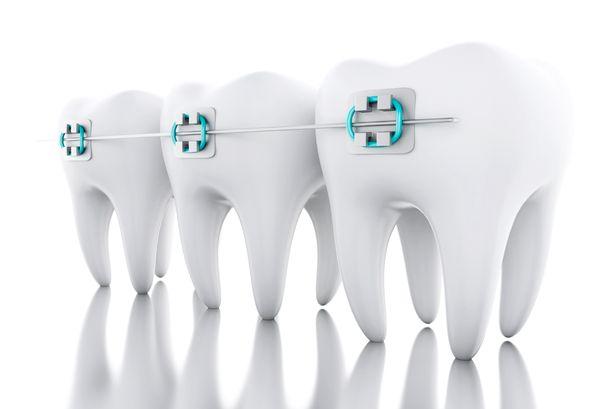
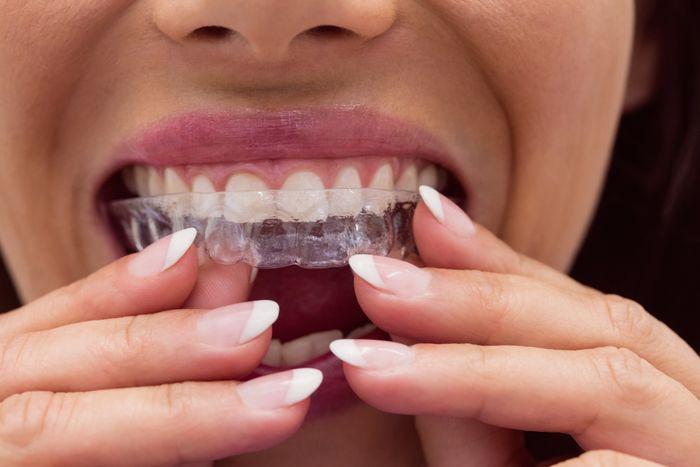
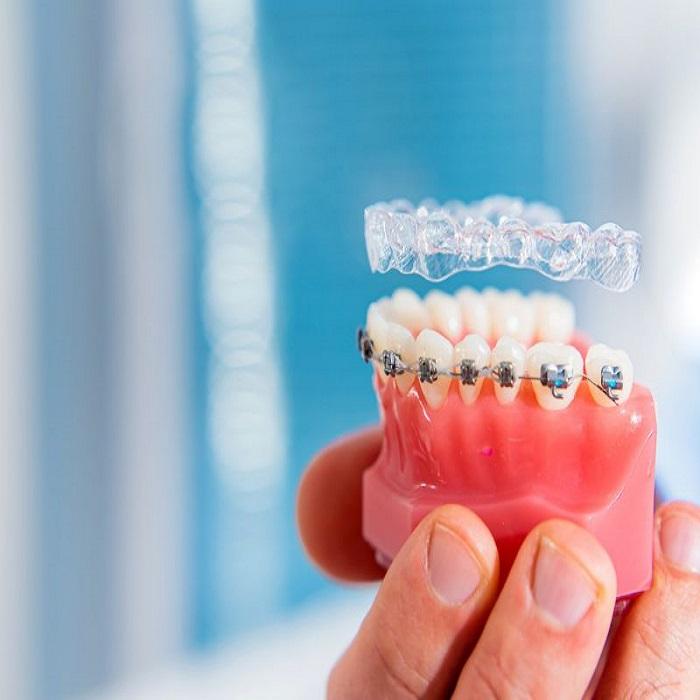
| Fixed braces | Clear aligners | |
|---|---|---|
| How they attach | Brackets glued to the teeth, joined by a wire | Removable plastic trays, changed in a series |
| Seen when you smile | Visible, unless fitted behind the teeth | Less noticeable |
| Cases where no teeth are removed | No significant difference found | No significant difference found |
| Cases where teeth are removed | Better treatment quality in studies | Less precise control of the roots in studies |
| Treatment time | Not shown to differ in mild to moderate crowding | Not shown to differ in mild to moderate crowding |
| Eating | Avoid gum and hard, sticky foods | Trays taken out to eat |
| After treatment | Retainer needed | Retainer needed |
Results: what the reviews found
- Adults, all kinds of cases. A review of 11 studies with 887 patients (average age 28) found that the finished bite was less precise with aligners than with fixed braces, and more patients had a result graded unacceptable1. The evidence was of moderate quality. The authors concluded that the evidence does not support aligners as equally effective to braces.
- Studies of one aligner brand. A review of 20 articles, all on a single brand, concluded that results were not as accurate as those achieved with fixed braces2.
- With and without extractions. A newer review of 15 trials with 1,084 patients found no significant difference in treatment quality or duration in cases without extractions, while fixed braces gave better treatment quality where teeth were removed3. Its authors concluded that both can achieve treatment goals, and that case complexity and how well the appliance is worn should guide the choice.
- Extraction cases in detail. A review of 20 studies in patients aged 12 and over found that, compared with fixed braces, aligners showed less precise control of the roots and poorer contact between the upper and lower teeth4.
In short: where teeth were removed, fixed braces did better; without extractions, no significant difference was found, which is not proof that results are the same.
Is one faster?
Not reliably. In mild to moderate crowding, a review of 10 studies found low-certainty evidence that treatment takes about as long with aligners as with fixed braces5. The review of 887 adults also found no significant difference in treatment duration1. Only the sensitivity analyses in one review suggested shorter treatment with aligners3, and that was not its main finding.
Most people are in orthodontic treatment for one to three years6. How long yours takes depends on what needs to move and, with aligners, on wearing them as instructed.
Comfort, cleaning and daily life
Pain. Both cause soreness when treatment starts, usually worst in the first 24 to 48 hours7. A review of seven studies, all of one aligner brand in adults with mild problems, found less pain with aligners during the first few days8. After that, up to three months, no difference was found. In another review, one study that followed patients for a year found more pain with aligners from the second month on7. The certainty of this evidence varies and is mostly low.
Eating. With fixed braces, do not chew gum, which can get stuck, and try to avoid hard, crunchy or sticky foods9. Aligners are taken out to eat, and the teeth are brushed before they go back in.
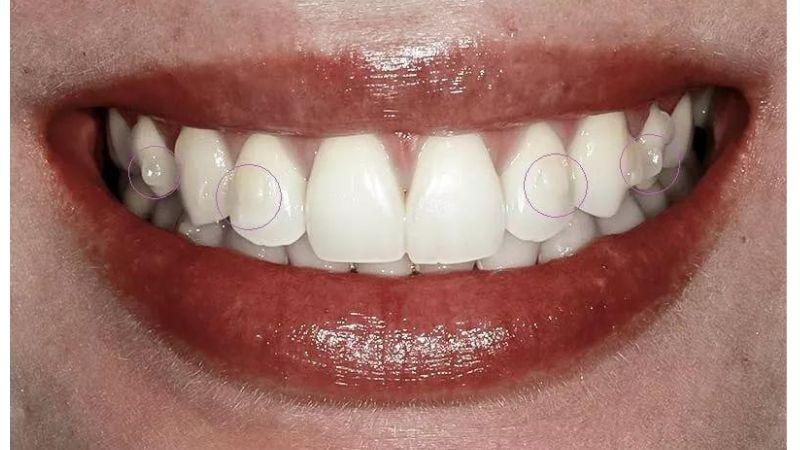
White marks. White marks that appear on the teeth during treatment can be an early stage of decay. They are common during fixed-brace treatment. One review found them more often with fixed braces than with no treatment, and more often than with other appliances, though that second result was borderline10. They became more common the longer treatment lasted. Aligners are not immune: that comparison grouped all other appliances.
Orthodontic treatment might also increase the risk of the gums pulling back (recession)11.
With either option, brush carefully with a fluoride toothpaste, clean between the teeth, and keep sugary snacks and drinks down; with fixed braces, sugar can lead to plaque build-up around the brackets6.
After treatment: relapse and retainers
After any orthodontic treatment, teeth tend to drift back towards where they started12, so a retainer is worn to hold them.
Whether teeth drift back more after aligners than after braces is barely studied. A review found only three studies, all of one aligner brand, with 137 aligner and 139 fixed-brace patients13. Only one, with 22 patients and a high risk of bias, found more relapse with aligners; the other two found no significant difference. The authors pointed to a lack of well-designed studies.
Retainers may be a thin wire bonded behind the front teeth or a removable one. Neither type has been shown to be clearly better at keeping teeth straight12; that review excluded aligner studies, and its evidence is of low or very low certainty. Bonded wires can come loose: bond-failure rates of 12% to 50% were reported for multistranded wire retainers14, varying between studies, on low-quality evidence. Your orthodontist will tell you how long to wear a retainer9. Research has not settled on an exact length of time, and no retainer can promise that teeth will never move again.
Which might suit you
Aligners may suit you if your problem is mild, no teeth need to be removed, and you are confident you will wear the trays as long as you are told every day. Fixed braces may be the stronger choice if the case is complex or teeth need to be removed to make space.
Several aligner reviews studied adults and others give no ages, so the findings may not apply in the same way to teenagers.
The choice should follow an examination, not a photo or an online form, and decay and gum problems are dealt with before any appliance is fitted. The UK dental regulator accepts that some parts of dental care can be provided safely at a distance, while others need a face-to-face visit or a physical examination15. For orthodontics, it says there is at present no effective substitute for a physical, clinical examination15. Ask what each option is expected to achieve, what happens if aligners do not move the teeth as planned, what the risks are, and what doing nothing would mean.
When to contact your orthodontist or a dentist
During or after treatment, contact your orthodontist if:
- teeth are still painful more than a few days after a fitting or adjustment9
- a bracket comes off, a wire breaks or digs in, or an aligner cracks, no longer fits or is lost
- you notice white or chalky marks on the teeth
- a bonded retainer feels loose, or a removable one no longer fits
Emergencies. Facial swelling, a fever or throbbing pain is not an expected part of orthodontic treatment: see a dentist without waiting. If you find it hard to breathe or swallow, or swelling spreads quickly in your mouth or neck, call 112 or go to the nearest emergency department.
Aligners or braces for you?
Send us a message with your question. Our dentists will explain what an examination would look at and which options might be worth discussing.
Frequently asked questions
Is Invisalign as effective as braces?
For cases without extractions, reviews found no significant difference. Where teeth are removed, and in one review of adults overall, fixed braces gave a more precise result. The choice depends on the case, not the brand.
Is Invisalign faster than braces?
It has not been shown to be. In mild to moderate crowding, treatment took about as long with either, on low-certainty evidence. With aligners, the time also depends on wearing them as instructed.
Is Invisalign less painful than braces?
Some studies found slightly less pain with aligners in the first few days, but no difference later, and one study found more pain with aligners from the second month. Both usually cause soreness at first.
Is Invisalign cheaper than braces?
This article gives no prices. What any option costs depends on the case and the plan. Ask for a written plan that says what is included, including retainers and follow-up visits, before you decide.
Do I need a retainer after Invisalign?
Yes. Teeth tend to drift back after any orthodontic treatment, and a retainer holds them. Your orthodontist will tell you how long to wear it; no retainer can promise that teeth will never move.
Sources
- Treatment outcome with orthodontic aligners and fixed appliances: a systematic review with meta-analyses. European Journal of Orthodontics 2020;42(3):331-343. 2020.↩doi.org
- A systematic review of the accuracy and efficiency of dental movements with Invisalign. Korean Journal of Orthodontics 2019;49(3):140-149. 2019.↩doi.org
- Quality and stability of orthodontic treatment outcomes with clear aligners versus fixed appliances: a systematic review and meta-analysis. European Journal of Orthodontics 2025;47(6):cjaf091. 2025.↩doi.org
- Clear aligners in extraction-based orthodontic treatment: a systematic review and meta-analysis. Orthodontics & Craniofacial Research 2026;29(1):12-29. 2026.↩doi.org
- Duration of orthodontic treatment with clear aligners versus fixed appliances in crowding cases: a systematic review. Clinical Oral Investigations 2024;28(5):249. 2024.↩doi.org
- Braces. American Dental Association, MouthHealthy.↩mouthhealthy.org
- Comparison of pain intensity and impacts on oral health-related quality of life between orthodontic patients treated with clear aligners and fixed appliances: a systematic review and meta-analysis. BMC Oral Health 2023;23(1):920. 2023.↩doi.org
- Pain level between clear aligners and fixed appliances: a systematic review. Progress in Orthodontics 2020;21(1):3. 2020.↩doi.org
- Braces. NHS (UK). 2026.↩nhs.uk
- Prevalence, incidence and risk factors of white spot lesions associated with orthodontic treatment - a systematic review and meta-analysis. Orthodontics & Craniofacial Research 2025;28(2):379-399. 2025.↩doi.org
- Mucogingival conditions in the natural dentition: narrative review, case definitions, and diagnostic considerations. Journal of Clinical Periodontology 2018;45 Suppl 20:S190-S198. 2018.↩doi.org
- Retention procedures for stabilising tooth position after treatment with orthodontic braces. Cochrane Database of Systematic Reviews 2023;5:CD002283. 2023.↩doi.org
- Comparison of relapse of orthodontic treatment following aligner versus conventional fixed appliance treatment. A systematic review. Journal of Clinical and Experimental Dentistry 2024;16(5):e586-e594. 2024.↩doi.org
- Failure of fixed orthodontic retainers: a systematic review. Journal of Dentistry 2015;43(8):876-896. 2015.↩doi.org
- GDC statement on 'direct-to-consumer' orthodontic treatment. General Dental Council (UK).↩gdc-uk.org

Dt. Dilek AKSU GÜLER
Dentist · Founder
She has completed advanced training in implantology and works in aesthetic restorations and smile design.