
What does oral surgery at a dental clinic cover?
Oral surgery at a dental clinic means operations inside the mouth. They include taking out teeth, wisdom teeth among them, and building up the jaw bone with a bone graft or a sinus lift. Placing dental implants is oral surgery too. Most of these operations are done under local anaesthetic, which numbs the area. If you are anxious, sedation may be discussed.
In Turkey, oral and maxillofacial surgery is also the name of a dental specialty, a field with its own training. What that title means, and when care belongs somewhere other than a dental clinic, is explained under “Who carries out oral surgery?” below. If your problem needs care beyond the treatments on this page, your dentist will tell you if you need a referral.
On this page, “we” means our clinic in Antalya. Each of the treatments above has its own page, linked below. This page compares them and lists what to tell your dentist and what to ask before you agree. The study figures on this page come from published studies, not from our own records.
- Oral surgery at a dental clinic covers extractions, wisdom tooth removal, bone grafts and sinus lifts, and implant placement, mostly under local anaesthetic.
- Keeping a tooth is considered before an extraction, because an extraction cannot be undone.
- A wisdom tooth that is not painful and shows no disease is usually left in place and watched at check-ups.
- Not every implant needs a bone graft, and an implant is not the only way to replace a missing tooth.
- Turkish law lets every dentist treat the teeth, gums and connected mouth and jaw tissues; a specialty title needs a Ministry-registered certificate.
Which treatment fits your situation?
A tooth that cannot be kept
A tooth may need to come out when it is too broken down to repair, or when gum disease or infection has destroyed its support. If a filling, a crown, root canal treatment or gum treatment could keep it, those are discussed first. An extraction cannot be undone. In a simple extraction, the tooth is loosened with an instrument called an elevator and removed with forceps1. In a surgical extraction, a small cut in the gum, removing some bone or cutting the tooth into pieces may be needed1. Whether yours will be simple or surgical is sometimes clear only after the examination and X-rays. See tooth extraction.
A wisdom tooth that hurts or keeps getting inflamed
A wisdom tooth that is not painful and shows no disease is usually left in place and watched at check-ups2. An impacted wisdom tooth cannot come through fully into its normal place. For impacted wisdom teeth without disease, a Cochrane review found insufficient evidence3 to decide whether removal or keeping them is better. Removal is discussed when there is disease, such as decay that cannot be repaired, infection, a cyst or gum inflammation that keeps coming back. Removing an impacted tooth is a surgical extraction. Dry socket is a painful condition in which the protective blood clot is lost from the socket. It is more common after the surgical removal of wisdom teeth than after routine extractions4. Less often, removing a lower wisdom tooth leaves the lower lip or chin numb5, because its roots can lie close to a nerve. This usually gets better but can take a few weeks or months2; rarely, it does not go away5. See wisdom tooth removal.
A missing tooth: implant surgery
A dental implant is an artificial root, usually a titanium screw, placed in the jawbone where a tooth is missing. Once it has fused with the bone, a crown or bridge is fixed on top. Placing it is surgery, and there is a healing period before the final tooth. Untreated gum disease is dealt with before an implant is placed. Afterwards, an implant needs cleaning and regular check-ups, because inflammation around it can lead to bone loss and to losing the implant. An implant is not the only way to replace a tooth: a bridge, a removable denture or leaving the gap are options too. See dental implants, which explains the risks and the maintenance.
Not enough bone for an implant
A bone graft builds up jaw bone where there is too little to hold an implant. In a sinus lift, the thin lining of the sinus in the back of the upper jaw is gently raised. Graft material is usually placed beneath it, to gain bone height for an implant. Neither replaces a tooth; both are extra surgical steps that make an implant possible. Not every patient needs one, and a graft is not the only route. For a shrunken (resorbed) lower jaw, a Cochrane review found short implants appear to be a better option6 than building the bone up in height. The same review found that complications were common, especially when bone was built up in height6. The review rests on few trials with few patients. See bone grafting and sinus lift.
Fear of treatment, or a long procedure
Most oral surgery is done under local anaesthetic. If you are very anxious, have a strong gag reflex or face a long procedure, conscious sedation may be discussed. It lowers anxiety, but you are not put to sleep: verbal contact with you is kept throughout the procedure7. A local anaesthetic is still given to numb the area. A general anaesthetic is a separate decision, with its own team and an approved setting. The conscious sedation page explains who it is not suitable for, its risks and the escort rule.
| Tooth extraction | Wisdom tooth removal | Bone graft or sinus lift | Implant surgery | |
|---|---|---|---|---|
| What it is for | A tooth that cannot be kept | A wisdom tooth with disease or repeated gum inflammation | Too little bone to hold a planned implant | Replacing a missing tooth with an artificial root |
| Is it always needed? | No; keeping the tooth is considered first | No; a tooth without pain or disease is usually watched | No; some patients have enough bone, and there are options without a graft | No; a bridge, a denture or leaving the gap are options too |
| Usual anaesthesia | Local anaesthetic; sedation may be used for a surgical extraction | Local anaesthetic; sedation or a general anaesthetic may be discussed | Local anaesthetic for a graft inside the mouth, with sedation if it suits you | Local anaesthetic, with sedation if it suits you |
| Main risks | Bleeding, dry socket, infection | Dry socket, infection, numbness of the lower lip or chin | Tear in the sinus membrane, infection, graft not taking | Infection, numbness, sinus problems in the upper jaw; later, inflammation around the implant or implant loss |
| What comes next | Healing of the socket; then the gap is filled or left | Healing of the socket | Months of bone healing before the implant, unless both are done in one session | Healing, then the crown or bridge |
How the treatments connect
An extraction, a bone graft and an implant are often steps of one plan. The usual order is below; not every plan has every step.
- Can the tooth be kept? A filling, a crown, root canal treatment or gum treatment is considered before an extraction.
- The extraction. Decide before it how the gap will be filled. The options are an implant, a bridge, a removable denture or, for some gaps, nothing.
- A graft, if the bone is not enough. In a staged graft, the graft comes first, and the implant follows once new bone has formed, which takes months. In some cases a small graft is placed in the same session as the implant instead.
- The implant, at once or after healing. Sometimes the implant is placed in the same session as the extraction. In a 2017 review, 95.2 per cent of implants placed straight into the extraction socket survived, against 98.4 per cent in healed bone8. These figures are counted per implant and come from published studies, not from our own records. The difference was statistically significant, and the authors ask for caution with same-session placement.
- The crown or bridge. It is fitted once the implant has fused with the bone.
The order decides how many appointments you need and how long the treatment takes. Ask for the whole sequence in writing before the first step.
Before any of these treatments: what to tell your dentist
Your dentist asks about your health and your medicines before any oral surgery. Tell your dentist if:
- You take a blood thinner, or an antiplatelet medicine such as aspirin. Do not stop or change it for dental treatment9 unless your dentist or doctor tells you to.
- You take, or have taken, a medicine for bone thinning (osteoporosis) or for cancer. Some of these medicines, such as bisphosphonates and denosumab, can rarely cause a healing problem of the jaw bone (osteonecrosis). A leaflet for people taking them for osteoporosis says that an extraction or an implant raises this risk, though it stays low10. It also advises them to keep taking the medicine. People taking them for cancer are at higher risk11. During high-dose cancer treatment with these medicines, implant surgery is usually avoided; taking them for osteoporosis does not on its own rule implants out11. Any change to the medicine is decided by the doctor who prescribes it.
- You have had radiotherapy to the head or neck.
- You have a heart condition, or your heart doctor has said you may need antibiotics before dental procedures.
- You have diabetes.
- You are pregnant, or might be.
- You smoke. Smoking is linked to dry socket after an extraction12 and to losing implants13.
Also mention any other medical condition and any allergies, and bring a list of every medicine you take, with the doses. Implants and grafts are planned with a 3D scan, which shows the bone, the sinus and the nerve canal. For a wisdom tooth, a 3D scan may be requested if needed. An assessment based on photographs, or on an X-ray you send us, is preliminary, not final.
Who carries out oral surgery?
Turkish law authorises every dentist to diagnose and treat the teeth, the gums and the mouth and jaw tissues directly connected to them14. Turkish rules add further requirements for some procedures and settings14.
Oral and maxillofacial surgery (in Turkish, ağız, diş ve çene cerrahisi) is one of the dental specialties set by law in Turkey14. It has its own training. The rules say that only a dentist with a certificate in that specialty, registered by the Ministry of Health15, may use its title. Turkish law also lists surgery of the mouth, face and jaws (ağız, yüz ve çene cerrahisi) as a separate specialty of medicine14.
On this page, “your dentist” means the dentist who examines and treats you. Before you agree to surgery, ask who will carry it out, what their title is and how often they do the procedure. If you ask, you have the right to be told who is treating you, and their role and title16. Ask for the answers in writing.
When care belongs somewhere else
A Turkish regulation covers private dental practices, polyclinics, centres and hospitals that provide oral and dental care. It says that these facilities may carry out no medical procedure other than oral and dental care17. If your problem needs care beyond the treatments on this page, your dentist will tell you if you need a referral.
Some of the treatments on this page can also need another setting. If bone for a graft has to be taken from outside the mouth, general anaesthesia and a hospital stay may be needed. You are told in advance if this applies to you. If a general anaesthetic is discussed for you, ask where it would be given and by whom.
Before you agree to surgery
Turkey's patient rights regulation says what you are told before treatment. It includes who will carry out the treatment, where and how, and how long it is expected to take16. It also includes the other options with their benefits and risks, the possible complications, and how to reach medical help when you need it16. Ask for your plan in writing as well. It should list the treatments, their order and the materials to be used, such as any graft material and membrane.
In private dental clinics, you are asked to sign a consent form for every treatment17. The form is signed in two copies, and one copy is given to you16. You can look at your records and get a copy16, including your X-rays and scans. Before you decide, you can also ask for another dentist's opinion16.
You can say no, or ask to stop, at any stage. The regulation gives you the right to refuse treatment or ask for it to be stopped16; the possible consequences are explained to you. Once a tooth has been extracted, that step cannot be undone.
Sedation and the escort rule
If sedation is suggested, ask what kind it is and why. A 2022 Turkish regulation on private dental facilities covers where sedation may be given. Under it, treatment under sedation or general anaesthesia may not be carried out in a single-dentist practice (muayenehane) or a polyclinic (poliklinik)17. Your written plan names the place where any sedation is given; ask who will give it.
A UK national standard for sedation in dentistry sets an escort rule. For adults, it requires an escort for every form of sedation other than inhalation sedation7. If an escort cannot be assured, it says, treatment under sedation must not be given. The same standard expects advice on eating and drinking beforehand, given verbally and in writing7. It also expects written and spoken aftercare instructions for you and your escort, and arrangements for advice out of hours7. Ask us before the day whether the method planned for you needs an escort, and plan who will take you home. If you have sedation, do not drive or operate machinery for as long as the sedation team tells you.
Questions to ask
- Who will carry out my surgery, and what are their qualifications and title?
- Is my extraction likely to be simple or surgical, and what changes if it is surgical?
- Will I need a graft? If so, which material and membrane, and where do they come from?
- Which anaesthetic or sedation is planned, who gives it and where, and do I need an escort?
- How many appointments will I need, and how long is the healing between them?
- If there are complications, who pays for further treatment?
- What aftercare do you provide, and how do I reach the clinic, including out of hours?
When to get help after oral surgery
After any of these treatments, contact your dentist without delay if you have:
- Bleeding that does not stop despite pressure
- Pain or swelling that increases after the third day, or that painkillers do not relieve
- Pain that starts 24 to 48 hours after an extraction, a socket that looks empty, and a bad taste or smell. These can be signs of dry socket; the Scottish guidance recommends getting urgent dental care18
- A high temperature, feeling unwell, a bad taste, or pus from the area
- Numbness of the lip, chin or tongue that lasts after the anaesthetic has worn off
- If you take a medicine for bone thinning or cancer: unexpected pain, tingling, numbness or swelling at the treated site. Scottish dental guidance asks for these to be reported to your dentist11
- After surgery in the upper jaw: discharge from the nose, a blocked nose, or liquid coming out of your nose when you drink
Emergencies. Swelling that makes it hard to breathe, speak or swallow, or that spreads to your eye or neck, needs urgent medical help19. Do not wait for a dental appointment or for the clinic's reply. Go to a hospital emergency department or call 112.
Each treatment page lists its own warning signs; the tooth extraction page also explains how to press on a socket that keeps bleeding.
What determines the cost?
This page carries no prices. A plan is prepared after an examination and X-rays, with a 3D scan for implants and grafts. The main factors that shape it are:
- Which treatments are needed, and how many teeth or implants
- Whether an extraction is simple or surgical
- Whether a graft or a sinus lift is needed, and the material used
- Imaging, anaesthesia and sedation
- Check-ups and stitch removal
Ask for your plan in writing, including what it covers. Also ask who pays for further treatment if there is a complication.
Frequently Asked Questions
Is oral surgery the same as oral and maxillofacial surgery?
Not quite. Here, oral surgery means the operations inside the mouth that a dental clinic carries out. They are extractions, wisdom tooth removal, bone grafts and implant placement. In Turkey, oral and maxillofacial surgery is also the name of a dental specialty with its own training. Only a dentist with a Ministry-registered certificate in that specialty may use its title. If your problem needs care beyond these treatments, your dentist will tell you if you need a referral.
Who will carry out my surgery?
Turkish law allows every dentist to diagnose and treat the teeth, the gums and the mouth and jaw tissues connected to them. Some procedures and settings have further requirements. The title of a dental specialty needs a certificate registered by the Ministry of Health. Ask us who will carry out your treatment, what their title is and how often they do the procedure. You have the right to be told who is treating you. Ask for the answers in writing.
Will I be awake during oral surgery?
Usually, yes. Most extractions, grafts inside the mouth and implant placements are done under local anaesthetic, which numbs the area; you may feel pressure. If you are anxious, conscious sedation may be discussed. You are not put to sleep: you stay able to respond. A general anaesthetic is a separate decision, with its own team and setting.
Can the tooth come out and the implant go in on the same day?
Sometimes. Whether the implant goes into the socket at the same session or after healing depends on the bone and on any infection. It is decided after an examination and a scan. In one review, more implants were lost when they were placed in the same session as the extraction. Ask what happens to your plan if same-day placement turns out not to be possible.
Do I need a bone graft before an implant?
Not always. If there is enough bone, the implant is placed directly. If there is too little, a graft or a sinus lift is one route; in a shrunken lower jaw, short implants may be another. The choice is made after an examination and a 3D scan.
Should a wisdom tooth that does not hurt come out?
Usually not. A wisdom tooth that is not painful and shows no disease is usually watched at check-ups rather than removed. Removal is discussed when there is disease, such as decay that cannot be repaired, infection or gum inflammation that keeps coming back. Removing it adds the risks of surgery, such as dry socket and, less often, numbness of the lower lip or chin.
What should I send before my first appointment?
A short description of the problem, a list of every medicine you take with the doses, and any X-rays, scans or photographs you have. Tell us about a heart condition, diabetes, radiotherapy to the head or neck, medicines for bone thinning or cancer, and pregnancy. Any view based on these is preliminary; the examination confirms or changes the plan.
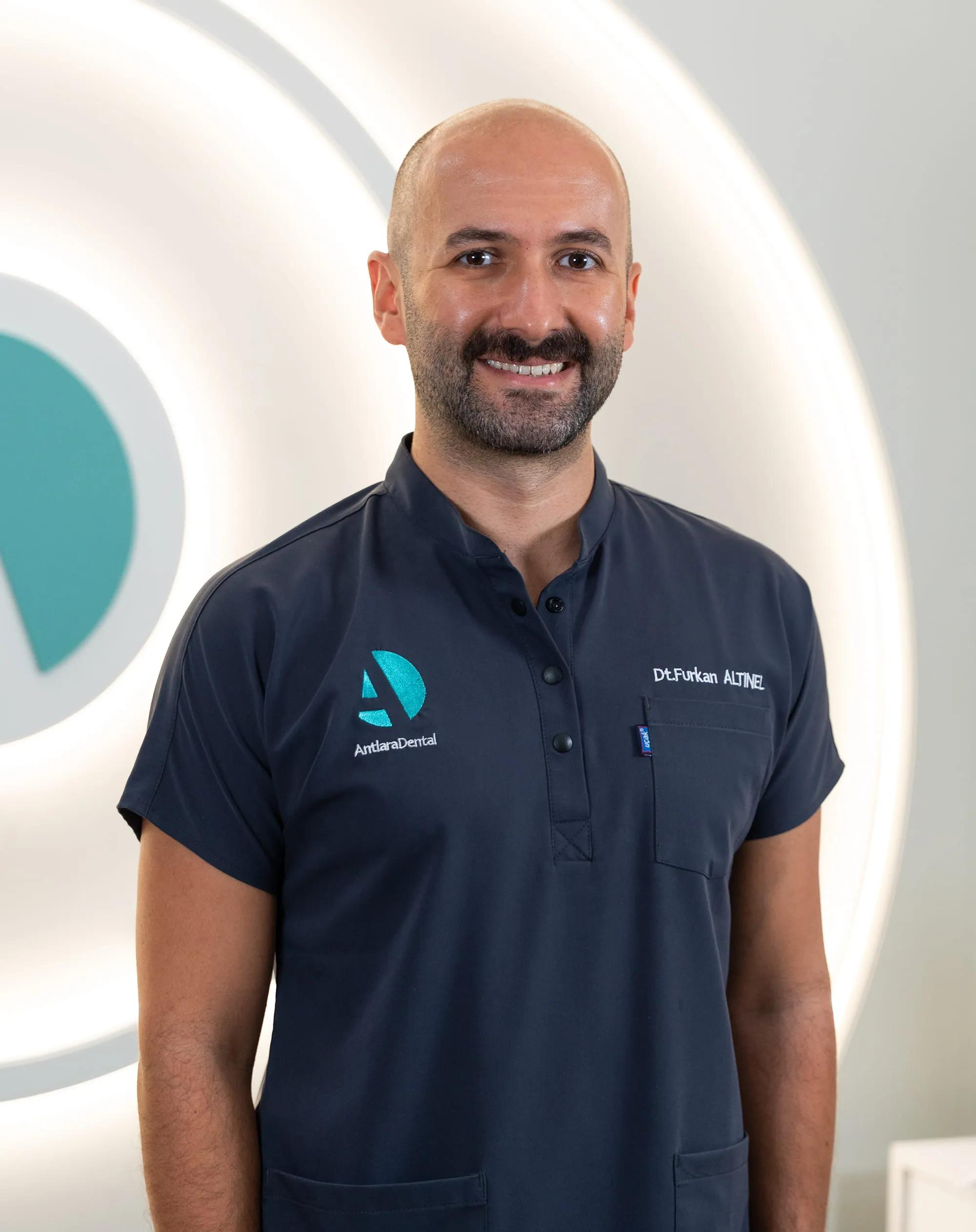
Dt. Furkan ALTINEL
Dentist
Dt. Furkan ALTINEL graduated from Istanbul University in 2011. Since 2024 he has worked at Antlara Dental in aesthetic dentistry, dental implantology, tooth extraction and implant surgery, and crowns, bridges and dentures. He speaks English.
Sources
- Tooth extraction (Medical Encyclopedia article 007630). MedlinePlus, US National Library of Medicine. 2024.↩medlineplus.gov
- NHS: Wisdom tooth removal. NHS (nhs.uk). 2024.↩nhs.uk
- Surgical removal versus retention for the management of asymptomatic disease-free impacted wisdom teeth (Cochrane review). Cochrane Database of Systematic Reviews 2020;5:CD003879. 2020.↩doi.org
- Local interventions for the management of alveolar osteitis (dry socket) (Cochrane review, 49 RCTs). Cochrane Database of Systematic Reviews 2022;9:CD006968. 2022.↩doi.org
- Risk relationship associated with inferior alveolar nerve injury following removal of mandibular third molars: a systematic review (23 studies). Journal of Stomatology, Oral and Maxillofacial Surgery 2020;121(1):63-69. 2020.↩doi.org
- Interventions for replacing missing teeth: horizontal and vertical bone augmentation techniques for dental implant treatment (Cochrane review, 13 RCTs). Cochrane Database of Systematic Reviews 2009;(4):CD003607. 2009.↩doi.org
- Standards for Conscious Sedation in the Provision of Dental Care (V1.1). Intercollegiate Advisory Committee for Sedation in Dentistry, Dental Faculties of the Royal Colleges of Surgeons and the Royal College of Anaesthetists, 2020. 2020.↩saad.org.uk
- Immediate implant placement into fresh extraction sockets versus delayed implants into healed sockets: systematic review and meta-analysis. International Journal of Oral and Maxillofacial Surgery 2017;46(9):1162-1177. 2017.↩doi.org
- SDCEP: Anticoagulant or antiplatelet medication and your dental treatment (information for patients). Scottish Dental Clinical Effectiveness Programme (SDCEP), March 2022. 2022.↩sdcep.org.uk
- Dental advice for patients prescribed anti-resorptive drugs for the treatment of osteoporosis or other non-malignant diseases of bone. Scottish Dental Clinical Effectiveness Programme (SDCEP), patient leaflet NESD0691, March 2017. 2017.↩sdcep.org.uk
- Oral Health Management of Patients at Risk of Medication-related Osteonecrosis of the Jaw: Dental Clinical Guidance. Scottish Dental Clinical Effectiveness Programme (SDCEP), March 2017 (extant after March 2024 review). 2017.↩sdcep.org.uk
- Smoking as a risk factor for dry socket: a systematic review (11 observational studies). Dentistry Journal (Basel) 2022;10(7):121. 2022.↩doi.org
- Levels of smoking and dental implants failure: systematic review and meta-analysis (23 articles). Journal of Clinical Periodontology 2020;47(4):518-528. 2020.↩doi.org
- 1219 sayılı Tababet ve Şuabatı San'atlarının Tarzı İcrasına Dair Kanun (consolidated text). T.B.M.M.; RG 14/4/1928 No 863; consolidated on mevzuat.gov.tr. 1928.↩mevzuat.gov.tr
- Tıpta ve Diş Hekimliğinde Uzmanlık Eğitimi Yönetmeliği. T.C. Sağlık Bakanlığı; RG 3/9/2022 No 31942, amended RG 7/10/2023-32332 and 16/5/2024-32548. 2022.↩mevzuat.gov.tr
- Hasta Hakları Yönetmeliği (consolidated text). T.C. Sağlık Bakanlığı; Resmî Gazete 1/8/1998 No 23420, amended RG 8/5/2014-28994, 23/12/2016-29927, 16/1/2019-30657. 1998.↩mevzuat.gov.tr
- Ağız ve Diş Sağlığı Hizmeti Sunulan Özel Sağlık Kuruluşları Hakkında Yönetmelik (consolidated text). T.C. Sağlık Bakanlığı; Resmî Gazete 6/10/2022 No 31975, amended RG 5/3/2024-32480 and 15/12/2024-32753. 2022.↩mevzuat.gov.tr
- SDCEP Management of Acute Dental Problems (2nd ed.): Alveolar osteitis (dry socket). Scottish Dental Clinical Effectiveness Programme (SDCEP). 2026.↩acutedentalproblems.sdcep.org.uk
- NHS: Toothache. NHS (nhs.uk). 2024.↩nhs.uk