
What is gum disease?
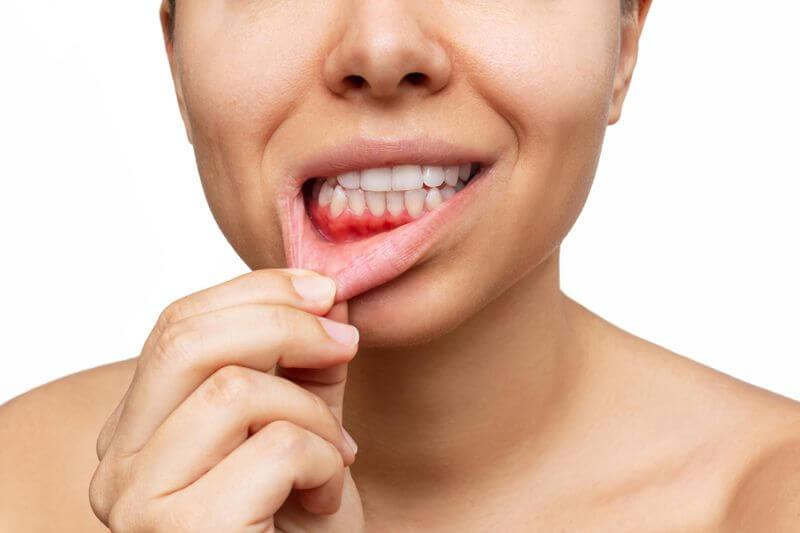
Gum disease is inflammation of the gums caused by the bacterial plaque that builds up around the teeth. Its early stage, gingivitis, shows as redness, swelling and gums that bleed easily, and it can be reversed with better oral hygiene1. If it progresses, it can turn into periodontitis: the connective tissue and bone that hold the tooth in place break down. This damage largely does not grow back, but the disease can be brought under control with treatment.
The stage of the disease decides which treatment you need. For gingivitis, improving your oral hygiene and having the tartar cleaned off is often enough. Periodontitis needs cleaning below the gum line (deep cleaning), surgery if necessary, and then regular supportive care.
- The occasional spot of bleeding when you brush is not a diagnosis on its own; but bleeding that keeps coming back is a reason to have a check-up.
- Tartar does not dissolve at home; it comes off only with a cleaning by a dentist or a dental hygiene professional.
- Periodontitis can come back after treatment; your dentist sets how often you are checked according to your risk.
Signs: bleeding, swelling, receding gums
Gum disease often starts without pain. Any of the following signs is a reason to see a dentist2:
- Gums that bleed when you brush or eat something hard
- Red, swollen or sore gums
- Bad breath that does not go away
- Gums pulling back from the teeth, so that the teeth look longer (recession can also happen without disease)
- In advanced disease, teeth that become loose or move out of place
Does a little bleeding mean disease?
The definition of healthy gums does not require that they never bleed. In a mouth considered healthy, bleeding can occur at fewer than 10 per cent3 of the points the dentist measures. Gingivitis is diagnosed when the bleeding points reach 10 per cent or more4. A single bleeding point is not a diagnosis. These percentages refer to points the dentist measures with a probe; they do not apply to bleeding you notice at home. Whether you have periodontitis is decided by also measuring pocket depth and the loss of supporting tissue. Even so, bleeding that keeps recurring when you brush should be checked.

What causes it, and who is at higher risk?
The main cause is bacterial plaque that builds up on the tooth surface and along the gum line. Plaque that is not cleaned away hardens and turns into tartar5. The rough surface of tartar makes it easier for new plaque to stick.
- Smoking. In an analysis that pooled 14 prospective studies, the risk of periodontitis starting or getting worse was about 85 per cent higher6 in smokers. This is observational evidence. Smoking also weakens the response to treatment; stopping can prevent further deterioration3.
- Diabetes. It is assumed that anyone with diabetes has a higher risk of gum disease. Well-controlled diabetes is not counted as a risk factor on its own, but blood sugar control can change over time.
- Some medicines. Medicines that cause a dry mouth, such as some antidepressants, and medicines that can cause gum enlargement. Gum enlargement is seen most often with calcium channel blockers, a group of blood pressure medicines.
- Pregnancy. Gums swell and bleed more easily in pregnancy; this is covered separately below.
The evidence on how stress, diet, weight and cannabis use affect gum disease is insufficient3.
How common is it?
In the United Kingdom, about half of adults3 have some degree of irreversible periodontitis. Severe periodontitis affects about 10 in every 100 people3 in the world's population and peaks most often at ages 60 to 64. We cannot give a comparable figure for Turkey on this page.
Who needs treatment, and who does not?
When treatment is needed
- Anyone found to have gingivitis or periodontitis at an examination. How much treatment is needed depends on the stage of the disease.
- People with diabetes who have periodontitis. Gum treatment can also help blood sugar control; the details are in the risks and benefits section.
When treatment may not be needed, or another route is considered
- Receding gums without signs of disease. Recession is common in adults and increases with age. If there are no signs of disease, monitoring the receded area7 is considered the appropriate approach; not every recession needs an operation. If the recession is getting worse, if the root is sensitive, decayed or worn, or if the appearance bothers you, surgery may be considered7.
- Healthy gums. If your gums are healthy, you do not need a deep cleaning. Your dentist decides how often routine cleaning is done. The research finding on this is in the questions section of the deep cleaning page.
- Gum problems not linked to plaque. Some gum conditions usually do not clear up8 when plaque is cleaned away, and they can be a sign of a general illness. These need a separate assessment.
Tell your dentist before treatment
If you take a blood thinner or any other regular medicine, have diabetes or heart disease, or are pregnant, tell your dentist before treatment. Do not stop or change9 your blood thinner for dental treatment unless your doctor or dentist tells you to.
Treatment options: from mild to advanced
- Doing nothing. Gingivitis continues if hygiene does not improve, and it can progress to periodontitis. In periodontitis, the supporting tissue that has been lost largely does not grow back. For recession without signs of disease, monitoring is an option.
- Improving oral hygiene. This is the core treatment for gingivitis. Brushing and cleaning between the teeth are planned for you; risk factors such as smoking and diabetes are addressed.
- Professional cleaning (scale and polish). Plaque and tartar above the gum line are cleaned off. Tartar does not dissolve at home; it comes off only with a professional cleaning5.
- Deep cleaning (cleaning below the gum; in Turkey often called küretaj). In periodontitis, plaque and tartar that have built up in the pockets below the gum are cleaned away. The details are on the deep cleaning and root planing page.
- Periodontal surgery. This is considered for pockets that stay deep after deep cleaning. Where the bone loss is suitable, regenerative surgery can also be done.
- Gum graft. Tissue taken from elsewhere in the mouth, or a ready-made material, is placed to cover an exposed root surface.
- Extracting a tooth that cannot be saved. In advanced disease, some teeth may not be saveable. Which teeth can be kept is decided after the examination and measurements.
- Supportive care. After treatment for periodontitis, regular check-ups and cleaning are part of the treatment.
What surgery would gain you is discussed based on the pockets measured at the re-assessment. Additional antibiotics or laser are not among the topics we give sources for on this page; if they are suggested, ask your dentist why.
| Gingivitis | Periodontitis | Receding gums without disease | |
|---|---|---|---|
| What is affected? | The gums | The gums, the connective tissue holding the tooth, and the bone | The gum margin |
| Does it get better? | Yes, with better oral hygiene | Bone loss is largely permanent; the disease can be brought under control | A graft can reduce the exposed root; the margin can recede again over time |
| First approach | Oral hygiene and professional cleaning | Oral hygiene and cleaning above the gum, then deep cleaning; surgery if needed | Monitoring; a graft if needed |
| Afterwards | Regular check-ups | Supportive care at intervals set by your risk | Regular check-ups |
How does treatment progress?
The European Federation of Periodontology's guideline describes treatment for periodontitis in four steps10. After each step the gums are re-assessed to see whether the next one is needed. For gingivitis, treatment often stops at the first step. How many appointments you need is planned after the examination.
Examination and measurement
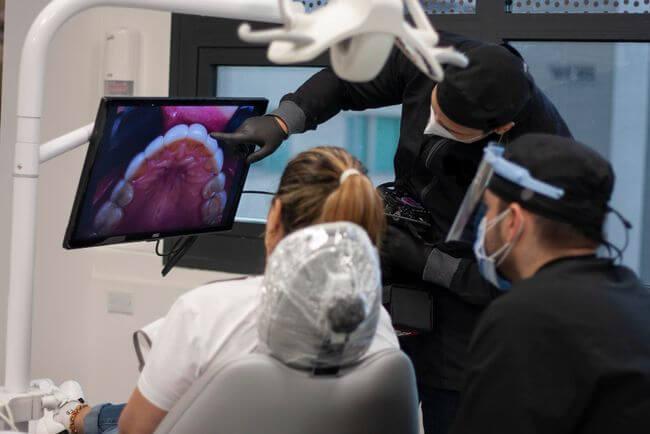
The dentist measures the gum pockets with a thin probe and checks for bleeding points and loose teeth. X-rays are taken if needed. The stage of the disease and your risk are established.
Step 1: hygiene and risk factors
Brushing and cleaning between the teeth are planned for you; risk factors such as smoking and diabetes are discussed. Plaque and tartar above the gum line are cleaned off.
Step 2: cleaning below the gum
In periodontitis, the pockets below the gum and the root surfaces are cleaned with hand instruments or ultrasonic instruments. This is usually done under local anaesthetic.
Re-assessment
Once the gums have healed, the measurements are repeated. If pockets are still deep, the cleaning can be repeated or surgery is discussed.
Step 3: surgery (if needed)
For pockets that stay deep, the gum is lifted so that the root surface can be cleaned under direct view. Where the bone loss is suitable, regenerative surgery can be done.
Step 4: supportive care
Regular check-ups and professional cleaning. The interval is set according to your risk.
Risks and benefits
If it is not treated
- Loss of supporting tissue. As periodontitis progresses, the bone that holds the tooth breaks down; teeth can become loose and be lost. This loss is irreversible1, but the disease can be stopped with treatment.
Risks and side effects of treatment
- Sensitivity and gums that look receded. As the inflammation settles and the swelling goes down, the gum margin can sit lower. Exposed root surfaces can be sensitive to hot and cold. We cannot say on this page how often this happens. For dentine sensitivity, toothpastes containing stannous fluoride or arginine are recommended among the first options11. This recommendation is based on studies of dentine sensitivity in general; it is not specific to the period after gum treatment.
- Air escaping into the tissues (emphysema). Air escaping into the tissues during dental treatment is an infrequently reported complication12. The case reports include tooth cleaning and air-polishing. Swelling that appears suddenly after treatment and crackles when touched should be checked straight away.
- Surgery and grafts. Like any surgical procedure, they can cause pain, swelling and bleeding. On a root surface covered with a graft, the gum margin can show a tendency to recede again over time13.
- Chlorhexidine mouthwash. It is used only for a short time. Used for 4 to 6 weeks, it stains the teeth14; altered taste and irritation inside the mouth have also been reported.
Benefits
- Gum health can be restored8 with treatment, and periodontitis can be brought under control.
- In people with periodontitis and diabetes (mostly type 2), gum treatment lowered HbA1c by 0.43 percentage points on average15 at 3 to 4 months; HbA1c is the long-term measure of blood sugar. This result is based on 30 studies and 2,443 participants, and the certainty of the evidence is moderate. Gum treatment does not replace diabetes treatment.
Gum disease, the heart and pregnancy
Heart and blood vessel disease
A strong statistical association16 has been reported between periodontitis and heart and blood vessel disease. This is not evidence of cause and effect. There is not enough evidence to support or rule out the idea that gum treatment prevents heart attack or stroke.
Pregnancy
Bleeding gums are common in pregnancy. In an analysis that pooled 20 studies, gum bleeding was found at examination in about 67 in every 10017 pregnant women. Gum treatment in pregnancy is safe and improves the condition of the gums18. The American College of Obstetricians and Gynecologists also considers dental treatment safe19 in pregnancy, including examinations, dental X-rays and local anaesthetic; putting treatment off can let problems grow. Guidelines differ20 on whether a lead apron or thyroid collar is needed for dental X-rays in pregnancy.
In observational studies, gum disease in pregnancy has been linked with a small increase in the risk of premature birth21; this link does not show that gum disease causes premature birth. Gum treatment has also not been shown to prevent premature birth: across 11 studies of 5,671 pregnant women, no clear difference was found22 in the rate of premature birth. The quality of this evidence is low.
After treatment, and daily care
In the first days after a deep cleaning or surgery, the gums can be tender and bleed a little. Bleeding that does not stop, or pain and swelling that keep getting worse, are not normal; contact your dentist. For what to expect after a deep cleaning, see the deep cleaning page.
If you have had surgery or a graft, that area needs different care. Follow the written instructions your dentist gives you on when and how to brush it; keep up your daily care in the rest of your mouth.
Daily care
- Brush your teeth at least twice a day with a fluoride toothpaste. After brushing, spit the toothpaste out and do not rinse2 your mouth with water.
- For most people, a toothbrush with a small head and medium bristles23 is suitable. Both electric and manual toothbrushes are effective at controlling plaque. Electric toothbrushes reduced plaque and gingivitis slightly more24; the clinical importance of the difference is unclear.
- Clean between your teeth every day. Dental floss or interdental brushes, used in addition to brushing, may reduce25 gingivitis and plaque; the certainty of the evidence is low. For people who have been treated for periodontitis, interdental brushes are recommended as the first choice10; floss is an option where the brush does not fit.
- Use chlorhexidine mouthwash only if your dentist recommends it, and only for a short time.
- If you smoke, ask for support to stop.
Does the result last?
After treatment for periodontitis, gum health can be restored. But in someone who has been treated, the risk of the disease coming back remains increased8, and it needs close monitoring. The European guideline recommends a supportive care interval of at least 3 and at most 12 months10, depending on the person's risk. This interval is for people who have been treated for periodontitis; for healthy gums, your dentist sets the check-up interval separately.
Bone destroyed by periodontitis largely does not grow back. The aim of treatment is to stop the loss and keep the remaining teeth.
In 40 studies that followed gum grafts for at least 5 years, the gum margin tended to recede again over time13. After a graft, keep up your daily cleaning and go to your follow-up appointments.
When should you see a dentist?
See a dentist if you have any of the following:
- Gums that bleed when you brush or eat hard food
- Sore or swollen gums
- Bad breath that does not go away
Get an urgent appointment2 if:
- Your gums are very painful and swollen
- Your teeth are loose or falling out
- You have a sore or red area in your mouth, or swelling of the lip or inside the mouth
- Your child's gums are painful and bleeding
Swelling that appears suddenly after dental treatment and crackles when touched should be checked without waiting12; if you cannot reach your dentist straight away, go to a hospital emergency department.
Emergencies. The following need urgent medical help26. Do not wait for a dental appointment; go to a hospital emergency department or call 112:
- Swelling that makes it hard to breathe, speak or swallow
- Swelling of the eye or the neck27, a painful eye, or sudden problems with your eyesight
- A lot of swelling inside the mouth
- Finding it hard to open your mouth
What determines the cost?
This page does not give prices. Your treatment plan is prepared for you after the examination. The main factors that shape the plan are:
- The stage of the disease and how many areas need treatment
- Whether you need only a professional cleaning, a deep cleaning, or surgery or a graft
- X-rays, if needed
- The number of re-assessment and supportive care appointments
Ask for the plan in writing, showing what is included and which procedures will be assessed separately.
Frequently Asked Questions
Can I remove tartar at home?
No. Hardened tartar does not dissolve with a toothbrush, toothpaste, mouthwash or natural remedies; it comes off only with a professional cleaning5. What you can do at home is stop new plaque from building up by brushing regularly and cleaning between your teeth.
What helps gum disease at home?
The most effective home care is regular brushing and cleaning between the teeth. Methods such as oil pulling28, aloe vera29 mouthwash and miswak30 reduced plaque or gingivitis in studies; green tea31 mouthwash was not clearly different from chlorhexidine mouthwash. The evidence for all of them is weak. For oil pulling, the certainty of the evidence is very low. In the sources reviewed, no home remedy was shown to remove tartar or bring back receded gums. Salt water, vinegar, lemon and baking soda were not assessed in these sources.
Do receded gums grow back?
In the sources we reviewed, no home remedy was shown to bring back receded gums. Recession is common in adults, and if there are no signs of disease it is often monitored7. When needed, a gum graft can reduce the exposed root surface. However, in studies with long follow-up, the gum margin showed a tendency to recede again over time13.
Does brushing hard make gums recede?
The data suggesting that brushing causes gum recession are inconclusive32. It is sensible to use a soft or medium brush instead of a hard one; but it has not been proven that this prevents recession.
I am pregnant and my gums bleed. Can I have treatment?
Bleeding gums are common in pregnancy. Gum treatment in pregnancy is safe and improves the condition of the gums18; however, it has not been shown to prevent premature birth. Dental X-rays and local anaesthetic are also considered safe19 in pregnancy. Tell your dentist you are pregnant before treatment.
Can I have implants if I have gum disease?
A history of gum disease does not rule out implants on its own, but the disease must be treated first. In an analysis that pooled 14 studies, the rate of implant loss in people with a history of treated periodontitis was about 1.75 times that33 of people without this history. This is why regular care matters after an implant too. The details are on the dental implants page.
Does gum treatment hurt?
Deep cleaning and surgery are usually done under local anaesthetic. Your gums may be tender for a few days afterwards. Increasing pain, swelling or a fever are not normal; contact your dentist.

Dt. Dilek AKSU GÜLER
Dentist · Founder
She has completed advanced training in implantology and works in aesthetic restorations and smile design.
Sources
- Prevention and Treatment of Periodontal Diseases in Primary Care, 2nd edition. Scottish Dental Clinical Effectiveness Programme (SDCEP), February 2024. 2024.↩periodontalcare.sdcep.org.uk
- Gum disease. NHS, page last reviewed 20 April 2026. 2026.↩nhs.uk
- Delivering Better Oral Health, Chapter 5: Periodontal diseases. Department of Health and Social Care / NHS England et al., updated 10 September 2025. 2025.↩gov.uk
- Plaque-induced gingivitis: case definition and diagnostic considerations. Journal of Clinical Periodontology 2018;45 Suppl 20:S44-S67. 2018.↩doi.org
- Dental Floss/Interdental Cleaners (Oral Health Topics). American Dental Association, last updated August 2026. 2026.↩ada.org
- Effect of smoking on periodontitis: a systematic review and meta-regression. American Journal of Preventive Medicine 2018;54(6):831-841. 2018.↩doi.org
- Mucogingival conditions in the natural dentition: narrative review, case definitions, and diagnostic considerations. Journal of Clinical Periodontology 2018;45 Suppl 20:S190-S198. 2018.↩doi.org
- Periodontal health and gingival diseases and conditions on an intact and a reduced periodontium: consensus report of workgroup 1 of the 2017 World Workshop. Journal of Clinical Periodontology 2018;45 Suppl 20:S68-S77. 2018.↩doi.org
- SDCEP: Anticoagulant or antiplatelet medication and your dental treatment (information for patients). Scottish Dental Clinical Effectiveness Programme (SDCEP), March 2022. 2022.↩sdcep.org.uk
- Treatment of stage I-III periodontitis - the EFP S3 level clinical practice guideline. Journal of Clinical Periodontology 2020;47 Suppl 22:4-60 (erratum 2021;48:163). 2020.↩doi.org
- Dentifrice formulations for the treatment of dentin hypersensitivity: a systematic review and network meta-analysis. Periodontology 2000, 2026 (Gormley AJ et al.). 2026.↩doi.org
- Dental Procedure-Related Emphysema: A Scoping Review of Clinical Presentation, Anatomical Distribution, Management, and Outcomes. Dental Journal (Basel) 2026;14(9):602. 2026.↩doi.org
- Long-term stability of gingival margin and periodontal soft-tissue phenotype achieved after mucogingival therapy: a systematic review. Journal of Clinical Periodontology 2024;51(2):177-195. 2024.↩doi.org
- Chlorhexidine mouthrinse as an adjunctive treatment for gingival health. Cochrane Database of Systematic Reviews 2017;3:CD008676. 2017.↩doi.org
- Treatment of periodontitis for glycaemic control in people with diabetes mellitus. Cochrane Database of Systematic Reviews 2022;4:CD004714. 2022.↩doi.org
- Periodontitis and cardiovascular diseases: consensus report. Journal of Clinical Periodontology 2020;47(3):268-288 (EFP / World Heart Federation). 2020.↩doi.org
- Prevalence of periodontal disease in pregnancy: a systematic review and meta-analysis. Journal of Dentistry 2022;125:104253. 2022.↩doi.org
- Periodontitis and adverse pregnancy outcomes: consensus report of the Joint EFP/AAP Workshop on Periodontitis and Systemic Diseases. Journal of Clinical Periodontology 2013;40 Suppl 14:S164-9. 2013.↩doi.org
- Oral health care during pregnancy and through the lifespan (Committee Opinion No. 569). American College of Obstetricians and Gynecologists, Obstet Gynecol 2013;122:417-22, reaffirmed 2025. 2013.↩acog.org
- Patient shielding during dentomaxillofacial radiography: recommendations from the American Academy of Oral and Maxillofacial Radiology. Journal of the American Dental Association 2023;154(9):826-835.e2. 2023.↩doi.org
- The risk of preterm birth in women with periodontitis: a systematic review and meta-analysis. International Journal of Dental Hygiene 2026;24(1):116-135. 2025.↩doi.org
- Treating periodontal disease for preventing adverse birth outcomes in pregnant women. Cochrane Database of Systematic Reviews 2017;6:CD005297. 2017.↩doi.org
- Delivering Better Oral Health, Chapter 8: Oral hygiene. Department of Health and Social Care / NHS England et al., updated 10 September 2025. 2025.↩gov.uk
- Powered versus manual toothbrushing for oral health. Cochrane Database of Systematic Reviews 2014;6:CD002281. 2014.↩doi.org
- Home use of interdental cleaning devices, in addition to toothbrushing, for preventing and controlling periodontal diseases and dental caries. Cochrane Database of Systematic Reviews 2019;4:CD012018. 2019.↩doi.org
- NHS: Dental abscess. NHS (nhs.uk). 2026.↩nhs.uk
- NHS: Toothache. NHS (nhs.uk). 2024.↩nhs.uk
- The effect of oil pulling in comparison with chlorhexidine and other mouthwash interventions in promoting oral health: a systematic review and meta-analysis. International Journal of Dental Hygiene 2024;22(1):78-94. 2024.↩doi.org
- Efficacy of aloe vera mouthwash versus chlorhexidine on plaque and gingivitis: a systematic review. International Journal of Dental Hygiene 2020;18(1):44-51. 2020.↩doi.org
- The effectiveness of miswak practices in reducing plaque and gingivitis among adults: a systematic review and meta-analysis. Journal of Ethnopharmacology 2022;298:115598. 2022.↩doi.org
- Efficacy of green tea-based mouthwashes on dental plaque and gingival inflammation: a systematic review and meta-analysis. Indian Journal of Dental Research 2018;29(2):225-232. 2018.↩doi.org
- Does tooth brushing influence the development and progression of non-inflammatory gingival recession? A systematic review. Journal of Clinical Periodontology 2007;34(12):1046-1061. 2007.↩doi.org
- Effectiveness of implant therapy in patients with and without a history of periodontitis: systematic review with meta-analysis of prospective cohort studies (14 studies, >=36 months). Journal of Periodontal Research 2025;60(6):524-543. 2025.↩doi.org