
What helps with gum recession?
No rinse, oil, herb or toothpaste has been shown to make receded gum grow back, and bone lost to gum disease cannot be rebuilt at home. What helps is stopping recession getting worse: gentle brushing with a soft or medium brush, treating any gum disease, not smoking and regular checks. Many receded areas only need watching. Where exposed root needs covering, that takes gum surgery.
- None of the studies behind this article showed a home remedy making receded gum grow back.
- Gum and bone support lost to gum disease largely cannot be rebuilt; the disease itself can be brought under control.
- Not every receded area needs treatment; often a dentist simply monitors it.
- Gum grafting can reduce exposed root, but the gum margin can slowly shift again over the years.
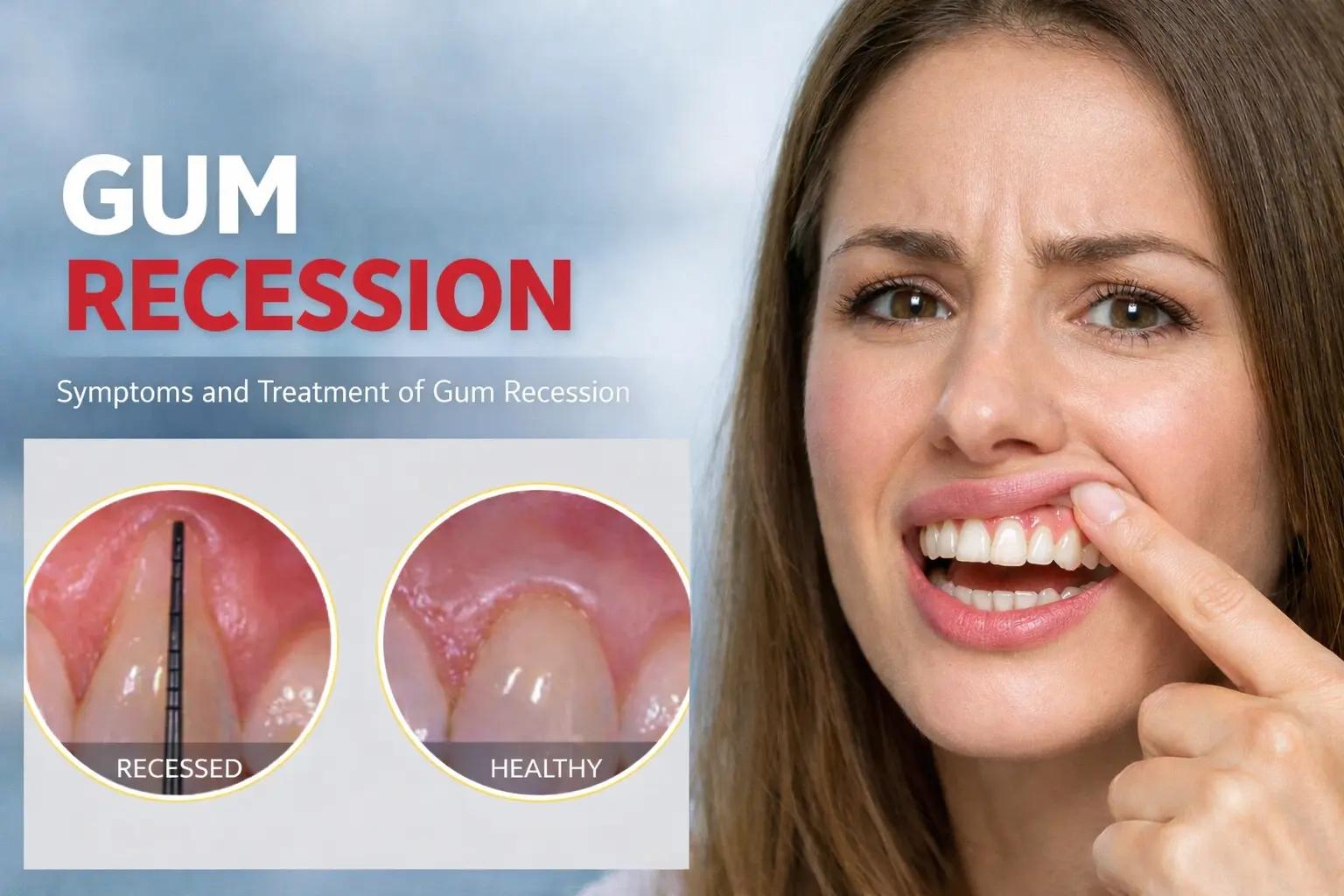
What gum recession is and why it happens
Gum recession means the gum margin has moved down (or up, on the upper teeth) and exposed part of the root. Teeth can look longer, and the exposed root can be sensitive to cold. A review from the 2017 World Workshop on periodontal diseases found that recession is common in adults and increases with age1, and that it occurs in people with both good and poor oral hygiene. It links exposed roots with sensitivity, root decay and wear near the gum line.
The same review names thin gums as a clear risk factor and says poor oral hygiene, orthodontic treatment and fillings or crowns near the gum line might increase the risk1. Gum disease (periodontitis) also causes the gum to recede as the bone beneath it is lost.
Brushing too hard is often blamed. A systematic review found the data on brushing and recession inconclusive2: it can neither confirm nor rule out a link. Gentle brushing is still sensible, but it is not proven to prevent recession.
What cannot grow back
This is the part many articles leave vague, so here it is plainly.
- Gum and bone lost to gum disease. Scottish dental guidance (SDCEP) states that damage caused by periodontitis is irreversible, but the disease can be stabilised3. UK prevention guidance calls the bone loss largely irreversible4: in some bone defects surgery can regenerate part of it, but no home method can.
- Receded gum and home remedies. None of the studies we checked showed any rinse, oil, herb or toothpaste making receded gum grow back. The reviews of natural remedies measured plaque and gum-inflammation scores; none of them, as we read them, reported on recession at all. That is an absence of evidence, and it means no remedy can honestly be sold as a way to regrow gum.
What can change is inflammation. Swollen, bleeding gums can settle with better cleaning, and that can make the gum line look different. That is healing of inflammation, not regrowth of lost gum.
Natural remedies: an honest verdict
Natural remedies are often recommended for receding gums. Here is what the evidence behind them actually measured.
- Green tea rinse. In a review that pooled 5 trials against chlorhexidine (an antiseptic rinse), results showed no clear difference either way5 on plaque or gum inflammation, and the trials disagreed with each other widely. The review did not report on recession.
- Aloe vera rinse. A review of 6 trials found it comparable to chlorhexidine on gum inflammation but weaker on plaque6, and the authors call the findings preliminary. The review did not report on recession.
- Oil pulling (swishing sesame or coconut oil). A review of 25 trials lasting 7 to 45 days rated the evidence of very low certainty7, and chlorhexidine reduced plaque more. The review did not report on recession.
- Thyme. We found no systematic review of thyme rinses for gum problems, and no evidence that a thyme infusion helps receding gums.
- Clove and clove oil. The European Medicines Agency accepts clove oil only as a traditional herbal medicine8, based on long-standing use rather than trials: a dilute mouthwash for minor mouth inflammation, and strong oil placed in a decayed tooth for temporary toothache, neither for more than a week. It is not a treatment for gum disease or recession. For the strong toothache use the agency says to avoid contact with the gums; it reports irritation and allergic reactions, advises against use under 18 or in pregnancy and breastfeeding, and warns that swallowed clove oil has caused life-threatening conditions in small children.
- Salt water, vinegar, lemon and other kitchen remedies. None was assessed for gums by the sources we use, so we make no claim that they help. The American Dental Association notes that studies of home whitening with acidic fruits and vinegar raise questions about their safety9, so ask your dentist before putting anything acidic on your teeth or gums.
Some of these remedies lowered plaque or gum-inflammation scores in studies, but the evidence is weak. They do not replace brushing and cleaning between the teeth, and none of them treats recession.
What a dentist can do
The first step is finding out why the gum has receded. A dentist checks for gum disease, the thickness of the gum, how you brush and any filling or crown edge near the gum line.
- Monitoring. Where there is no disease, the World Workshop review says that monitoring the site seems to be the proper approach1.
- Treating gum disease. If recession comes from periodontitis, treatment aims to stop further loss. How that works is explained on the gum disease treatment page.
- Easing sensitivity and protecting the root. Exposed roots can be sensitive and more prone to decay. Fluoride toothpaste helps protect them, and a worn area can be covered with a filling where needed.
- Gum grafting surgery. Considered when recession is getting worse, the root is at risk, or for appearance. In a Cochrane review of 48 trials, 3 trials with 98 people compared two techniques. A graft of your own tissue, usually taken from the palate and placed under gum that is moved over the root, reduced recession more than a technique using a membrane, but the difference was about a third of a millimetre10 and the evidence was of low quality. The membrane technique left the gum slightly more firmly attached to the root, so neither is better on every measure. Grafting is surgery, and where tissue is taken from the palate there is a second area to heal; ask about pain, healing time and possible complications before you decide. The review covered recession of at least 3 mm without loss of the gum between the teeth.
Grafting reduces how much root is exposed, but we found no reliable figure for how much it covers, so ask the dentist what result to expect for your tooth. Results also change over time: a review of studies with at least 5 years of follow-up found that recession tends to increase again over the years11 after root-coverage surgery, less so with grafts of the patient's own tissue.
Protecting the gum you have
- Use a soft or medium brush with a small head, and brush gently. UK guidance reports low-certainty evidence12 that soft and medium bristles are less likely than hard ones to injure the gums.
- Brush twice a day with fluoride toothpaste and spit out rather than rinse, so the fluoride stays on exposed roots.
- Clean between your teeth every day with interdental brushes that fit, or floss.
- Do not smoke. Smoking raises the risk of periodontitis, one of the causes of recession.
- Keep your check-ups, so a dentist can compare the gum line over time and catch gum disease early.
When to see a dentist
Book an appointment if your teeth look longer than before, a tooth has become sensitive to cold, or you can see or feel the edge of a root. The NHS also advises seeing a dentist if your gums bleed when you brush13, are painful or swollen, or you have bad breath, and if a child has sore, bleeding gums.
Ask for an urgent appointment if teeth feel loose or are falling out, your gums are very sore and swollen, or you have ulcers, red patches or a lump in your mouth or on your lip.
Emergencies. Call 112 or go to the nearest emergency department if you:
- find it hard to breathe, speak or swallow14
- have a swollen or painful eye, sudden problems with your eyesight, or swelling in your neck15
- have a lot of swelling inside your mouth
- find it hard to open your mouth
Frequently asked questions
Can receded gums grow back naturally?
No natural remedy has been shown to make receded gum grow back. Gentle cleaning can calm inflamed gums and help stop recession getting worse. Covering exposed root again takes gum surgery.
Does oil pulling or green tea help receding gums?
Some trials found small effects on plaque or gum inflammation, with weak evidence; the oil-pulling trials lasted 7 to 45 days. None of the reviews we checked reported on recession, so neither is a treatment for it.
Is it safe to put clove oil on my gums?
Clove oil is not a treatment for gum recession or gum disease. The European medicines regulator says to avoid gum contact with strong clove oil, reports irritation and allergy, and advises against it under 18 and in pregnancy.
Does every receded gum need surgery?
No. Where there is no gum disease, a dentist often monitors the area. Surgery is considered when recession is getting worse, the root is at risk or its appearance bothers you.
Is gum grafting permanent?
Not necessarily. Studies following patients for 5 years or more found the gum margin tends to shift again over time, less so with grafts of the patient's own tissue. Regular checks and gentle cleaning still matter.
Did brushing too hard cause my recession?
It may have played a part, but studies have not settled whether brushing causes recession. Thin gums, gum disease and fillings near the gum line matter too. A soft or medium brush used gently is sensible.

Dt. Dilek AKSU GÜLER
Dentist · Founder
She has completed advanced training in implantology and works in aesthetic restorations and smile design.
Sources
- Mucogingival conditions in the natural dentition: narrative review, case definitions, and diagnostic considerations. Journal of Clinical Periodontology 2018;45 Suppl 20:S190-S198. 2018.↩doi.org
- Does tooth brushing influence the development and progression of non-inflammatory gingival recession? A systematic review. Journal of Clinical Periodontology 2007;34(12):1046-1061. 2007.↩doi.org
- Prevention and Treatment of Periodontal Diseases in Primary Care, 2nd edition. Scottish Dental Clinical Effectiveness Programme (SDCEP), February 2024. 2024.↩periodontalcare.sdcep.org.uk
- Delivering Better Oral Health, Chapter 5: Periodontal diseases. Department of Health and Social Care / NHS England et al., updated 10 September 2025. 2025.↩gov.uk
- Efficacy of green tea-based mouthwashes on dental plaque and gingival inflammation: a systematic review and meta-analysis. Indian Journal of Dental Research 2018;29(2):225-232. 2018.↩doi.org
- Efficacy of aloe vera mouthwash versus chlorhexidine on plaque and gingivitis: a systematic review. International Journal of Dental Hygiene 2020;18(1):44-51. 2020.↩doi.org
- The effect of oil pulling in comparison with chlorhexidine and other mouthwash interventions in promoting oral health: a systematic review and meta-analysis. International Journal of Dental Hygiene 2024;22(1):78-94. 2024.↩doi.org
- Community herbal monograph on Syzygium aromaticum (L.) Merill et L. M. Perry, floris aetheroleum (clove oil). European Medicines Agency, Committee on Herbal Medicinal Products, EMA/HMPC/534924/2010, adopted 13 September 2011. 2011.↩ema.europa.eu
- Oral Health Topics: Whitening. American Dental Association (ADA Library & Archives), last updated 16 August 2022. 2022.↩ada.org
- Root coverage procedures for treating localised and multiple recession-type defects. Cochrane Database of Systematic Reviews 2018;10:CD007161. 2018.↩doi.org
- Long-term stability of gingival margin and periodontal soft-tissue phenotype achieved after mucogingival therapy: a systematic review. Journal of Clinical Periodontology 2024;51(2):177-195. 2024.↩doi.org
- Delivering Better Oral Health, Chapter 8: Oral hygiene. Department of Health and Social Care / NHS England et al., updated 10 September 2025. 2025.↩gov.uk
- Gum disease. NHS, page last reviewed 20 April 2026. 2026.↩nhs.uk
- NHS: Dental abscess. NHS (nhs.uk). 2026.↩nhs.uk
- NHS: Toothache. NHS (nhs.uk). 2024.↩nhs.uk