
How long does a dental implant last?
Most implants last many years, but no one can promise a lifetime. In a review of 46 studies of implants carrying a single crown, about 97 in 100 were still in the mouth after five years and an estimated 95 after ten1. The crown on top is replaced more often: an estimated 89 in 100 were still in use after ten years. The pooled survival estimates quoted here for single implants extend to ten years.
- About 97 in 100 single implants were still in place after five years and about 95 after ten; the ten-year values were modelled.
- The crown on the implant is replaced more often than the implant itself.
- Staying in place is not the same as trouble-free: loose screws, gum problems and chipped porcelain happen.
- Smoking, a history of gum disease and clenching are linked with more implant loss; daily cleaning and regular reviews help.
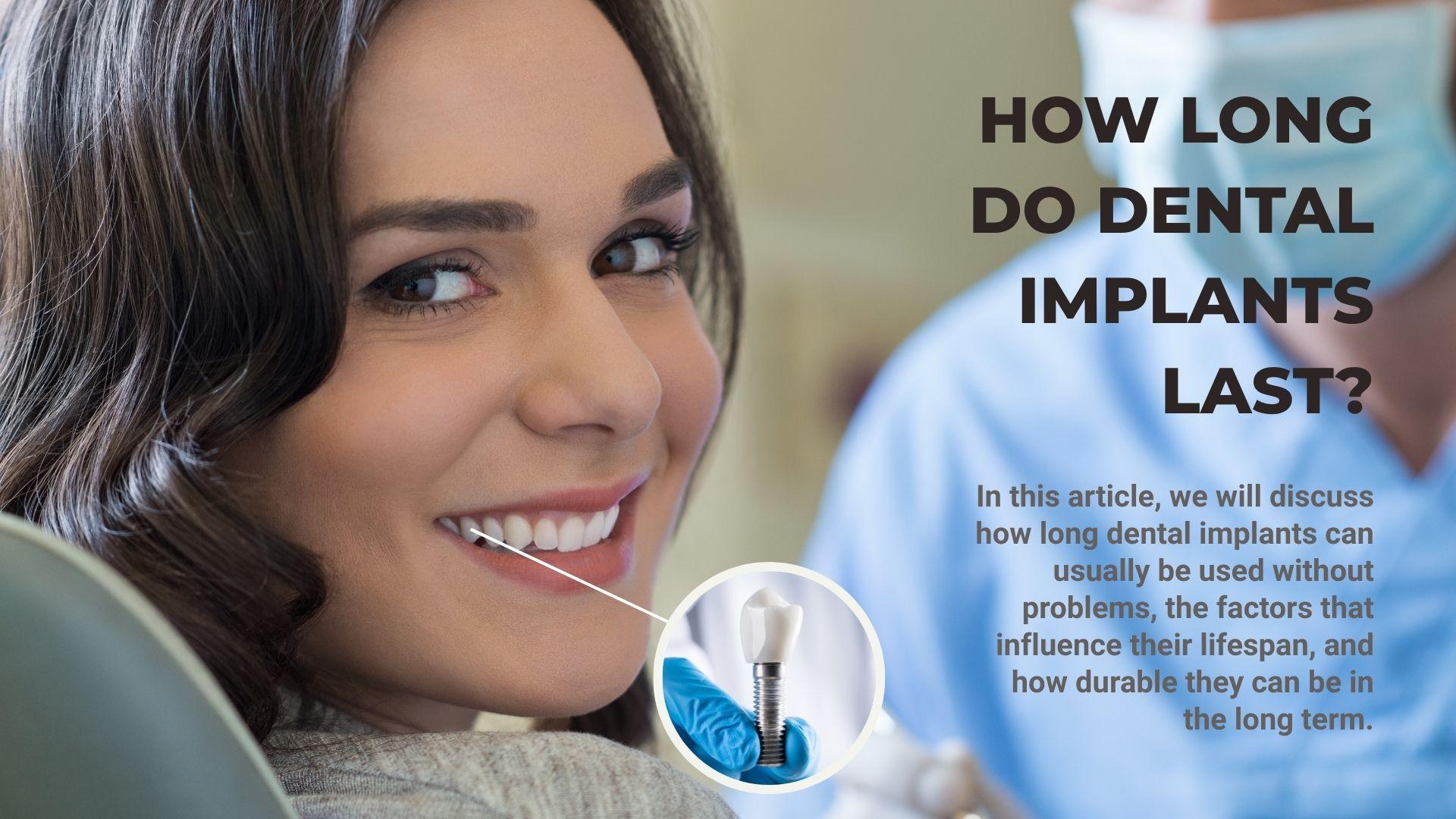
Single implants: five and ten years
The pooled figures for a single missing tooth come from a review of 46 studies. Of every 100 implants carrying a single crown, about 97 were still in the mouth after five years and about 95 after ten1. The ten-year values are model estimates from studies with a mean follow-up of at least five years1.
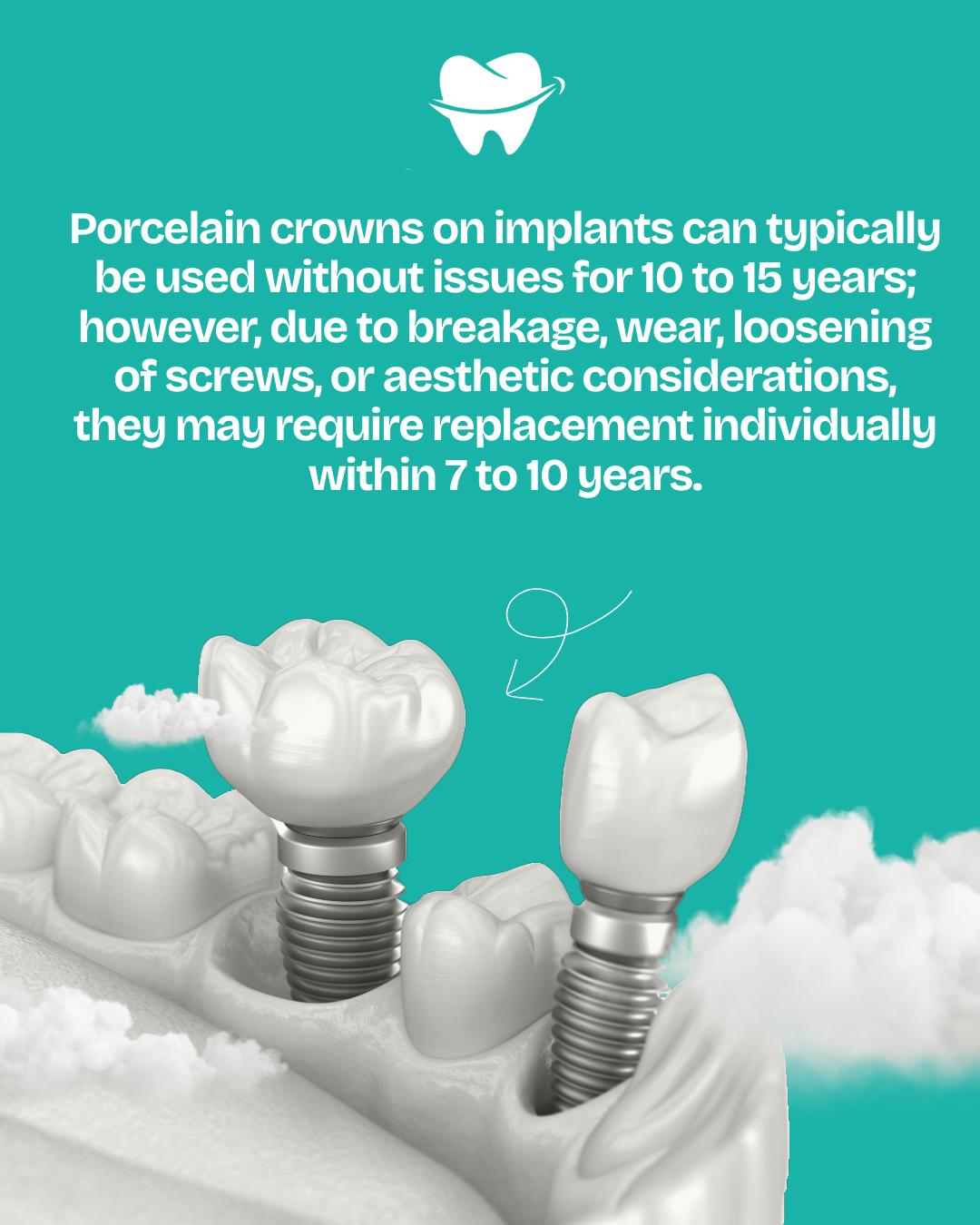
The crown is a separate part and does not last as long. In the same review, about 96 in 100 crowns were still in use after five years and an estimated 89 after ten. An older review gave about 95 after five years and 89 after ten2 for crowns on implants. A crown that has to be remade does not mean the implant has failed.
These figures are averages pooled from studies in different countries and groups of patients. They are not the result of one clinic, dentist or implant brand, and they are not your personal risk. When you read a success rate, ask what was counted (implants, crowns or patients), how success was defined and over how many years.
Full-arch bridges on implants
For a fixed bridge replacing all the teeth in a jaw, a 2026 review of 55 studies found that about 98 in 100 implants were still in place after five years or more with All-on-43, and about 97 to 98 with All-on-6. These rates are per implant, and the results varied a lot between studies; the review did not measure what losing one implant means for a bridge on four compared with six. The same review found bone loss of about 1 millimetre per implant3 on average over five years.
The bridge itself also needs care. A 2012 review of full-arch bridges on four to six implants found about 97 in 100 upper bridges in use after five years and 95 after ten4; for lower bridges the figures were about 98 and 96. An umbrella review of seven reviews reported that about 90 to 97 in 100 bridges were in use5 over 5 to 15 years of follow-up, as far as the review summaries show. The same reviews report screw loosening at 5 to 15 per cent5, and chipping of the porcelain layer on veneered zirconia bridges at 15 to 35 per cent; the summaries do not make clear what these percentages were counted against. See the All-on-4 page for how the treatment works.
Staying in place is not the same as trouble-free
An implant that is still in the mouth may still have needed repairs. In the 46-study review, over five years there was screw loosening in 8.8 per cent and soft-tissue problems in 7.1 per cent1. The crown came loose (loss of retention) in 4.1 per cent. Bone loss of more than 2 millimetres was 5.2 per cent and chipped porcelain 3.5 per cent.
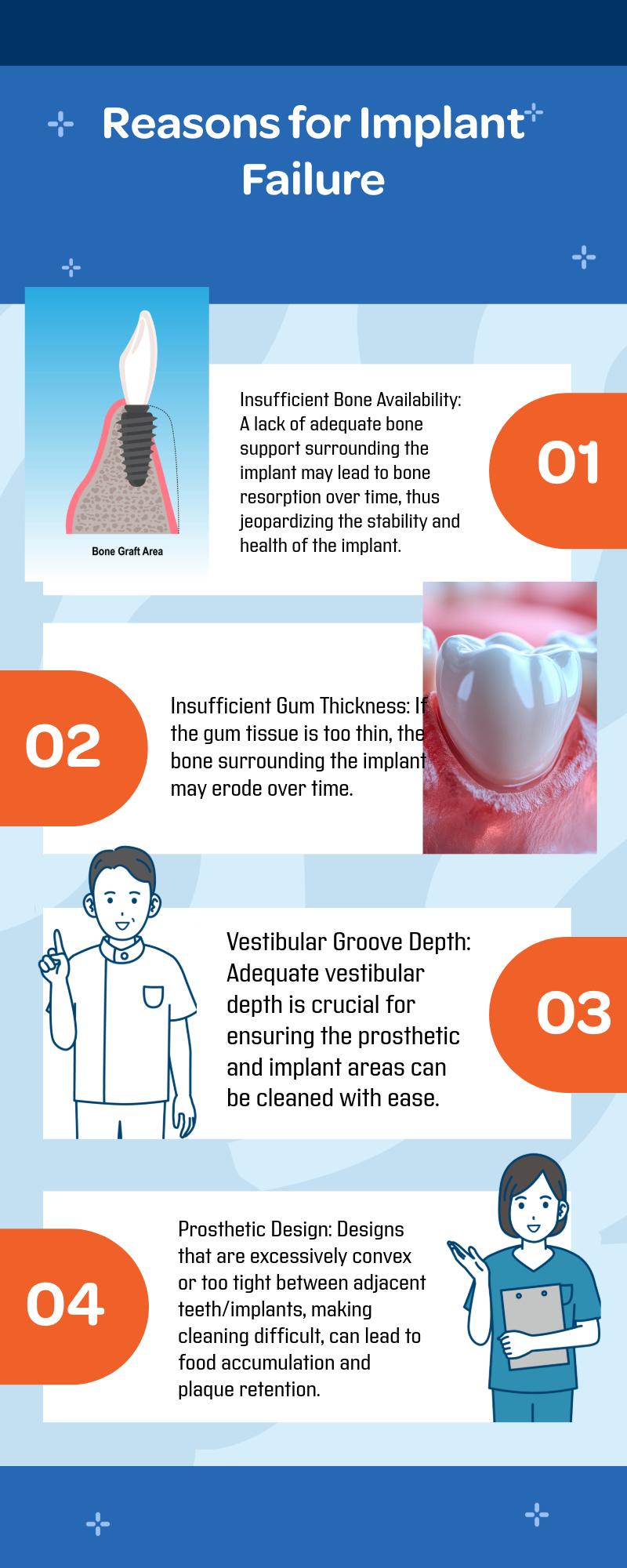
A later problem is inflammation around the implant. It can affect the gum alone (peri-implant mucositis), without bone loss; a dentist checks whether the bone is affected. Peri-implantitis is inflammation of the gum around the implant together with loss of the bone that supports it. A 57-study review found it in about 20 in 100 patients and about 12 in 100 implants6; the rate depends on the definition used. These figures show how many people had it when they were examined, not the chance of developing it within five or ten years. If it is not controlled, the implant can be lost.
What shortens an implant's life
The figures below come from observational studies. They show an association, not proven cause and effect.
- Smoking. In people smoking more than 20 cigarettes a day, implant loss was about 2.5 times as likely per implant7 as in non-smokers. Per patient it was about 4 times as likely. No safe number of cigarettes has been shown.
- A history of gum disease. In people treated for periodontitis, implants were lost at about 1.75 times the rate8 seen in people without that history, and about twice the rate in studies with ten or more years of follow-up.
- Clenching or grinding. The odds of failure per implant were about 2.2 times as high9 in people judged likely to clench or grind as in others (an odds ratio). A night guard may be advised to protect the crown; these studies did not test whether it prevents implant loss.
- Diabetes. The findings on implant loss are mixed. Two of three reviews found no significant difference (2021 review10; 2016 review11), and the third found higher odds of implant loss12 in people with diabetes than in people without. All three found more bone loss around implants, so blood-sugar control, daily cleaning and regular reviews matter.
- Placing the implant straight into an extraction socket. Survival was 95.2 per cent, against 98.4 per cent13 for implants placed into healed bone, across the included studies; these are not five- or ten-year figures like those above. The review's authors advise caution with immediate placement; the decision depends on the patient and the site.
Can an implant last a lifetime, or 20 years?
For single implants carrying a crown, the pooled survival estimates quoted here extend to ten years. A promise that an implant will last a lifetime is not based on evidence. What can be said is that the risk depends partly on things you and your dentist can influence: smoking, gum health, clenching, daily cleaning and regular reviews.
Over a long life with an implant, expect maintenance. Screws may need tightening, and the crown or bridge on top may need repair or replacement before the implant itself does.
Helping your implant last
- Daily cleaning. Brush twice a day with a soft brush and fluoride toothpaste, paying attention to the line where the implant meets the gum, and clean between the teeth every day. If you have a bridge on implants, ask your dental team to show you how to clean around each implant and under the bridge.
- A baseline record. The 2017 consensus report recommends that an X-ray and gum measurements be taken as a baseline14 when the crown or bridge is completed. Later changes are judged against that record.
- Regular reviews. The European guideline on peri-implant diseases calls for a structured supportive care programme15. The interval between reviews is set for each patient16 by their risk, so there is no 'once a year' that suits everyone; that guideline covers check-ups in general, not implants.
- Smoking, clenching and health. Tell your dentist if you smoke, clench or grind, have diabetes or gum disease, and about your medicines.
The dental implants page explains how implant treatment runs, stage by stage.
When to see a dentist
Contact your dentist if an implant or the tooth on it moves or feels loose, if a crown comes off or chips, or if you notice bleeding, swelling, pus, a bad taste or receding gum around an implant. Do not wait for your next planned review. Pain on biting or a bite that suddenly feels different is also a reason to be seen.
Emergencies. Difficulty breathing or swallowing, rapidly spreading swelling of the face or neck, high fever or swelling around the eye are serious signs. Go to the nearest emergency department or call 112.
Frequently asked questions
Do dental implants last forever?
No one can promise that. Pooled studies estimated that about 95 in 100 single implants were still in place after ten years (a model estimate), and the pooled survival estimates quoted here for single implants extend to ten years. Screws, crowns and the gum around an implant also need care.
How long does the crown on an implant last?
Crowns are replaced more often than implants. In the same pooled studies, an estimated 89 in 100 crowns on single implants were still in use after ten years. A crown that needs remaking does not mean the implant has failed.
When can an implant fail?
An implant can be lost early, before it has fused with the bone, or years later. Inflammation with bone loss around it (peri-implantitis) can lead to loss if it is not controlled. Smoking, a history of gum disease and clenching are linked with more loss.
How long do full-arch implants like All-on-4 last?
In a 2026 review, about 98 in 100 All-on-4 implants were still in place after five years or more. The bridge on top needs its own maintenance, and screws, bridges and the gum around the implants are checked at reviews.
What can I do to make my implant last longer?
Clean around it every day, keep your reviews, and do not smoke. Tell your dentist if you clench or grind, or if you have diabetes or gum disease. See your dentist early if the gum bleeds or anything feels loose.

Dt. Dilek AKSU GÜLER
Dentist · Founder
She has completed advanced training in implantology and works in aesthetic restorations and smile design.
Sources
- Systematic review of the survival rate and the incidence of biological, technical and aesthetic complications of single crowns on implants (46 studies, mean follow-up 5 years). Clinical Oral Implants Research 2012;23 Suppl 6:2-21. 2012.↩doi.org
- Comparison of survival and complication rates of tooth-supported fixed dental prostheses and implant-supported fixed dental prostheses and single crowns. Clinical Oral Implants Research 2007;18 Suppl 3:97-113 (erratum 2008;19(3):326-8). 2007.↩doi.org
- All-on-4 and All-on-6 implant-supported fixed prostheses for the edentulous jaw: systematic review and meta-analysis (55 studies). International Journal of Oral and Maxillofacial Surgery 2026;55(9):1098-1112. 2026.↩doi.org
- What is the optimal number of implants for fixed reconstructions: a systematic review (9 studies, per prosthesis). Clinical Oral Implants Research 2012;23 Suppl 6:217-228. 2012.↩doi.org
- Prosthetic complications of implant-supported complete arch prostheses: an umbrella review of systematic reviews (7 reviews, >=5-year follow-up). Journal of Prosthetic Dentistry 2026;136(1):52-59. 2026.↩doi.org
- What is the prevalence of peri-implantitis? A systematic review and meta-analysis (57 articles, 2005-2021). BMC Oral Health 2022;22(1):449. 2022.↩doi.org
- Levels of smoking and dental implants failure: systematic review and meta-analysis (23 articles). Journal of Clinical Periodontology 2020;47(4):518-528. 2020.↩doi.org
- Effectiveness of implant therapy in patients with and without a history of periodontitis: systematic review with meta-analysis of prospective cohort studies (14 studies, >=36 months). Journal of Periodontal Research 2025;60(6):524-543. 2025.↩doi.org
- Bruxism and dental implants: systematic review and meta-analysis (27 studies; 2,105 implants in probable bruxers, 10,264 in non-bruxers). Journal of Oral Rehabilitation 2024;51(1):202-217. 2024.↩doi.org
- Impact of hyperglycemia on the rate of implant failure and peri-implant parameters in patients with type 2 diabetes mellitus: systematic review and meta-analysis (9 studies). Journal of the American Dental Association 2021;152(3):189-201. 2021.↩doi.org
- The impact of diabetes on dental implant failure: a systematic review and meta-analysis. International Journal of Oral and Maxillofacial Surgery 2016;45(10):1237-1245. 2016.↩doi.org
- Diabetes mellitus and dental implants: systematic review and meta-analysis (89 publications; 5,510 implants in diabetic and 62,780 in non-diabetic patients). Materials 2022;15(9):3227. 2022.↩doi.org
- Immediate implant placement into fresh extraction sockets versus delayed implants into healed sockets: systematic review and meta-analysis. International Journal of Oral and Maxillofacial Surgery 2017;46(9):1162-1177. 2017.↩doi.org
- Peri-implant diseases and conditions: consensus report of workgroup 4 of the 2017 World Workshop on the Classification of Periodontal and Peri-Implant Diseases and Conditions. Journal of Clinical Periodontology 2018;45 Suppl 20:S286-S291. 2018.↩doi.org
- Prevention and treatment of peri-implant diseases: the EFP S3 level clinical practice guideline. Journal of Clinical Periodontology 2023;50 Suppl 26:4-76. 2023.↩doi.org
- Dental checks: intervals between oral health reviews (clinical guideline CG19). National Institute for Health and Care Excellence, published 27 October 2004. 2004.↩nice.org.uk