
What is a zygomatic implant, and who is it for?
A zygomatic implant is a long implant anchored in the cheekbone when the bone in the upper jaw is not enough for a standard implant. It takes its support from the cheekbone rather than the jawbone. Depending on the plan, the fixed bridge can also rest on standard implants placed at the front of the upper jaw alongside them. It is not a routine option: if conventional implants can be placed, this route is not taken. A Cochrane review describes the procedure as technically demanding and notes that it may be associated with serious complications1.
This page explains who it is considered for, how limited the evidence is, the balance of complications and the bone grafting alternative. The decision is made together with your dentist; getting a second opinion is reasonable.
- Zygomatic implants are considered when the upper jaw no longer has enough bone for standard implants; a patient with enough bone does not need them.
- The evidence is limited: two small randomised trials (71 and 20 participants) and observational reviews.
- In the only randomised comparison, implant loss was lower and complications were higher; the two results belong together.
- The most commonly reported biological complication is sinus inflammation (sinusitis); the alternative route is bone grafting or a sinus lift.
How strong is the evidence?
When you read the numbers on this page, you need to know the limits of the evidence behind them. There is little research on zygomatic implants.
- Randomised evidence is limited to two small trials. A 2026 Cochrane review found two trials with 71 and 20 participants1, each followed for three years. The two trials do not ask the same question. The 71-participant trial compared zygomatic implants with conventional implants placed after bone grafting. The 20-participant trial compared two surgical methods of preparing the site for a zygomatic implant. So only one randomised trial assesses the grafting alternative. The certainty of the evidence was rated moderate to low. Because the samples are small and the confidence intervals wide, the findings cannot be carried over to clinical practice with confidence.
- The rest of the evidence is observational. The survival figures come from two reviews of 18 studies each: one compared zygomatic implants with conventional implants2, the other pooled long-term outcomes3. Patients in these studies were not randomly allocated; which patient was given which method may have affected the results.
- There is no grading of the evidence. The observational reviews were not graded with GRADE.
- Averages are not one clinic's results. Published rates are averages of studies from different countries, different patient groups and different years.
That is why, next to every rate on this page, we say which study it comes from and what was counted. The evidence we have cannot support a claim that one route is clearly better than, or equivalent to, the other.
Who it suits, and who it does not
Where it may be considered
- Bone loss in the upper jaw is advanced and a standard implant cannot be placed. The patients in the trials of the Cochrane review had a severely resorbed upper jaw in which conventional implants could not be placed1.
- The bone grafting route has been assessed, and the patient and dentist have decided against it.
- General health allows surgery of this extent and anaesthesia.
Who it is not for
- Patients with enough bone in the upper jaw to hold standard implants. A zygomatic implant is more extensive surgery that reaches the cheekbone, and these patients do not need it.
- Patients with untreated sinus or nasal disease. These problems are assessed first and, where needed, managed together with an ear, nose and throat specialist.
- Active infection, untreated gum disease, uncontrolled general illness. These are dealt with first.
- General health that does not allow surgery or anaesthesia.
- A jaw that is still growing. In young patients, implants are postponed until growth is complete.
What increases the risk
The figures below are for implant treatment in general and are pooled results of observational studies; they show an association and do not establish cause.
- Smoking. In people smoking more than 20 cigarettes a day, implant loss was about 2.5 times as likely per implant4 as in non-smokers. No safe number of cigarettes has been shown.
- A history of gum disease. Across 14 prospective studies, the risk of implant loss was about 1.75 times higher5.
- Clenching or grinding. In 27 studies, the odds of implant loss were about 2.2 times higher6 (an odds ratio).
- Bone-strengthening medicines (bisphosphonates, denosumab). A 21-study review found that in people taking bisphosphonates, implant loss was about 1.7 times more likely per implant7. Per patient, the risk of medication-related death of jaw bone (osteonecrosis) was about 3.5 times higher. In the per-patient analysis of implant loss there was no significant difference. These figures apply to bisphosphonates and cannot be generalised to denosumab. At the high doses used in cancer treatment, implants are often not appropriate; doses used for osteoporosis are assessed separately. The certainty of the evidence is very low. Always tell your dentist about your medicines, and do not stop a medicine without asking the doctor who prescribed it.
- Diabetes, radiotherapy to the head and neck, and other medicines also change the plan. These factors are covered in detail on the All-on-6 page.
Routes to discuss first
- Bone grafting and sinus lift. If the bone can be built up, the standard implant route may open up. This route takes longer and has its own risks.
- A removable full denture. It needs no surgery and is a reversible option.
- A different fixed design. If the bone allows, All-on-4 or All-on-6 may come into consideration; we compare the options on the full-mouth implants page.
The decision is made on a 3D scan and your medical history, with an ear, nose and throat assessment where needed.
| Zygomatic implants | Implants after bone grafting | Removable full denture | |
|---|---|---|---|
| Who is it considered for? | When the upper jaw does not have enough bone for standard implants | When the bone can be built up | Patients who do not want surgery, or for whom surgery is not suitable |
| Extent of surgery | Extensive surgery reaching the cheekbone | A separate bone procedure, then implant surgery | No surgery |
| Overall time | In one trial, a working bridge was reached markedly sooner | In the same trial, the grafting route took markedly longer | Short |
| Level of evidence | Two small randomised trials and observational reviews | Randomised trials and prospective reviews | A long-established method |
| Commonly reported complications | Sinusitis, infection, an opening between the mouth and the sinus | Tearing of the sinus lining; complications of the bone-adding (graft) procedure | |
| Maintenance | Daily cleaning and reviews; sinus symptoms are monitored separately | Daily cleaning and reviews | Taken out and cleaned daily |
How the treatment runs
The sequence below is the usual course of this treatment. Times and details vary from patient to patient; your plan is given in writing.
Examination, 3D scan and sinus assessment
The amount of bone, the condition of the cheekbone and the position of the sinuses are assessed on a 3D scan. If you have nasal or sinus complaints, they are assessed together with an ear, nose and throat specialist. You are asked about smoking, diabetes, a history of gum disease, clenching and your medicines.
Planning and decision
How many implants go where and how the bridge will be supported are planned. Bone grafting is written down as the alternative and discussed with the reasons. The plan is given in writing with its alternatives and risks; we recommend getting a second opinion.
Anaesthesia and setting
This surgery can be done under deep sedation or general anaesthesia. Your plan states in writing who will give it, in what setting and by which method. The rules on having someone with you and on fasting are explained in advance.
Surgery
The gum is lifted, the path for the implant is prepared and the implant is anchored in the cheekbone. If planned, standard implants are also placed at the front. How the implant relates to the sinus cavity depends on the technique chosen.
Temporary bridge
If the implants' initial hold in the bone (primary stability) is sufficient, a fixed temporary bridge can be fitted early. If it is not, fitting is postponed. This decision is made during surgery, patient by patient.
Healing and integration
Swelling and bruising are expected in the first days. The expected time for the implants to integrate with the bone is written in your plan. During this period, a soft diet, cleaning under the bridge and reviews matter.
Final bridge and review programme
Once integration is confirmed, the final bridge is made and fitted. At fitting, measurements around the implants and an X-ray are taken as a baseline record. Your review interval is set by your risk and given in writing.
Risks and benefits
Risks
- Sinusitis. Sinus inflammation is the most commonly reported biological complication of zygomatic implants. In an estimate pooled from 11 studies with a mean follow-up of 65 months, it was reported in 14.2 per cent of patients3. The rate ranges from 2.8 to 36.4 per cent across studies, and the methods of diagnosis differ. The authors point out that chronic sinusitis affects more than 10 per cent of people in western populations even without implants. This figure is not an individual patient's risk.
- Infection and a connection between the mouth and the sinus. After sinusitis, the most commonly reported problems are infection and an opening forming between the mouth and the sinus2. Sinusitis has mostly been associated with the technique in which the implant passes through the sinus.
- The complication trade-off. In a single randomised trial, zygomatic implants led to fewer implant losses but more complications1 than conventional implants placed after bone grafting. The odds ratio was 4.53 for complications and 0.23 for implant loss. Both findings are of moderate certainty and belong together.
- Implant loss. In an observational review, implant loss was 0.7 per cent a year3 per implant. What is done if an implant is lost depends on the patient, and further surgery may be needed.
- Changes in sensation (neurological complications). Numbness or altered sensation in the cheek, under the eye or in the upper lip can occur; it is usually temporary and rarely permanent. The same review gives the rate of implants that stayed in place with no biological or neurological complication as 95.7 per cent3; in other words, these complications were counted and did occur. The sources we have do not give the frequency of each of these complications separately.
- Inflammation around implants. Peri-implantitis is inflammation of the tissue around an implant with loss of the supporting bone. The sources we have give no rate specific to zygomatic implants; in implant patients in general, a 57-study review found it in about 20 in 100 patients8.
- Problems with the bridge. In the observational review, 94 per cent of bridges3 were in use. Technical problems such as screw loosening and chipped porcelain are common with full-arch bridges9.
- Risks of surgery and anaesthesia. Bleeding, swelling, bruising, infection and risks related to anaesthesia apply to this surgery too. The method of anaesthesia and the setting should be written in the plan.
Benefits
- A fixed bridge without bone grafting. In the single randomised trial, the time until a working fixed bridge was fitted averaged 444 days on the grafting route and about 1.3 days1 with zygomatic implants. This does not mean "teeth in a day". What was compared is not the length of an appointment but the overall time of two treatment routes. A bridge fitted early may be temporary; this time does not show that integration or the final bridge treatment has been completed. The result comes from a single trial with 71 participants.
- Reported survival. In an 18-study review that included at least five years of follow-up, about 96.5 per cent2 of implants were reported to be in place; the rate for conventional implants in the same studies was 95.8 per cent. The review does not tie this rate to a single follow-up period. No comparison found a significant difference. These studies were not randomised, so they do not count as evidence of equivalence.
- We cannot say anything about patient satisfaction. The satisfaction measure in the single trial is of low certainty and at high risk of bias; no claim about satisfaction can be drawn from it.
After surgery and daily care
The first days
- Swelling and bruising increase over the first two to three days, then settle; use cold packs and the medicines prescribed.
- Soft, lukewarm food for the first weeks. While the temporary bridge is in, do not chew hard or sticky foods.
- Your dentist will give you written precautions to protect the nose and sinus area, such as not blowing your nose hard.
- If you had sedation or anaesthesia, do not drive or operate machinery for as long as the team tells you. The UK national standard for conscious sedation in dentistry requires an escort. This applies to every form of sedation other than inhalation sedation in adults10. For deep sedation and general anaesthesia, the anaesthesia team gives the discharge rules.
- Smoking impairs healing; at the least, avoid it during the healing period.
Daily care
- Clean under the bridge every day with bridge floss, interdental brushes or a water flosser. Your dentist will show you which works for you.
- Brush twice a day with a soft brush and fluoride toothpaste, paying particular attention to the line where the gum meets the bridge.
- When the bridge is completed, an X-ray and probing measurements are taken as a baseline11; these records allow later changes to be compared reliably. Without a baseline, assessment relies on other diagnostic criteria.
- At reviews, you are also asked about sinus symptoms (nasal discharge, a blocked nose, fullness in the face).
How long does it last?
Staying in the mouth does not mean being trouble-free. The rates below come from observational studies; they are not randomised, and there is no such thing as a treatment "for life".
- Implants. In an 18-study review that included at least five years of follow-up, about 96.5 per cent2 of zygomatic implants were reported to be in place (per implant).
- Six-year follow-up. In another review, about 96.2 per cent3 of implants were in place at six years, and 94 per cent of bridges were in use.
- Maintenance. Being in use does not mean no repair was ever needed. Tightening screws, repairing the bridge and renewing it over the years are normal maintenance; ask about the cost of these in advance.
When to contact a dentist
Contact your dentist after surgery, or while you are using the bridge, if any of the following happens:
- Pain or swelling that increases after the third day; bleeding that does not stop
- Nasal discharge on one side, a blocked nose, a bad smell, or fullness in the face and sinus pain
- You notice liquid or air passing from your mouth into your nose
- Numbness in the cheek, under the eye or in the upper lip that does not go away
- The bridge moves, a screw feels loose, or a piece cracks or breaks
- Bleeding, pus or receding gum around the bridge
Emergencies. Difficulty breathing or swallowing, rapidly spreading swelling of the face or neck, a high fever or swelling around the eye are serious signs. If you have any of them, do not wait for the clinic's reply. Go to the nearest emergency department or call 112.
What determines the cost?
Fees are not given on this page. The main factors that shape the plan are:
- The number of implants and the design
- The method of anaesthesia and the setting
- The type and material of the temporary and final bridges
- An ear, nose and throat assessment and any treatment needed first
- The number of visits and the review programme
- The conditions for remaking if there is a complication
Ask for the plan in writing, including what it covers. The plan should also state who pays for further treatment if there is a complication.
Not enough bone in your upper jaw?
Send a 3D scan or panoramic X-ray if you have one. Our dentists will write back on whether bone grafting is possible, whether zygomatic implants come into consideration and how many visits are likely; the plan is confirmed after an examination and a 3D scan.
Frequently Asked Questions
Can anyone have zygomatic implants?
No. Zygomatic implants are considered when the upper jaw no longer has enough bone for standard implants. If you have enough bone, a conventional implant is smaller surgery and a zygomatic implant is not needed. Sinus or nasal disease, untreated gum disease and general health that does not allow surgery are dealt with first.1
Should I have zygomatic implants instead of a bone graft?
Only one randomised trial compares the two routes, and it had 71 participants. In that trial, zygomatic implants had fewer implant losses but more complications, and the bridge was completed much sooner. The two results belong together. Which suits you depends on your bone, your sinuses and what you are prepared to accept.1
Can zygomatic implants cause sinusitis?
They can; it is the most commonly reported biological complication. An estimate pooled from 11 studies reported it in 14.2 per cent of patients, but the rate ranges from 2.8 to 36.4 per cent across studies and the methods of diagnosis differ. This figure is not your personal risk. Report nasal discharge, a blocked nose or fullness in the face straight away.3
Do zygomatic implants last for life?
No such promise can be made. In observational reviews that included at least five years of follow-up, about 96.5 per cent of implants were in place. In another review, about 96.2 per cent were in place at six years and 94 per cent of bridges were in use. The randomised trials followed patients for three years each; longer follow-up is observational and patient numbers are limited. Staying in the mouth does not mean being trouble-free either: the bridge needs maintenance and occasional repair.23
Can fixed teeth be fitted on the same day?
If the implants' initial hold is sufficient, a fixed temporary bridge can be fitted early; if not, it is postponed, and this decision is made during surgery. In the single randomised trial, a working bridge was reached much sooner than on the grafting route. But this is not the length of an appointment; it is the overall time of two treatment routes, and a bridge fitted early may be temporary. We do not promise you teeth on the same day.1
Is the operation painful, and will I be put to sleep?
The surgery can be done under deep sedation or general anaesthesia; local anaesthesia is added for pain control. Your plan states in writing which method will be used, in what setting and by which team. No pain is expected during the procedure. Afterwards, swelling, bruising and some pain are normal: they increase over the first two to three days, then settle, and are managed with the medicines prescribed. You will be asked to go home with a responsible adult; the anaesthesia or sedation team gives the discharge rules for the method used.
How long does healing take?
The expected time for the implants to integrate varies from person to person and is written in your plan; we do not promise you a number. Swelling and bruising are expected in the first days, and a soft diet is advised. Your review appointments after surgery, including checks of the sinus area, are also set out in your plan.
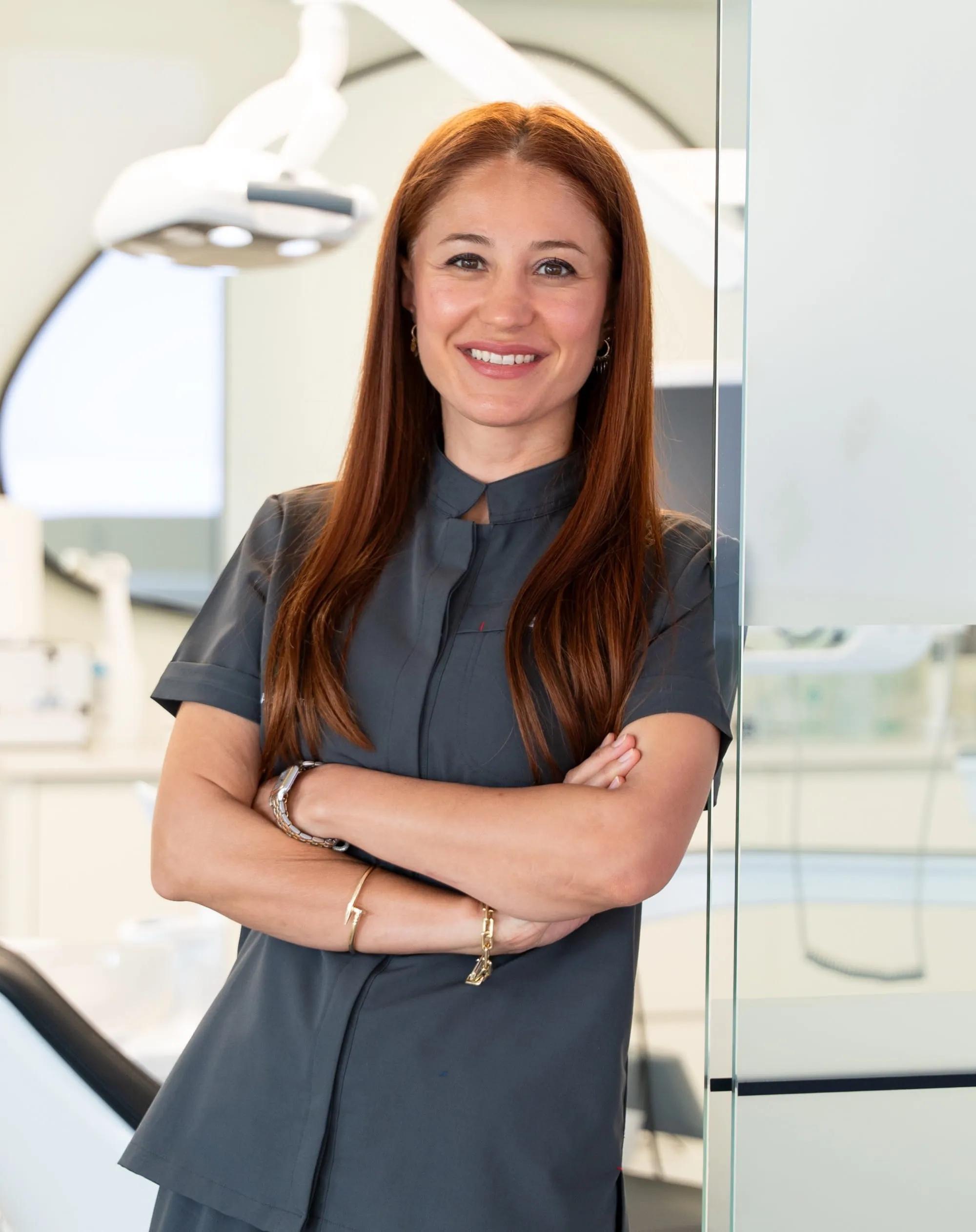
Dt. Dilek AKSU GÜLER
Dentist · Founder
She has completed advanced training in implantology and works in aesthetic restorations and smile design.
Sources
- Interventions for replacing missing teeth: zygomatic implants for the rehabilitation of the severely atrophic edentulous maxilla (Cochrane review, 2 RCTs). Cochrane Database of Systematic Reviews 2026;7(7):CD004151. 2026.↩doi.org
- Survival and complications of zygomatic implants compared to conventional implants in longitudinal studies with at least 5 years of follow-up: systematic review and meta-analysis (18 studies). Clinical Implant Dentistry and Related Research 2023;25(1):177-189. 2023.↩doi.org
- Long-term treatment outcomes with zygomatic implants: systematic review and meta-analysis (18 studies). International Journal of Implant Dentistry 2023;9(1):21. 2023.↩doi.org
- Levels of smoking and dental implants failure: systematic review and meta-analysis (23 articles). Journal of Clinical Periodontology 2020;47(4):518-528. 2020.↩doi.org
- Effectiveness of implant therapy in patients with and without a history of periodontitis: systematic review with meta-analysis of prospective cohort studies (14 studies, >=36 months). Journal of Periodontal Research 2025;60(6):524-543. 2025.↩doi.org
- Bruxism and dental implants: systematic review and meta-analysis (27 studies; 2,105 implants in probable bruxers, 10,264 in non-bruxers). Journal of Oral Rehabilitation 2024;51(1):202-217. 2024.↩doi.org
- Effects of bisphosphonates and denosumab on dental implants: systematic review with meta-analysis (21 studies, ROBINS-I, GRADE). Oral Diseases 2025;31(10):2835-2847. 2025.↩doi.org
- What is the prevalence of peri-implantitis? A systematic review and meta-analysis (57 articles, 2005-2021). BMC Oral Health 2022;22(1):449. 2022.↩doi.org
- Prosthetic complications of implant-supported complete arch prostheses: an umbrella review of systematic reviews (7 reviews, >=5-year follow-up). Journal of Prosthetic Dentistry 2026;136(1):52-59. 2026.↩doi.org
- Standards for Conscious Sedation in the Provision of Dental Care (V1.1). Intercollegiate Advisory Committee for Sedation in Dentistry, Dental Faculties of the Royal Colleges of Surgeons and the Royal College of Anaesthetists, 2020. 2020.↩saad.org.uk
- Peri-implant diseases and conditions: consensus report of workgroup 4 of the 2017 World Workshop on the Classification of Periodontal and Peri-Implant Diseases and Conditions. Journal of Clinical Periodontology 2018;45 Suppl 20:S286-S291. 2018.↩doi.org