
What types of dental implants are there?
Lists of 'the three types' name implants in the jawbone (endosteal), on the bone under the gum (subperiosteal) and in the cheekbone (zygomatic). The standard implant is the first kind: a screw-shaped post that carries a crown or a bridge. Zygomatic implants are for an upper jaw with severe bone loss, where standard implants cannot go in without first building the bone up; a Cochrane review calls the surgery technically demanding1.
- Standard implants sit in the jawbone; they differ in length, width, shape and surface, and in what they carry.
- In a lower jaw that has lost bone height, a Cochrane review found that short implants appear to be a better option than building the bone up in height.
- Zygomatic implants are not a routine option: in one small trial they had fewer implant losses but more complications than implants placed after bone grafting.
- A brand name is not a type. Published survival figures are averages pooled from many studies, not the result of one brand.
- The type is chosen for your bone, the gap and what the implant must carry, after an examination and a 3D scan.
Implants in the jawbone
This is what a dentist usually means by a dental implant. It is also called an endosteal implant, which means 'within the bone'. A post is placed in the jawbone where a tooth is missing. Once it has fused with the bone, a connector (the abutment) is fixed to it and the tooth is built on top. Most are made of titanium; ceramic (zirconia) implants also exist.
Implants in this group differ in length, width, thread, surface and in how the abutment connects. Each manufacturer makes its parts as a system designed to fit together. The 2017 international consensus report on diseases around implants noted that there is no generic implant2: there are numerous designs, with different surfaces.
The same kind of implant can carry different teeth:
- One implant, one crown, for a single missing tooth.
- Two or more implants carrying a bridge, for several missing teeth in a row.
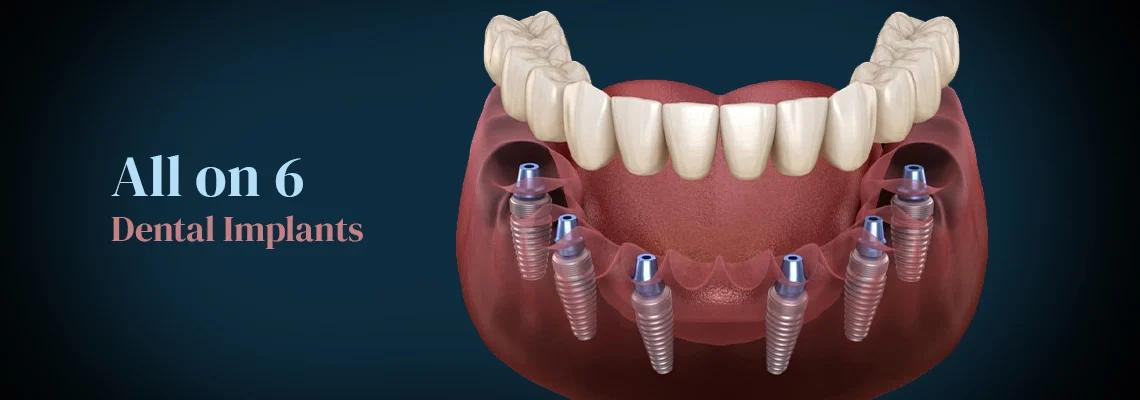
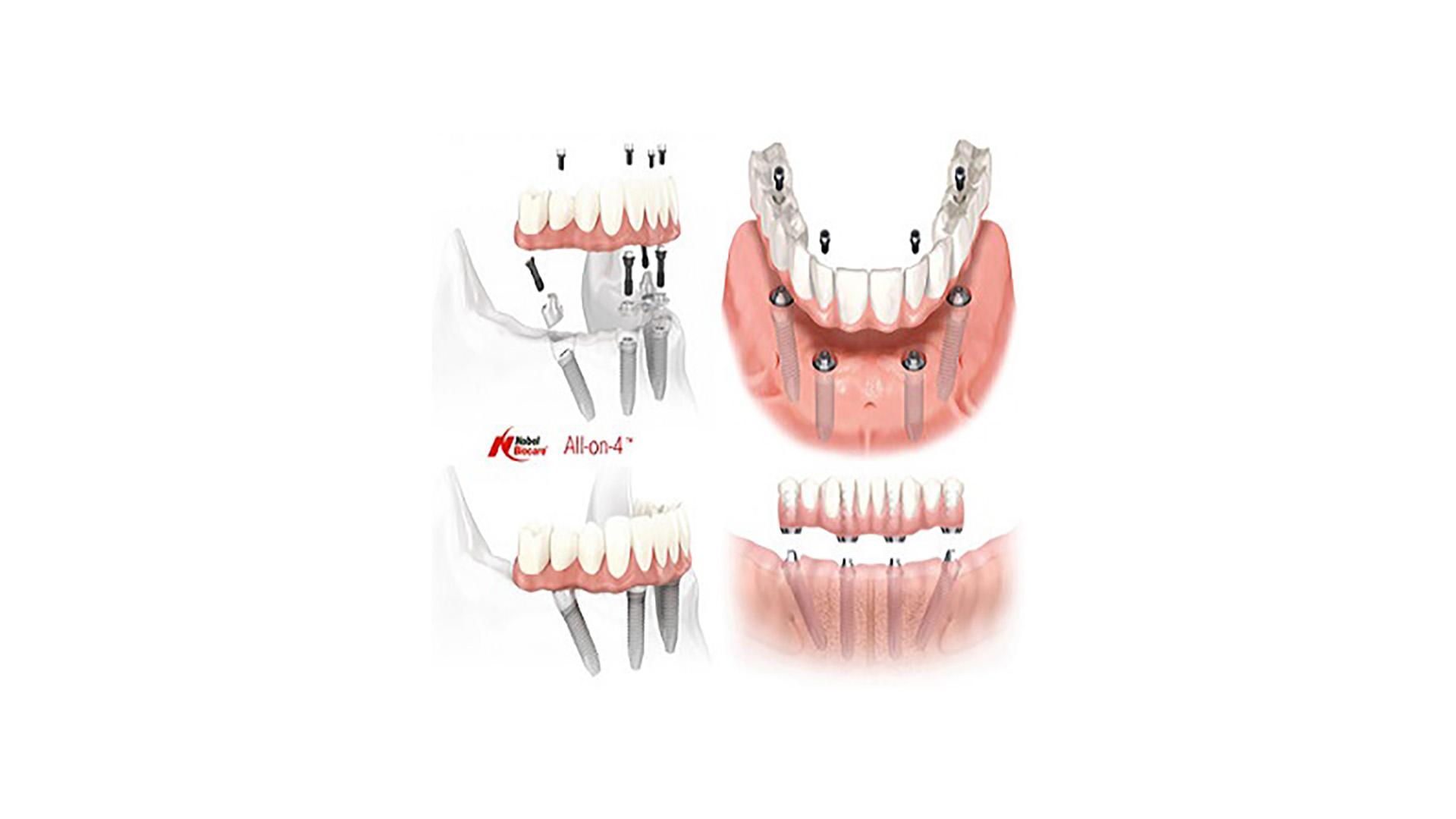
- Four or six implants carrying a fixed bridge for a whole jaw. The All-on-4 page explains this design.
- Implants holding a denture that clips on and can be taken out for cleaning.
For implants carrying a single crown, a review of 46 studies found that about 97 in 100 were still in the mouth after five years and about 95 after ten3. Of every 100 crowns on them, about 96 were in use after five years and about 89 after ten. Staying in the mouth is not the same as trouble-free: the same review estimated these cumulative five-year rates: screw loosening 8.8 per cent, soft-tissue problems 7.1 per cent and aesthetic complaints 7.1 per cent. For whole-jaw bridges on four implants, a 2026 review of 55 studies found about 98 in 100 implants4 still in place at five years and beyond. The same review reported an average bone loss of about 1 mm around the implants at five years, and reviews of full-arch bridges followed for 5 to 15 years report screw loosening at 5 to 15 per cent5; the review summaries do not say whether that counts patients, bridges or implants. These figures are averages pooled from studies in different countries and groups of patients. They are not the result of one clinic, dentist or implant brand, and they are not your personal risk. Surgery has its own risks. Bleeding, swelling, bruising and infection can occur. In the lower jaw the lip and chin can go numb; this is usually temporary and rarely permanent. An implant may also fail to fuse with the bone and have to be removed. Peri-implantitis is inflammation around an implant with loss of the supporting bone: a 57-study review found it in about 20 in 100 patients6, and if it progresses the implant can be lost. How treatment runs is explained on the dental implants page.
Short, narrow and ceramic implants
Length and width are chosen for the bone that is there. Where the bone is low, the choice is often between a shorter implant and building the bone up first. For a lower jaw that has lost bone height, a Cochrane review found that short implants appear to be a better option7 than a vertical bone graft. Complications were more frequent with the graft, at an odds ratio of 4.97 per patient; the difference in implant loss was not significant. The review rests on few trials with few patients, often at high risk of bias.
Implants also come narrower than standard; only the narrowest, usually under about 3 mm wide8, are called mini implants, and studies draw that line in different places. They are mostly used to hold a removable denture when there is little bone (mini dental implants). Ceramic (zirconia) implants also exist, but titanium is regarded as the international standard9 and has a much longer record (ceramic dental implants).
Zygomatic implants: for severe bone loss in the upper jaw
Zygomatic implants take their hold mainly in the cheekbone (the zygoma). They are not a routine option. They are used when the upper jaw has lost so much bone that standard implants cannot be placed without building the bone up first, and they are an alternative to that graft. A Cochrane review describes the procedure as technically demanding and notes that it may be associated with serious complications.
- Randomised trials. The review found only two small randomised trials and rates their certainty moderate to low; one of them compared two drilling methods. In the other, with 71 participants, zygomatic implants were compared with standard implants placed after bone grafting. After three years, zygomatic implants led to fewer implant losses but more complications1: odds ratios of 0.23 for implant loss and 4.53 for complications. The trial was small, so both estimates are imprecise, and the two results belong together.
- Observational studies. In a review of 18 studies with at least five years of follow-up, about 96.5 per cent of zygomatic implants10 were reported in place, against 95.8 per cent of standard implants in the same studies. The review does not tie this rate to a single follow-up period. These studies were not randomised, so this does not show that the two are equivalent.
- The sinus. Sinus inflammation was the most common problem. Pooled from 11 studies with an average follow-up of about five and a half years, it was reported in 14.2 per cent of patients11, but the studies ranged from 2.8 to 36.4 per cent and diagnosed it in different ways. The authors note that long-term sinus inflammation affects more than 1 in 10 people in Western populations without any implant, so the figure does not show how much of it the implants caused. It is not a personal risk. After sinus inflammation, the problems reported most often were infection and an opening between the mouth and the sinus.
If zygomatic implants are proposed to you, ask how often the team places them and how your sinuses will be assessed first.
Subperiosteal and other older designs
Lists of implant types often include subperiosteal implants: a metal framework made to fit the jaw, resting on the bone under the gum rather than inside it. Older blade-shaped implants are sometimes mentioned too. The reviews used in this article do not cover these designs, so we give no figures and make no comparison with standard implants.
If a design other than a standard implant is proposed to you, including a mini or ceramic implant, ask three questions: why this design suits your case, how often the dentist uses it, and what studies support it.
What decides the type for you
An implant is one way to replace a tooth. A bridge on the neighbouring teeth, a removable denture or, sometimes, leaving the gap are others; they are compared in alternatives to dental implants. If an implant is chosen, the type is decided after an examination, a 3D scan and a look at your medical history. Four things weigh most:
- The bone. How much there is, and where. If there is too little, the options include a bone graft or sinus lift, a short implant or, in the upper jaw, zygomatic implants. After a sinus lift, a review of 11 studies followed for at least five years found implant loss of about 0.43 per cent a year per implant12. Its patients had 6 mm of bone height or less, and their sinus floor was raised through a side window. A graft lengthens treatment and has its own risks.
- The gap. One tooth, several teeth or a whole jaw, and whether the teeth next to the gap are healthy.
- What the implant must carry. A single crown, a bridge or a denture, and the force of your bite.
- Your health. Smoking, a history of gum disease and clenching or grinding are associated with more implant loss. Gum disease is treated first. Diabetes and some medicines change the plan. Tell your dentist about all of them; they will also check that you can clean around the implant every day.
The studies used here do not rank implant types or brands. Ask which system is planned for you, why, and get it written down.
When to see a dentist
See a dentist for an examination if you have a missing tooth, a tooth that may need to come out or a denture that no longer fits. The type of implant, if any, can only be chosen after that examination. Bring a list of the medicines you take.
Follow-up does not wait for symptoms. The consensus report recommends that an X-ray and probing measurements be taken as a baseline2 when the crown or bridge is completed, and the European Federation of Periodontology guideline calls for a structured supportive care programme13 once implants are in use.
If you already have an implant, contact your dentist if you notice any of these:
- The implant or the tooth on it moves, a screw feels loose, or a piece breaks
- Bleeding, a bad smell, pus or receding gum around the implant
- Bleeding that does not stop after firm pressure
- Pain or swelling that is severe or getting worse, when painkillers are not helping
- Numbness of the lip, tongue or chin that lasts beyond the anaesthetic
- After upper-jaw surgery: nasal discharge, blockage or sinus pain
Emergencies. Difficulty breathing or swallowing, rapidly spreading swelling of the face or neck, high fever or swelling around the eye are serious signs. Go to the nearest emergency department or call 112.
Frequently asked questions
What are the three types of dental implants?
Lists usually name implants in the jawbone (endosteal), implants resting on the bone under the gum (subperiosteal) and implants anchored in the cheekbone (zygomatic). The standard implant is the first kind. Zygomatic implants are for an upper jaw with severe bone loss.
Which type of implant is best?
No type suits everyone. The choice depends on your bone, the gap, what the implant must carry and your health. The studies used here do not rank implant types or brands. Ask why the one proposed suits you and get the system written down.
Can a short implant avoid a bone graft?
Sometimes. In a lower jaw that has lost bone height, a Cochrane review found that short implants appear to be a better option than building the bone up in height, which had more complications. The conclusion rests on few, small trials.
Are zygomatic implants a way to skip bone grafting?
For some people whose upper jaw has too little bone for standard implants without a graft, they are an alternative, not a routine option. In one small trial they had fewer implant losses but more complications than implants placed after grafting. The surgery is technically demanding.
What about mini or ceramic implants?
Both exist. Mini implants are much narrower and are mostly used to hold a removable denture when there is little bone. Ceramic implants are an alternative to titanium in selected cases; titanium has the longer record. If one is proposed, ask why it suits your case.

Dt. Dilek AKSU GÜLER
Dentist · Founder
She has completed advanced training in implantology and works in aesthetic restorations and smile design.
Sources
- Interventions for replacing missing teeth: zygomatic implants for the rehabilitation of the severely atrophic edentulous maxilla (Cochrane review, 2 RCTs). Cochrane Database of Systematic Reviews 2026;7(7):CD004151. 2026.↩doi.org
- Peri-implant diseases and conditions: consensus report of workgroup 4 of the 2017 World Workshop on the Classification of Periodontal and Peri-Implant Diseases and Conditions. Journal of Clinical Periodontology 2018;45 Suppl 20:S286-S291. 2018.↩doi.org
- Systematic review of the survival rate and the incidence of biological, technical and aesthetic complications of single crowns on implants (46 studies, mean follow-up 5 years). Clinical Oral Implants Research 2012;23 Suppl 6:2-21. 2012.↩doi.org
- All-on-4 and All-on-6 implant-supported fixed prostheses for the edentulous jaw: systematic review and meta-analysis (55 studies). International Journal of Oral and Maxillofacial Surgery 2026;55(9):1098-1112. 2026.↩doi.org
- Prosthetic complications of implant-supported complete arch prostheses: an umbrella review of systematic reviews (7 reviews, >=5-year follow-up). Journal of Prosthetic Dentistry 2026;136(1):52-59. 2026.↩doi.org
- What is the prevalence of peri-implantitis? A systematic review and meta-analysis (57 articles, 2005-2021). BMC Oral Health 2022;22(1):449. 2022.↩doi.org
- Interventions for replacing missing teeth: horizontal and vertical bone augmentation techniques for dental implant treatment (Cochrane review, 13 RCTs). Cochrane Database of Systematic Reviews 2009;(4):CD003607. 2009.↩doi.org
- Narrow-diameter implants: a systematic review and meta-analysis. Clin Oral Implants Res 2018;29 Suppl 16:21-40. 2018.↩doi.org
- German S3 guideline on the use of dental ceramic implants. International Journal of Implant Dentistry 2022;8(1):43. 2022.↩doi.org
- Survival and complications of zygomatic implants compared to conventional implants in longitudinal studies with at least 5 years of follow-up: systematic review and meta-analysis (18 studies). Clinical Implant Dentistry and Related Research 2023;25(1):177-189. 2023.↩doi.org
- Long-term treatment outcomes with zygomatic implants: systematic review and meta-analysis (18 studies). International Journal of Implant Dentistry 2023;9(1):21. 2023.↩doi.org
- Long-term effectiveness of maxillary sinus floor augmentation: systematic review and meta-analysis (11 prospective studies, follow-up at least 5 years). Journal of Clinical Periodontology 2019;46 Suppl 21:307-318. 2019.↩doi.org
- Prevention and treatment of peri-implant diseases: the EFP S3 level clinical practice guideline. Journal of Clinical Periodontology 2023;50 Suppl 26:4-76. 2023.↩doi.org